SKU: WR5401 Categories: ,

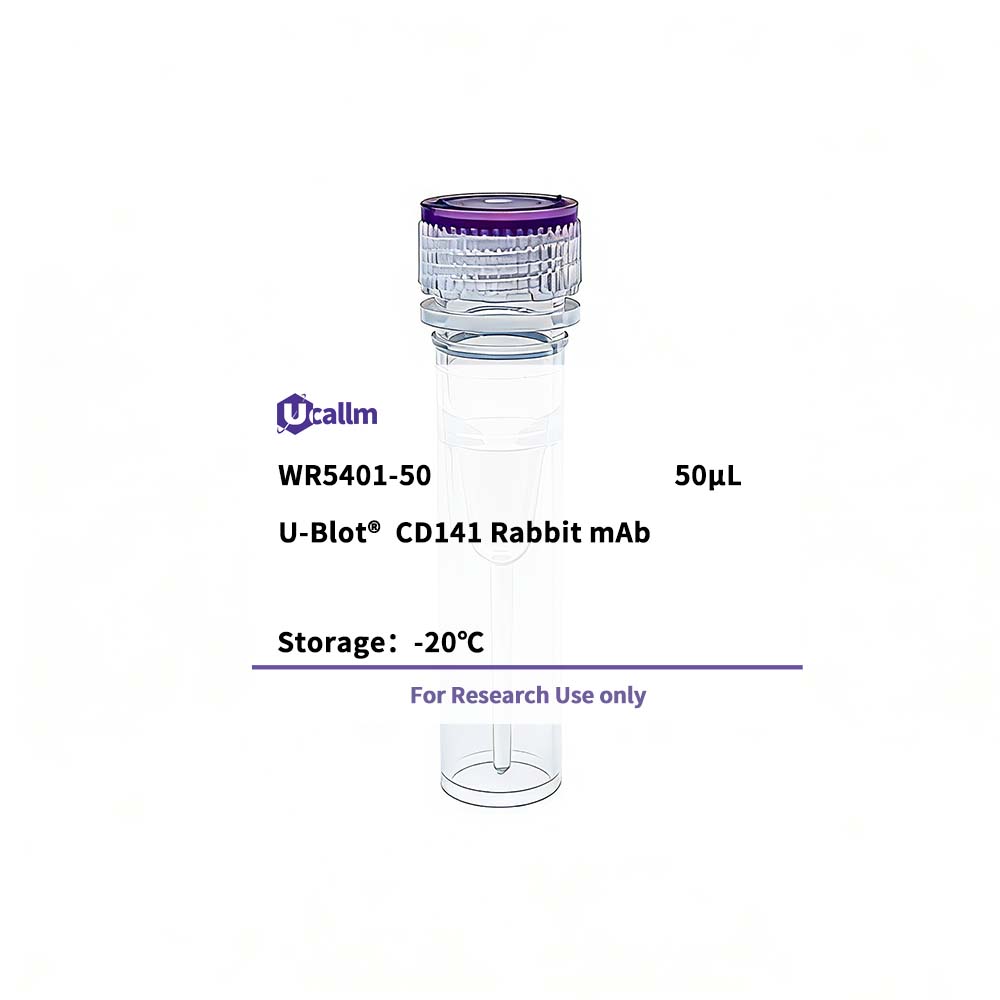
U-Blot® CD141 Rabbit mAb

Price range: $268.00 through $328.00

SKU: WR5401-50
Enter the quantity you would like, or drag the panel to find the quantity and price that best for you
Bulk QuoteAuthorize OEM & ODM

Product details

Background:The protein encoded by this intronless gene is an endothelial-specific type I membrane receptor that binds thrombin. This binding results in the activation of protein C, which degrades clotting factors Va and VIIIa and reduces the amount of thrombin generated. Mutations in this gene are a cause of thromboembolic disease, also known as inherited thrombophilia. [provided by RefSeq, Jul 2008],

Specifications

TargetCD141
ReactivityHuman
ApplicationsWB, IHC, IF, IP, ELISA
MW(Calculated)95kD
MW(Observed)105kD
Host SpeciesRabbit
IsotypeIgG,Kappa
Conjugate/ModificationUnmodified
Modification
Recommended Dilution RatioIHC 1:200-1:1000; WB 1:2000-1:10000; IF 1:200-1:1000; ELISA 1:5000-1:20000; IP 1:50-1:200; / Note: For IHC, we suggest antigen retrieval with TE buffer pH 9.0 (Cat#YS0004)
FormulationPBS, 50% glycerol, 0.05% Proclin 300, 0.05%BSA
Source
PurificationRecombinant Antibody expressed in animal component-free (ACF) media, purified via Protein A affinity chromatography.
Purity
Storage-15°C to -25°C/1 year(Do not lower than -25°C)
Concentration
ClonalityMonoclonal
Clone NumberPT1650R
ImmunogenThe specific immunogen used to produce this antibody is proprietary information.
Sequence
SpecificityEndogenous
Gene NameTHBD
Protein NameThrombomodulin
Other NameTHBD; / THRM; / Thrombomodulin; / TM; / Fetomodulin; / CD antigen CD141
SpeciesHuman
Gene ID-17056
UniprotP07204,
Species.1Mouse
Gene ID-2
Uniprot.1P15306
Species.2
Gene ID-3
Uniprot.2
Organism-4
Gene ID-4
SwissProt-4
BackgroundThe protein encoded by this intronless gene is an endothelial-specific type I membrane receptor that binds thrombin. This binding results in the activation of protein C, which degrades clotting factors Va and VIIIa and reduces the amount of thrombin generated. Mutations in this gene are a cause of thromboembolic disease, also known as inherited thrombophilia. [provided by RefSeq, Jul 2008],
Cellular LocalizationMembrane; Single-pass type I membrane protein.
Tissue ExpressionEndothelial cells are unique in synthesizing thrombomodulin.
Signaling_pathwayOrganismal Systems >> Immune system >> Complement and coagulation cascades
Research Areas>>Complement and coagulation cascades; / >>AGE-RAGE signaling pathway in diabetic complications; / >>Fluid shear stress and atherosclerosis
FunctionDisease:Defects in THBD are the cause of thrombophilia due to thrombomodulin defect (THR-THBDD) [MIM:188040]. THR-THBDD is a hemostatic disorder characterized by a tendency to thrombosis.,Function:Thrombomodulin is a specific endothelial cell receptor that forms a 1:1 stoichiometric complex with thrombin. This complex is responsible for the conversion of protein C to the activated protein C (protein Ca). Once evolved, protein Ca scissions the activated cofactors of the coagulation mechanism, factor Va and factor VIIIa, and thereby reduces the amount of thrombin generated.,online information:Thrombomodulin,online information:Thrombomodulin entry,PTM:N-glycosylated.,PTM:The iron and 2-oxoglutarate dependent 3-hydroxylation of aspartate and asparagine is (R) stereospecific within EGF domains.,similarity:Contains 1 C-type lectin domain.,similarity:Contains 6 EGF-like domains.,tissue specificity:Endothelial cells are unique in synthesizing thrombomodulin.,
RRID
Please login to post questions
Back to Top
Product has been added to your cart