

U-Blot® CD279/PD1 Nb-FC recombinant antibody
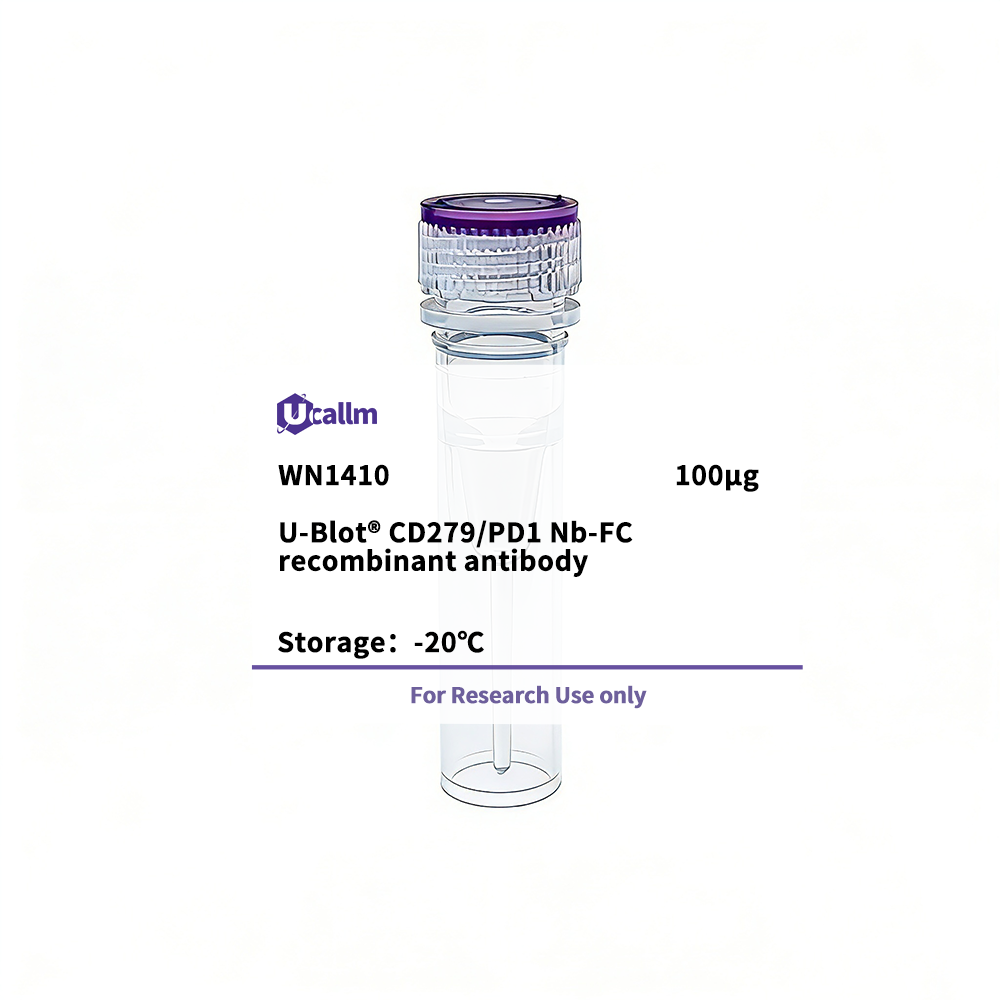
WN1410
$999.00
Product details
Background:This gene encodes a cell surface membrane protein of the immunoglobulin superfamily.This protein is expressed in pro-B-cells and is thought to play a role in their differentiation. In mice, expression ofThis gene is induced in the thymus when anti-CD3 antibodies are injected and large numbers of thymocytes undergo apoptosis. Mice deficient forThis gene bred on a BALB/c background developed dilated cardiomyopathy and died from congestive heart failure. These studies suggest thatThis gene product may also be important in T cell function and contribute to the prevention of autoimmune diseases. [provided by RefSeq, Jul 2008]
Specifications
| Size | 6mL |
| Target | PD1 |
| Reactivity | Human |
| Applications | ELISA |
| MW(Calculated) | |
| MW(Observed) | |
| Host Species | |
| Isotype | IgG2a,Kappa |
| Conjugate/Modification | Unmodified |
| Recommended Dilution Ratio | ELISA 1:5000-100000 |
| Formulation | Phosphate-buffered solution |
| Purification | Recombinant Expression and Affinity purified |
| Storage | -15°C to -25°C/1 year(Avoid freeze / thaw cycles) |
| Concentration | Please check the information on the tube |
| Clonality | |
| Clone Number | VF0664 |
| Immunogen | Purified recombinant Human PD1 |
| Specificity | This recombinant monoclonal antibody can detects endogenous levels of CD279/PD1 protein. |
| Gene Name | PDCD1 PD1 |
| Protein Name | Programmed cell death protein 1 (Protein PD-1) (hPD-1) (CD antigen CD279) |
| Other Name | CD279 antibody; / CD279 antigen antibody; / hPD 1 antibody; / hPD l antibody; / hPD-1 antibody; / hSLE1 antibody; / PD 1 antibody; / PD-1 antibody; / PD1 antibody; / PDCD 1 antibody; / PDCD1 antibody; / PDCD1_HUMAN antibody; / Programmed cell death 1 antibody; / Programmed cell death 1 protein antibody; / Programmed cell death protein 1 antibody; / Protein PD 1 antibody; / Protein PD-1 antibody; / SLEB2 antibody; / Systemic lupus erythematosus susceptibility 2 antibody; / CD279 nanobody; / PD1 nanobody |
| Species | Human |
| Gene ID | 5133 |
| Uniprot | Q15116 |
| Species.1 | |
| Gene ID.1 | |
| Uniprot.1 | |
| Species.2 | |
| Gene ID.2 | |
| Uniprot.2 | |
| Cellular Localization | Cell membrane; Single-pass type I membrane protein. |
| Tissue Expression | Placenta,Pooled tissue,Uterine cervix |
| Signaling_pathway | Organismal Systems >> Immune system >> T cell receptor signaling pathway;Human Diseases >> Cancer: overview >> PD-L1 expression and PD-1 checkpoint pathway in cancer;Environmental Information Processing >> Signaling molecules and interaction >> Cell adhesion molecules |
| Research Areas | |
| Function | developmental stage:Induced at programmed cell death.,Disease:Genetic variation in PDCD1 is associated with susceptibility to systemic lupus erythematosus type 2 (SLEB2) [MIM:605218]. Systemic lupus erythematosus is a chronic, inflammatory and often febrile multisystemic disorder of connective tissue. It affects principally the skin, joints, kidneys and serosal membranes. It is thought to represent a failure of the regulatory mechanisms of the autoimmune system.,Possible cell death inducer, in association with other factors.,similarity:Contains 1 Ig-like V-type (immunoglobulin-like) domain.,subunit:Monomer., |
Please login to post questions
Related products




