SKU: WR5360 Categories: ,

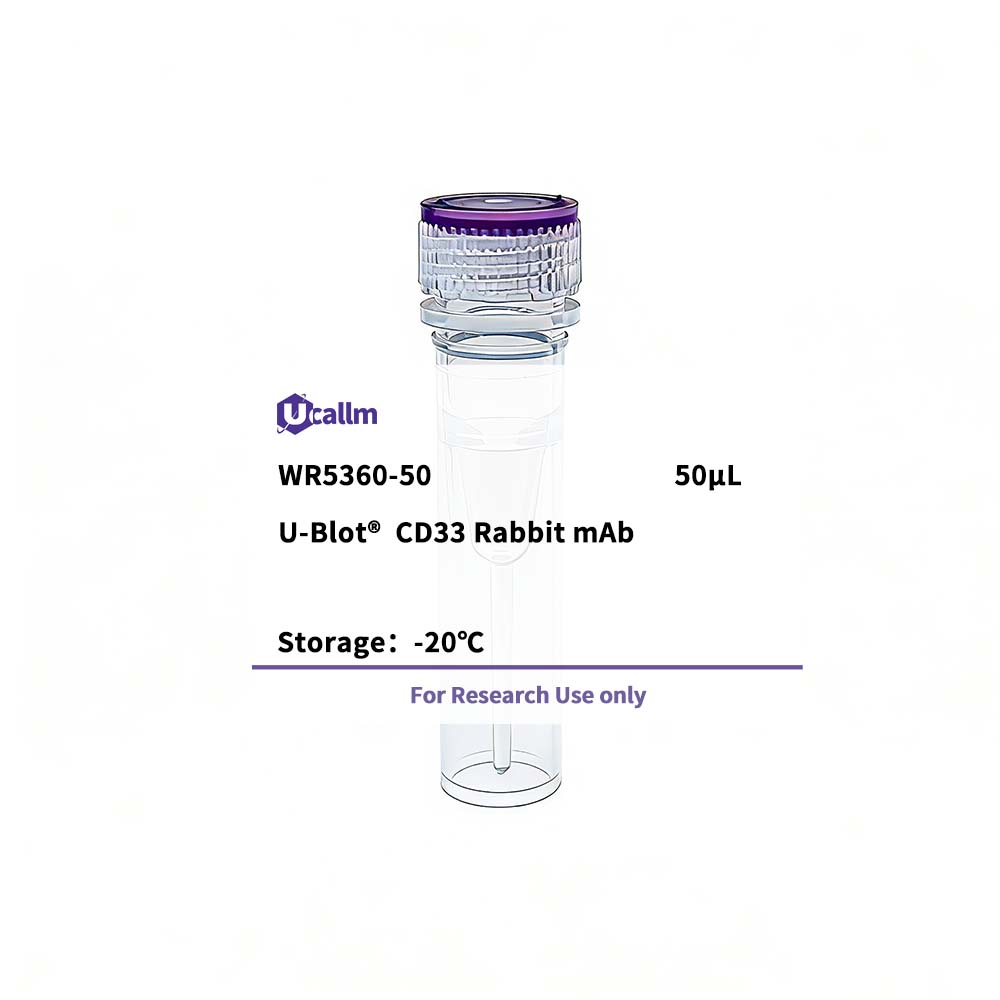
U-Blot® CD33 Rabbit mAb

Price range: $268.00 through $328.00

SKU: WR5360-50
Enter the quantity you would like, or drag the panel to find the quantity and price that best for you
Bulk QuoteAuthorize OEM & ODM

Product details

Background:domain:Contains 2 copies of a cytoplasmic motif that is referred to as the immunoreceptor tyrosine-based inhibitor motif (ITIM). This motif is involved in modulation of cellular responses. The phosphorylated ITIM motif can bind the SH2 domain of several SH2-containing phosphatases.,function:Putative adhesion molecule of myelomonocytic-derived cells that mediates sialic-acid dependent binding to cells. Preferentially binds to alpha-2,6-linked sialic acid. The sialic acid recognition site may be masked by cis interactions with sialic acids on the same cell surface. In the immune response, may act as an inhibitory receptor upon ligand induced tyrosine phosphorylation by recruiting cytoplasmic phosphatase(s) via their SH2 domain(s) that block signal transduction through dephosphorylation of signaling molecules. Induces apoptosis in acute myeloid leukemia (in vitro).,online information:Siglec-3,PTM:Phosphorylation of Tyr-340 is involved in binding to PTPN6 and PTPN11. Phosphorylation of Tyr-358 is involved in binding to PTPN6.,similarity:Belongs to the immunoglobulin superfamily. SIGLEC (sialic acid binding Ig-like lectin) family.,similarity:Contains 1 Ig-like C2-type (immunoglobulin-like) domain.,similarity:Contains 1 Ig-like V-type (immunoglobulin-like) domain.,subunit:Interacts with PTPN6/SHP-1 and PTPN11/SHP-2 upon phosphorylation.,tissue specificity:Monocytic/myeloid lineage cells.,

Specifications

Size50μL/100μL
TargetCD33
ReactivityHuman
ApplicationsWB, IHC, IF, IP, ELISA
MW(Calculated)40kD
MW(Observed)60-90kD
Host SpeciesRabbit
IsotypeIgG,Kappa
Conjugate/ModificationUnmodified
Recommended Dilution RatioIHC 1:50-1:100; WB 1:2000-1:10000; IF 1:200-1:1000; ELISA 1:5000-1:20000; IP 1:50-1:200; / Note: For IHC, we suggest antigen retrieval with TE buffer pH 9.0 (Cat#WT1004)
FormulationPBS, 50% glycerol, 0.05% Proclin 300, 0.05%BSA
PurificationRecombinant Antibody expressed in animal component-free (ACF) media, purified via Protein A affinity chromatography.
Storage-15°C to -25°C/1 year(Do not lower than -25°C)
Concentration
ClonalityMonoclonal
Clone NumberRM1601R
ImmunogenThe specific immunogen used to produce this antibody is proprietary information.
SpecificityEndogenous
Gene NameCD33
Protein NameMyeloid cell surface antigen CD33
Other NameCD33; / SIGLEC3; / Myeloid cell surface antigen CD33; / Sialic acid-binding Ig-like lectin 3; / Siglec-3; / gp67; / CD33
SpeciesHuman
Gene ID945
UniprotP20138
Species.1
Gene ID.1
Uniprot.1
Species.2
Gene ID.2
Uniprot.2
Cellular Localization[Isoform CD33M]: Cell membrane; Single-pass type I membrane protein.; [Isoform CD33m]: Peroxisome . CD33m isoform does not localize to cell surfaces but instead accumulates in peroxisomes. .
Tissue ExpressionMonocytic/myeloid lineage cells. In the brain, CD33 is mainly expressed on microglial cells.
Signaling_pathwayOrganismal Systems >> Immune system >> Hematopoietic cell lineage
Research Areas>>Hematopoietic cell lineage
FunctionDomain:Contains 2 copies of a cytoplasmic motif that is referred to as the immunoreceptor tyrosine-based inhibitor motif (ITIM). This motif is involved in modulation of cellular responses. The phosphorylated ITIM motif can bind the SH2 domain of several SH2-containing phosphatases.,Function:Putative adhesion molecule of myelomonocytic-derived cells that mediates sialic-acid dependent binding to cells. Preferentially binds to alpha-2,6-linked sialic acid. The sialic acid recognition site may be masked by cis interactions with sialic acids on the same cell surface. In the immune response, may act as an inhibitory receptor upon ligand induced tyrosine phosphorylation by recruiting cytoplasmic phosphatase(s) via their SH2 domain(s) that block signal transduction through dephosphorylation of signaling molecules. Induces apoptosis in acute myeloid leukemia (in vitro).,online information:Siglec-3,PTM:Phosphorylation of Tyr-340 is involved in binding to PTPN6 and PTPN11. Phosphorylation of Tyr-358 is involved in binding to PTPN6.,similarity:Belongs to the immunoglobulin superfamily. SIGLEC (sialic acid binding Ig-like lectin) family.,similarity:Contains 1 Ig-like C2-type (immunoglobulin-like) domain.,similarity:Contains 1 Ig-like V-type (immunoglobulin-like) domain.,subunit:Interacts with PTPN6/SHP-1 and PTPN11/SHP-2 upon phosphorylation.,tissue specificity:Monocytic/myeloid lineage cells.,
Please login to post questions
Back to Top
Product has been added to your cart

