

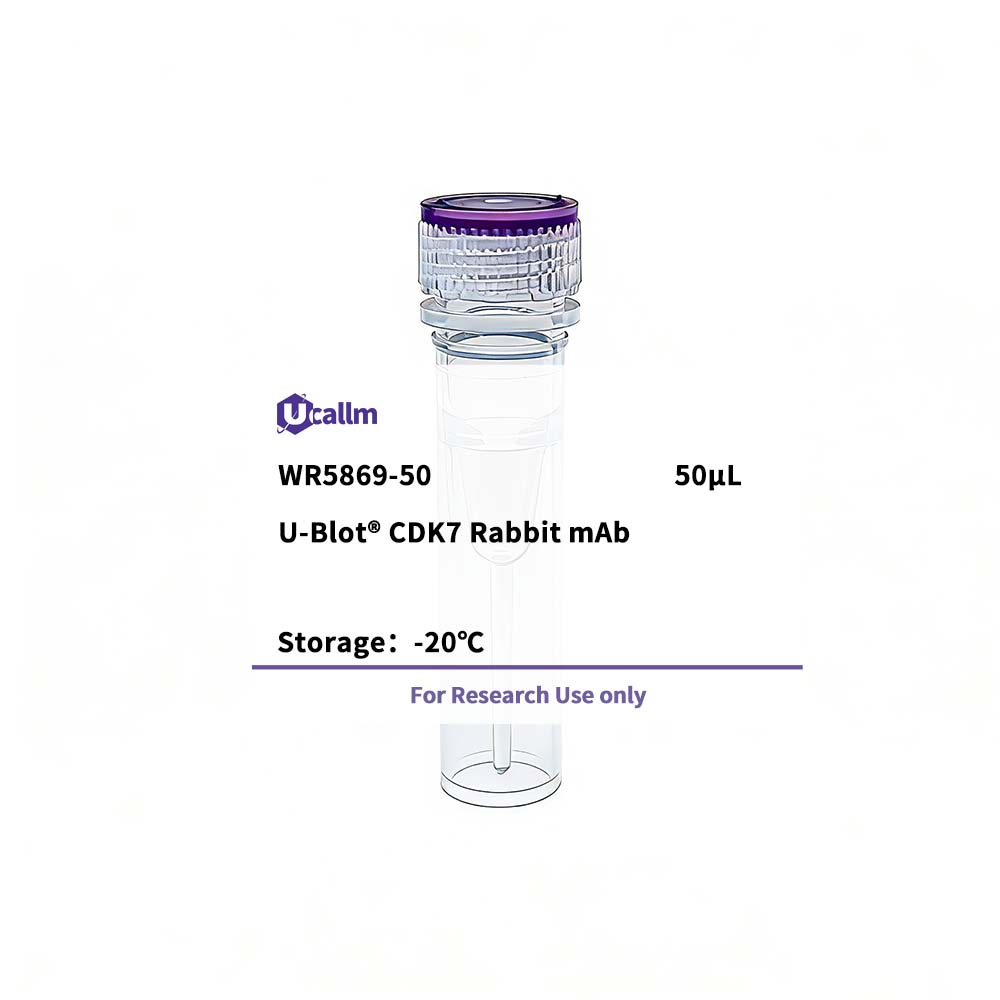
Specifications
| Size | 50μL/100μL |
| Target | CDK7 |
| Reactivity | Human, Mouse, Rat |
| Applications | WB, IHC, IF, IP, ELISA |
| MW(Calculated) | 39kD |
| MW(Observed) | 43kD |
| Host Species | Rabbit |
| Isotype | IgG,Kappa |
| Conjugate/Modification | Unmodified |
| Recommended Dilution Ratio | IHC 1:200-1:1000; WB 1:2000-1:10000; IF 1:200-1:1000; ELISA 1:5000-1:20000; IP 1:50-1:200; / Note: For IHC, we suggest antigen retrieval with TE buffer pH 9.0 (Cat#WT1004) |
| Formulation | PBS, 50% glycerol, 0.05% Proclin 300, 0.05%BSA |
| Purification | Recombinant Antibody expressed in animal component-free (ACF) media, purified via Protein A affinity chromatography. |
| Storage | -15°C to -25°C/1 year(Do not lower than -25°C) |
| Concentration | |
| Clonality | Monoclonal |
| Clone Number | RM1841R |
| Immunogen | The specific immunogen used to produce this antibody is proprietary information. |
| Specificity | Endogenous |
| Gene Name | CDK7 |
| Protein Name | Cyclin-dependent kinase 7 |
| Other Name | CDK7; / CAK; / CAK1; / CDKN7; / MO15; / STK1; / Cyclin-dependent kinase 7; / 39 kDa protein kinase; / p39 Mo15; / CDK-activating kinase 1; / Cell division protein kinase 7; / Serine/threonine-protein kinase 1; / TFIIH basal transcription factor complex kinase subu |
| Species | Human |
| Gene ID | 1022 |
| Uniprot | P50613, |
| Species.1 | Mouse |
| Gene ID.1 | 12169 |
| Uniprot.1 | P97504 |
| Species.2 | |
| Gene ID.2 | |
| Uniprot.2 | |
| Cellular Localization | Nucleus . Cytoplasm . Cytoplasm, perinuclear region . Colocalizes with PRKCI in the cytoplasm and nucleus (PubMed:15695176). Translocates from the nucleus to cytoplasm and perinuclear region in response to DNA-bound peptides (PubMed:19071173). . |
| Tissue Expression | Ubiquitous. |
| Signaling_pathway | Cellular Processes >> Cell growth and death >> Cell cycle |
| Research Areas | >>Basal transcription factors; / >>Nucleotide excision repair; / >>Cell cycle |
| Function | Catalytic activity:ATP + [DNA-directed RNA polymerase] = ADP + [DNA-directed RNA polymerase] phosphate.,Catalytic activity:ATP + a protein = ADP + a phosphoprotein.,enzyme regulation:Inactivated by phosphorylation.,Function:Cyclin-dependent kinases (CDKs) are activated by the binding to a cyclin and mediate the progression through the cell cycle. Each different complex controls a specific transition between two subsequent phases in the cell cycle. CDK7 is the catalytic subunit of the CDK-activating kinase (CAK) complex, a serine-threonine kinase. CAK activates the cyclin-associated kinases CDC2/CDK1, CDK2, CDK4 and CDK6 by threonine phosphorylation. CAK complexed to the core-TFIIH basal transcription factor activates RNA polymerase II by serine phosphorylation of the repetitive C-terminus domain (CTD) of its large subunit (POLR2A), allowing its escape from the promoter and elongation of the transcripts. Involved in cell cycle control and in RNA transcription by RNA polymerase II. Its expression and activity are constant throughout the cell cycle.,PTM:Phosphorylation of Ser-164 during mitosis inactivates the enzyme.,PTM:Phosphorylation of Thr-170 is required for activity.,similarity:Belongs to the protein kinase superfamily. CMGC Ser/Thr protein kinase family. CDC2/CDKX subfamily.,similarity:Contains 1 protein kinase domain.,subunit:Associates primarily with cyclin H and MAT1 to form the CAK complex. CAK can further associate with the core-TFIIH to form the TFIIH basal transcription factor. Interacts with PUF60.,tissue specificity:Ubiquitous., |





