SKU: WR6050 Categories: ,

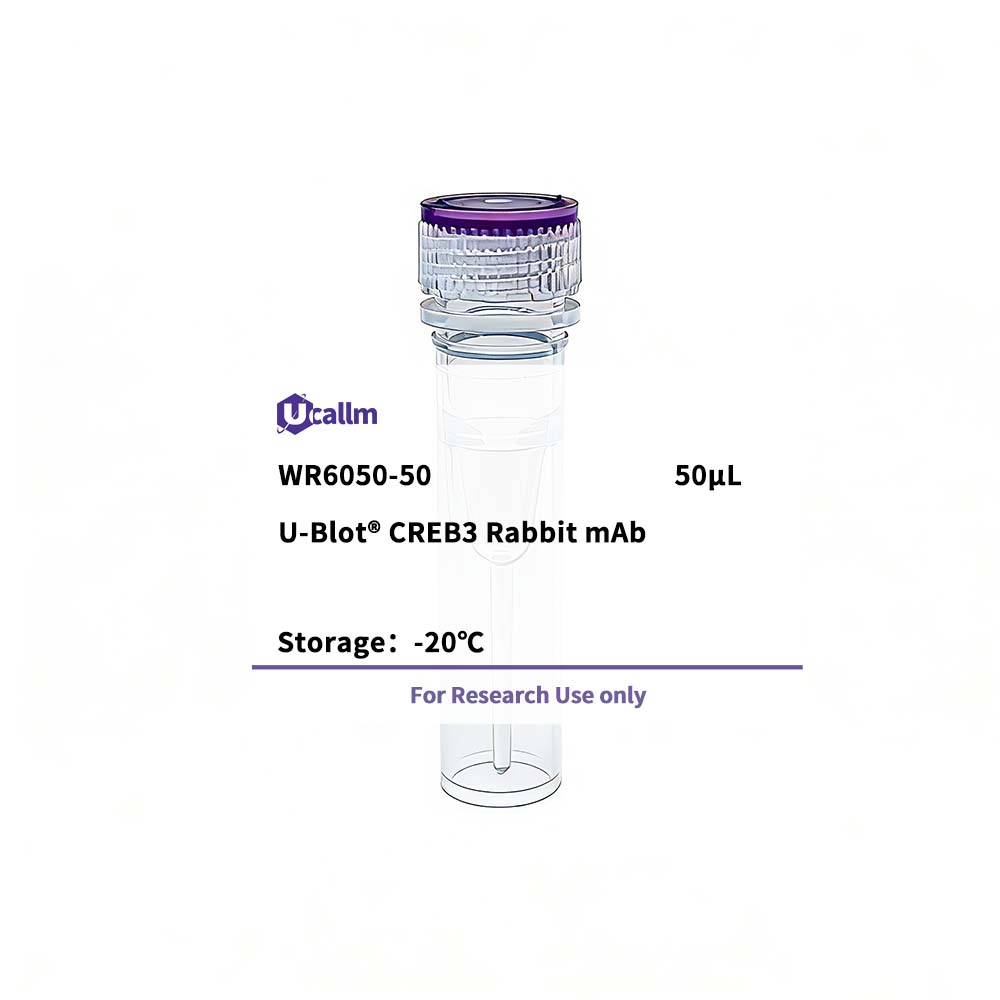
U-Blot® CREB3 Rabbit mAb

Price range: $268.00 through $328.00

SKU: WR6050-50
Enter the quantity you would like, or drag the panel to find the quantity and price that best for you
Bulk QuoteAuthorize OEM & ODM

Product details

Background:
This gene encodes a transcription factor that is a member of the leucine zipper family of DNA binding proteins. This protein binds to the cAMP-response element and regulates cell proliferation. The protein interacts with host cell factor C1 , which also associates with the herpes simplex virus (HSV) protein VP16 that induces transcription of HSV immediate-early genes. This protein and VP16 both bind to the same site on host cell factor C1. It is thought that the interaction between this protein and host cell factor C1 plays a role in the establishment of latency during HSV infection. This protein also plays a role in leukocyte migration , tumor suppression , and endoplasmic reticulum stress-associated protein degradation. Additional transcript variants have been identified , but their biological validity has not been determined.[provided by RefSeq , Nov 2009] ,

Specifications

Size50μL/100μL
TargetCREB3
ReactivityHuman, Mouse
ApplicationsWB, IHC, IF, ELISA
MW(Calculated)41kD
MW(Observed)44kD
Host SpeciesRabbit
IsotypeIgG, Kappa
Conjugate/ModificationUnmodified
Recommended Dilution RatioIHC 1:200-1:1000; WB 1:2000-1:10000; IF 1:200-1:1000; ELISA 1:5000-1:20000 / Note: For IHC, we suggest antigen retrieval with TE buffer pH 9.0 (Cat#WT1004)
FormulationPBS, 50% glycerol, 0.05% Proclin 300, 0.05%BSA
PurificationRecombinant Antibody expressed in animal component-free (ACF) media, purified via Protein A affinity chromatography.
Storage-15°C to -25°C/1 year (Do not lower than -25°C)
Concentration
ClonalityMonoclonal
Clone NumberRM1953R
ImmunogenThe specific immunogen used to produce this antibody is proprietary information.
SpecificityEndogenous
Gene NameCREB3
Protein NameCREB3
Other NameCyclic AMP-responsive element-binding protein 3; / CREB-3; / cAMP-responsive element-binding protein 3; / Leucin zipper proitein; / Luman; / Transcription factor LZIP-alpha; / [Cleaved into: Processed cyclic AMP-responsive element-binding protein 3; / N-terminal Luman; / Transcriptionally active form; / ]
SpeciesHuman
Gene ID10488
UniprotO43889,
Species.1Mouse
Gene ID.1
Uniprot.1Q61817
Species.2
Gene ID.2
Uniprot.2
Cellular Localization[Isoform 1]: Endoplasmic reticulum membrane; Single-pass type II membrane protein . Golgi apparatus . Colocalizes with HCFC1 in neuronal cell bodies of the trigeminal ganglia (PubMed:10623756) . Colocalizes with DCSTAMP in the ER membrane of immature dendritic cell (DC) (PubMed:20546900) . Colocalizes with CANX , CCR1 , HCFC1 in the ER membrane (PubMed:10623756) . .; [Isoform 2]: Nucleus . Cytoplasm . Predominantly in the nucleus (PubMed:19779205) . Not associated with membranes (PubMed:19779205) . .; [Processed cyclic AMP-responsive element-binding protein 3]: Nucleus. Upon RIP activation the transcriptional active processed cyclic AMP-responsive element-binding protein 3 form translocates into the nucleus. Detected in the nucleus upon dendritic cell maturation and RIP activation. Colocalizes with CREBRF in nuclear foci. Colocalizes with CREBZF in promyelocytic leukemia protein nuclear bodies (PML-NB) . .; [Isoform 1]: Cytoplasm. (Microbial infection) Sequestered into the cytoplasm by the HCV core protein. .
Tissue ExpressionUbiquitously expressed (PubMed:9271389 , PubMed:19779205) . Expressed in dendritic cells (DC) . Weakly expressed in monocytes (at protein level) (PubMed:20546900) .
Signaling_pathwayOrganismal Systems >> Endocrine system >> Insulin secretion;Organismal Systems >> Endocrine system >> Glucagon signaling pathway;Organismal Systems >> Endocrine system >> Estrogen signaling pathway;Organismal Systems >> Endocrine system >> Relaxin signaling pathway;Organismal Systems >> Endocrine system >> Growth hormone synthesis, secretion and action;Organismal Systems >> Endocrine system >> Aldosterone synthesis and secretion;Organismal Systems >> Circulatory system >> Adrenergic signaling in cardiomyocytes;Organismal Systems >> Nervous system >> Cholinergic synapse;Organismal Systems >> Nervous system >> Dopaminergic synapse;Organismal Systems >> Aging >> Longevity regulating pathway;Human Diseases >> Cancer: specific types >> Prostate cancer;Human Diseases >> Neurodegenerative disease >> Huntington disease;Human Diseases >> Neurodegenerative disease >> Prion disease;Environmental Information Processing >> Signal transduction >> TNF signaling pathway;Environmental Information Processing >> Signal transduction >> cAMP signaling pathway;Environmental Information Processing >> Signal transduction >> cGMP-PKG signaling pathway;Environmental Information Processing >> Signal transduction >> PI3K-Akt signaling pathway;Environmental Information Processing >> Signal transduction >> AMPK signaling pathway
Research Areas>>cGMP-PKG signaling pathway; / >>cAMP signaling pathway; / >>PI3K-Akt signaling pathway; / >>AMPK signaling pathway; / >>Longevity regulating pathway; / >>Adrenergic signaling in cardiomyocytes; / >>TNF signaling pathway; / >>Thermogenesis; / >>Cholinergic synapse; / >>Dopaminergic synapse; / >>Insulin secretion; / >>Estrogen signaling pathway; / >>Melanogenesis; / >>Thyroid hormone synthesis; / >>Glucagon signaling pathway; / >>Aldosterone synthesis and secretion; / >>Relaxin signaling pathway; / >>Cortisol synthesis and secretion; / >>Parathyroid hormone synthesis , secretion and action; / >>Insulin resistance; / >>Cushing syndrome; / >>Growth hormone synthesis , secretion and action; / >>Vasopressin-regulated water reabsorption; / >>Huntington disease; / >>Prion disease; / >>Cocaine addiction; / >>Amphetamine addiction; / >>Alcoholism; / >>Hepatitis B; / >>Human cytomegalovirus infection; / >>Human papillomavirus infection; / >>Human T-cell leukemia virus 1 infection; / >>Viral carcinogenesis; / >>Chemical carcinogenesis - receptor activation; / >>Prostate cancer
FunctionFunction:Transcription factors activated upon intramembrane proteolysis (RIP) , binds the cAMP response element (CRE) (consensus: 5'-GTGACGT[AG][AG]-3') , a sequence present in many viral and cellular promoters. Binds to and requires HCFC1 as a coactivator. Activity and expression are suppressed when the HCFC1-CREB3 complex binds with CREBZF. Participates in LKN-1/CCL15-induced chemotaxis signaling. ,PTM:During activation , an approximative 40 kDa fragment containing the cytoplasmic transcription factor domain is released by proteolysis. The cleavage is probably performed sequentially by site-1 and site-2 proteases. ,PTM:N-glycosylated. ,similarity:Belongs to the bZIP family. ATF subfamily. ,similarity:Contains 1 bZIP domain. ,subcellular location:Under activation the cleaved N-terminal cytoplasmic domain translocates into the nucleus. ,subunit:Interacts with CCR1. Interacts with HCFC1; required to activate it. Binds with CREBZF only when in combination with HCFC1. Interacts with HCV core protein. ,tissue specificity:Ubiquitous. ,
Please login to post questions
Back to Top
Product has been added to your cart
