

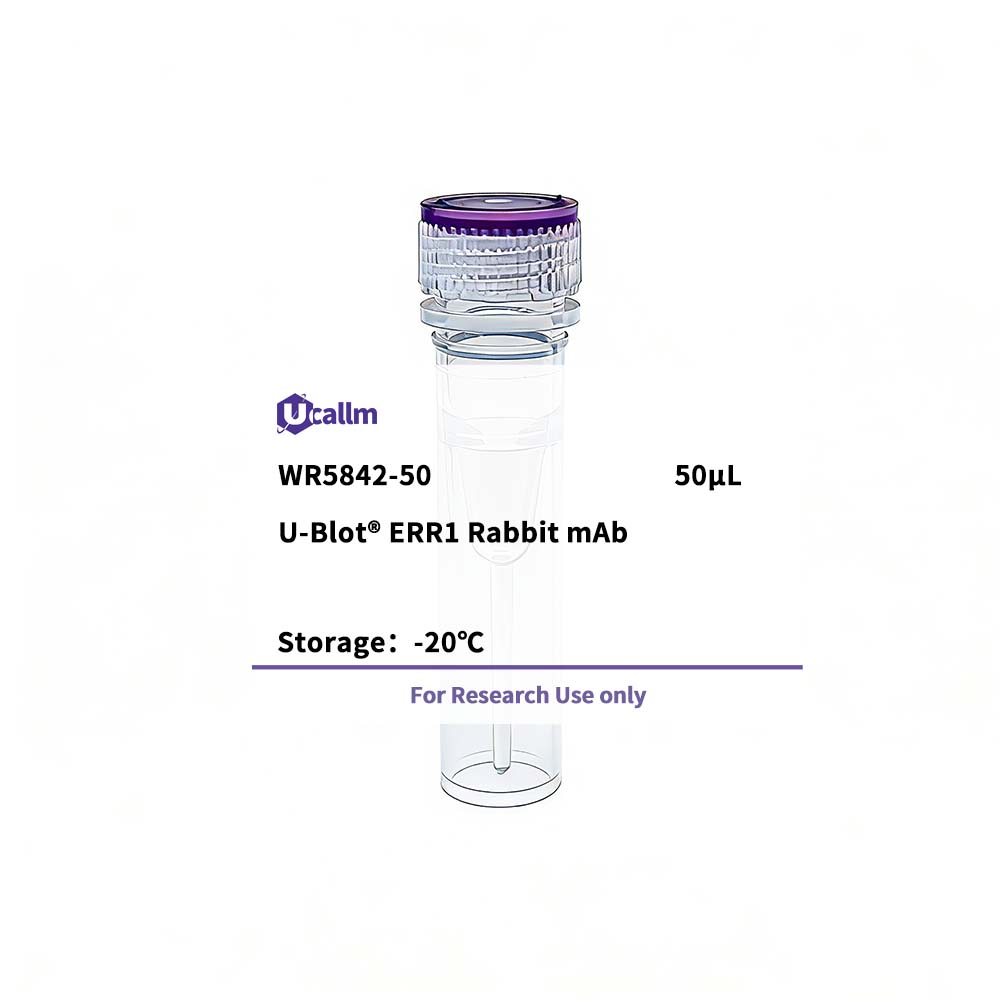
Specifications
| Size | 50μL/100μL |
| Target | ERR1 |
| Reactivity | Human, Mouse, Rat |
| Applications | WB, IHC, IF, IP, ELISA |
| MW(Calculated) | 46kD |
| MW(Observed) | 55kD |
| Host Species | Rabbit |
| Isotype | IgG,Kappa |
| Conjugate/Modification | Unmodified |
| Recommended Dilution Ratio | IHC 1:200-1:1000; WB 1:2000-1:10000; IF 1:200-1:1000; ELISA 1:5000-1:20000; IP 1:50-1:200; / Note: For IHC, we suggest antigen retrieval with TE buffer pH 9.0 (Cat#WT1004) |
| Formulation | PBS, 50% glycerol, 0.05% Proclin 300, 0.05%BSA |
| Purification | Recombinant Antibody expressed in animal component-free (ACF) media, purified via Protein A affinity chromatography. |
| Storage | -15°C to -25°C/1 year(Do not lower than -25°C) |
| Concentration | |
| Clonality | Monoclonal |
| Clone Number | RM1811R |
| Immunogen | The specific immunogen used to produce this antibody is proprietary information. |
| Specificity | Endogenous |
| Gene Name | ESRRA ERR1 ESRL1 NR3B1 |
| Protein Name | ERRα(Estrogen Related Receptor Alpha) |
| Other Name | Steroid hormone receptor ERR1; / Estrogen receptor-like 1; / Estrogen-related receptor alpha; / ERR-alpha; / Nuclear receptor subfamily 3 group B member 1 |
| Species | Human |
| Gene ID | 2101 |
| Uniprot | P11474, |
| Species.1 | Mouse |
| Gene ID.1 | |
| Uniprot.1 | O08580, |
| Species.2 | Rat |
| Gene ID.2 | |
| Uniprot.2 | Q5QJV7 |
| Cellular Localization | Nucleus . Cytoplasm . Co-localizes to the cytoplasm only in presence of MAPK15. . |
| Tissue Expression | Brain,Cervix,Colon,Epithelium,Kidney,Lung,Placenta,Uterus, |
| Signaling_pathway | |
| Research Areas | |
| Function | Function:Binds to an ERR-alpha response element (ERRE) containing a single consensus half-site, 5'-TNAAGGTCA-3'. Can bind to the medium-chain acyl coenzyme A dehydrogenase (MCAD) response element NRRE-1 and may act as an important regulator of MCAD promoter. Binds to the C1 region of the lactoferrin gene promoter. Requires dimerization and the coactivator, PGC-1A, for full activity. The ERRalpha/PGC1alpha complex is a regulator of energy metabolism.,induction:Induced by PGC1alpha in a number of specific cell types including heart, kidney and muscle.,PTM:Phosphorylation on Ser-19 enhances sumoylation on Lys-14 increasing repression of transcriptional activity.,PTM:Sumoylated by SUMO2. Main site is Lys-14 which is enhanced by phosphorylation on Ser-19, cofactor activation, and by interaction with PIAS4. Sumoylation enhances repression of transcriptional activiy, but has no effect on subcellular location nor on DNA binding.,similarity:Belongs to the nuclear hormone receptor family.,similarity:Belongs to the nuclear hormone receptor family. NR3 subfamily.,similarity:Contains 1 nuclear receptor DNA-binding domain.,subunit:Binds DNA as a monomer or a homodimer. Interacts (via the AF2 domain) with coactivator PPARGC1A (via the L3 motif); the interaction greatly enhances transriptional activity of genes involved in energy metabolism. Interacts with PIAS4; the interaction enhances sumoylation., |





