

U-Blot® FGF-1 Rabbit mAb
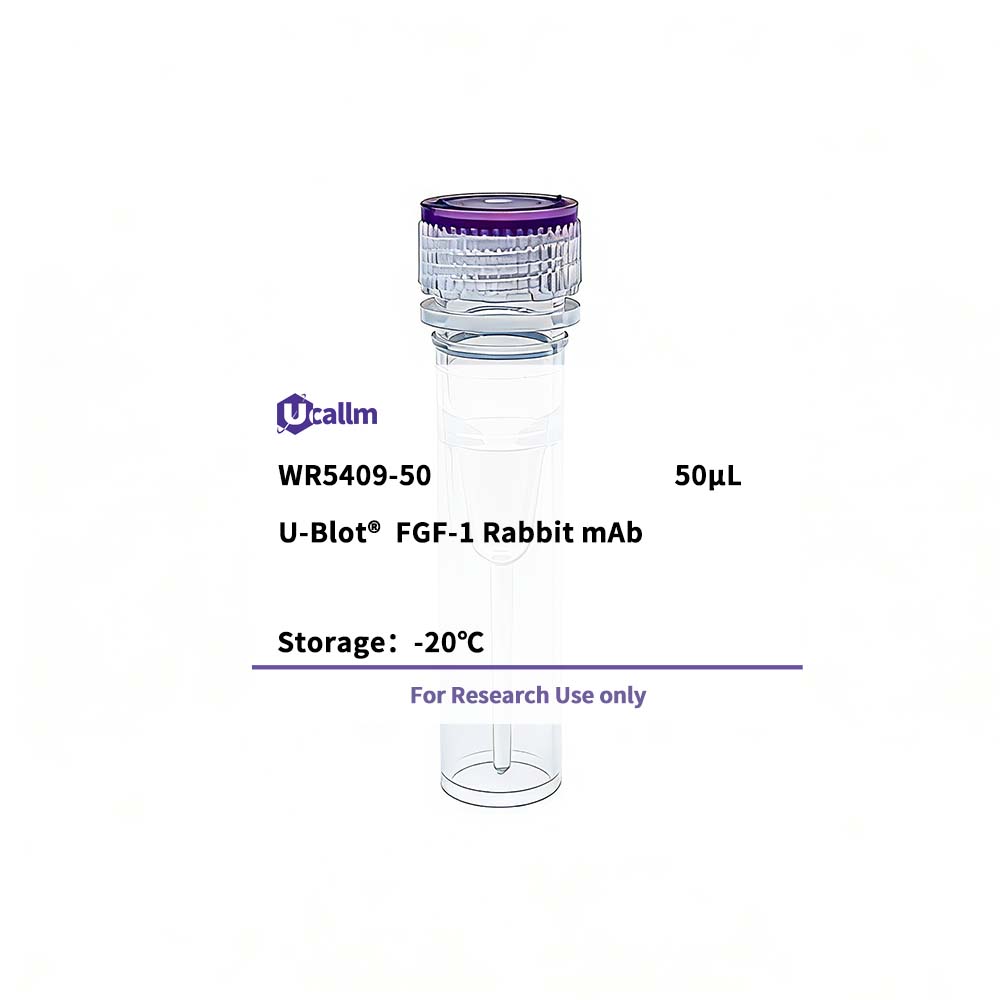
Ucallm_WR5409-50
Price range: $268.00 through $328.00
Product details
Background:The protein encoded by this gene is a member of the fibroblast growth factor (FGF) family. FGF family members possess broad mitogenic and cell survival activities, and are involved in a variety of biological processes, including embryonic development, cell growth, morphogenesis, tissue repair, tumor growth and invasion. This protein functions as a modifier of endothelial cell migration and proliferation, as well as an angiogenic factor. It acts as a mitogen for a variety of mesoderm- and neuroectoderm-derived cells in vitro, thus is thought to be involved in organogenesis. Multiple alternatively spliced variants encoding different isoforms have been described. [provided by RefSeq, Jan 2009],
Specifications
| Size | 50μL/100μL |
| Target | FGF-1 |
| Reactivity | Human, Mouse, Rat |
| Applications | WB, IHC, IF, ELISA |
| MW(Calculated) | 17kD |
| MW(Observed) | 18kD |
| Host Species | Rabbit |
| Isotype | IgG,Kappa |
| Conjugate/Modification | Unmodified |
| Recommended Dilution Ratio | IHC 1:200-1:1000; WB 1:2000-1:10000; IF 1:200-1:1000; ELISA 1:5000-1:20000; / Note: For IHC, we suggest antigen retrieval with TE buffer pH 9.0 (Cat#WT1004) |
| Formulation | PBS, 50% glycerol, 0.05% Proclin 300, 0.05%BSA |
| Purification | Recombinant Antibody expressed in animal component-free (ACF) media, purified via Protein A affinity chromatography. |
| Storage | -15°C to -25°C/1 year(Do not lower than -25°C) |
| Concentration | |
| Clonality | Monoclonal |
| Clone Number | RM1658R |
| Immunogen | The specific immunogen used to produce this antibody is proprietary information. |
| Specificity | Endogenous |
| Gene Name | FGF1 |
| Protein Name | Fibroblast growth factor 1 |
| Other Name | FGF1; / FGFA; / Fibroblast growth factor 1; / FGF-1; / Acidic fibroblast growth factor; / aFGF; / Endothelial cell growth factor; / ECGF; / Heparin-binding growth factor 1; / HBGF-1 |
| Species | Human |
| Gene ID | 2246 |
| Uniprot | P05230, |
| Species.1 | Mouse |
| Gene ID.1 | 14164 |
| Uniprot.1 | P61148, |
| Species.2 | Rat |
| Gene ID.2 | 25317 |
| Uniprot.2 | P61149 |
| Cellular Localization | Secreted. Cytoplasm. Cytoplasm, cell cortex. Cytoplasm, cytosol. Nucleus. Lacks a cleavable signal sequence. Within the cytoplasm, it is transported to the cell membrane and then secreted by a non-classical pathway that requires Cu(2+) ions and S100A13. Secreted in a complex with SYT1 (By similarity). Binding of exogenous FGF1 to FGFR facilitates endocytosis followed by translocation of FGF1 across endosomal membrane into the cytosol. Nuclear import from the cytosol requires the classical nuclear import machinery, involving proteins KPNA1 and KPNB1, as well as LRRC59. . |
| Tissue Expression | Predominantly expressed in kidney and brain. Detected at much lower levels in heart and skeletal muscle. |
| Signaling_pathway | Cellular Processes >> Cell motility >> Regulation of actin cytoskeleton;Human Diseases >> Cancer: overview >> Pathways in cancer;Human Diseases >> Cancer: specific types >> Gastric cancer;Human Diseases >> Cancer: specific types >> Melanoma;Human Diseases >> Cancer: specific types >> Breast cancer;Environmental Information Processing >> Signal transduction >> MAPK signaling pathway;Environmental Information Processing >> Signal transduction >> Ras signaling pathway;Environmental Information Processing >> Signal transduction >> Rap1 signaling pathway;Environmental Information Processing >> Signal transduction >> Hippo signaling pathway;Environmental Information Processing >> Signal transduction >> Calcium signaling pathway;Environmental Information Processing >> Signal transduction >> PI3K-Akt signaling pathway |
| Research Areas | >>MAPK signaling pathway; / >>Ras signaling pathway; / >>Rap1 signaling pathway; / >>Calcium signaling pathway; / >>PI3K-Akt signaling pathway; / >>Hippo signaling pathway; / >>Regulation of actin cytoskeleton; / >>Pathways in cancer; / >>Melanoma; / >>Breast cancer; / >>Gastric cancer |
| Function | Function:The heparin-binding growth factors are angiogenic agents in vivo and are potent mitogens for a variety of cell types in vitro. There are differences in the tissue distribution and concentration of these 2 growth factors.,miscellaneous:This protein binds heparin, although less strongly than does bFGF.,similarity:Belongs to the heparin-binding growth factors family.,subunit:Monomer. Binds FGFR2. Forms a ternary complex containing 2 molecules each of FGFR2 and FGF1 for 1 heparin molecule. Found in a complex with FGFBP1, FGF1 and FGF2. Interacts with FGFBP1., |
Please login to post questions
Related products





