

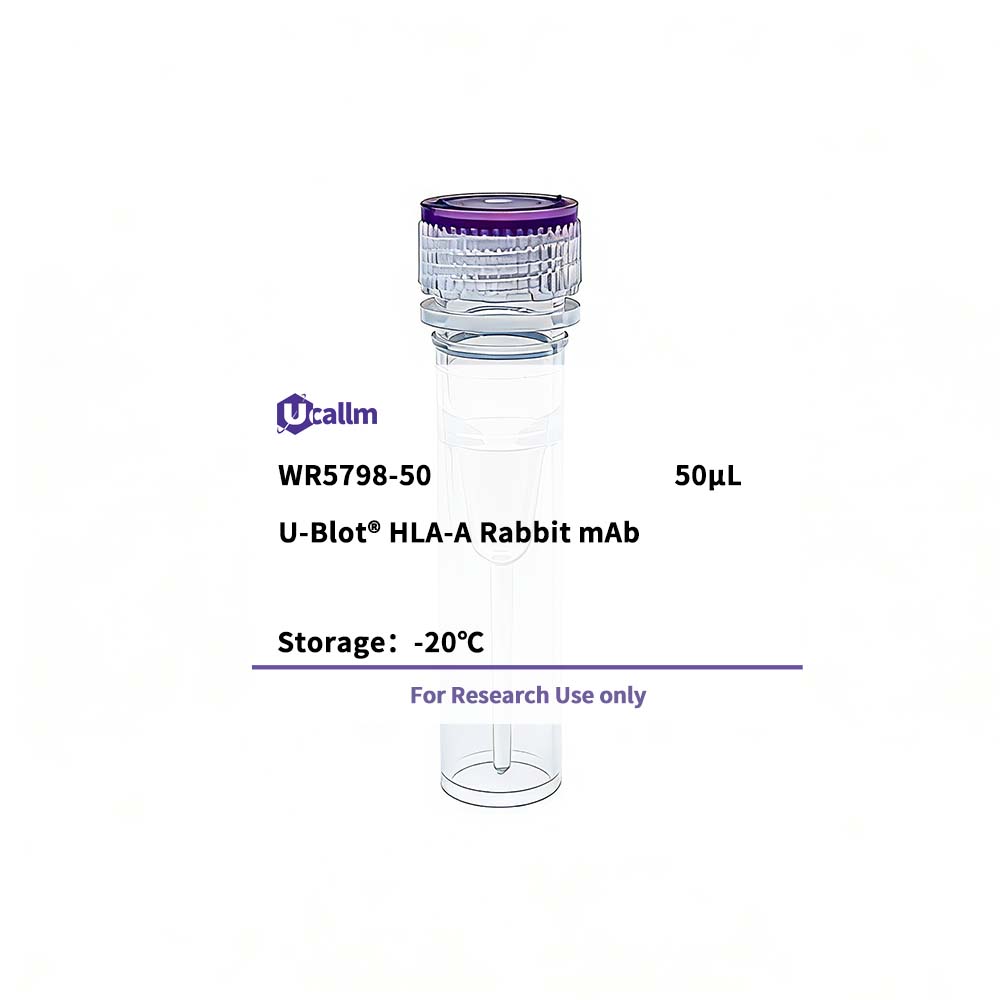
Specifications
| Size | 50μL/100μL |
| Target | 1A68 |
| Reactivity | Human |
| Applications | WB, IHC, IF, IP, ELISA |
| MW(Calculated) | 41kD |
| MW(Observed) | 43kD |
| Host Species | Rabbit |
| Isotype | IgG,Kappa |
| Conjugate/Modification | Unmodified |
| Recommended Dilution Ratio | IHC 1:200-1:1000; WB 1:2000-1:10000; IF 1:200-1:1000; ELISA 1:5000-1:20000; IP 1:50-1:200; / Note: For IHC, we suggest antigen retrieval with TE buffer pH 9.0 (Cat#WT1004) |
| Formulation | PBS, 50% glycerol, 0.05% Proclin 300, 0.05%BSA |
| Purification | Recombinant Antibody expressed in animal component-free (ACF) media, purified via Protein A affinity chromatography. |
| Storage | -15°C to -25°C/1 year(Do not lower than -25°C) |
| Concentration | |
| Clonality | Monoclonal |
| Clone Number | RM1761R |
| Immunogen | The specific immunogen used to produce this antibody is proprietary information. |
| Specificity | Endogenous |
| Gene Name | HLA-A HLAA |
| Protein Name | 1A68 |
| Other Name | |
| Species | Human |
| Gene ID | 3105 |
| Uniprot | P01891 |
| Species.1 | |
| Gene ID.1 | |
| Uniprot.1 | |
| Species.2 | |
| Gene ID.2 | |
| Uniprot.2 | |
| Cellular Localization | Golgi membrane,endoplasmic reticulum,Golgi apparatus,Golgi medial cisterna,plasma membrane,integral component of plasma membrane,cell surface,ER to Golgi transport vesicle membrane,membrane,integral component of membrane, |
| Tissue Expression | |
| Signaling_pathway | Cellular Processes >> Transport and catabolism >> Phagosome;Cellular Processes >> Cell growth and death >> Cellular senescence;Organismal Systems >> Immune system >> Natural killer cell mediated cytotoxicity;Organismal Systems >> Immune system >> Antigen processing and presentation;Human Diseases >> Immune disease >> Autoimmune thyroid disease;Human Diseases >> Immune disease >> Allograft rejection;Human Diseases >> Immune disease >> Graft-versus-host disease;Environmental Information Processing >> Signaling molecules and interaction >> Cell adhesion molecules |
| Research Areas | |
| Function | Function:Involved in the presentation of foreign antigens to the immune system.,polymorphism:The following alleles of A-1 are known: A*0101, A*0102, A*0103, A*0106 and A*0107. The sequence shown is that of A*0101.,polymorphism:The following alleles of A-11 are known: A*1101 (A-11E), A*1102 (A-11K), A*1103, A*1104, A*1105 and A*1107. The sequence shown is that of A*1101.,polymorphism:The following alleles of A-2 are known: A*0201, A*0202, A*0203, A*0204, A*0205, A*0206 (A2.4A), A*0207, A*0208, A*0209, A*0210, A*0211 (A2.5), A*0212, A*0213 (A*02SLU), A*0216, A*0217, A*0218 (A2K), A*0219, A*0220, A*0221, A*0231, A*0234 (A*AAT), A*0235, A*0236 and A*0237. The sequence shown is that of A*0201.,polymorphism:The following alleles of A-23 are known: A*2301, A*2302, A*2303, A*2304 and A*2305. The sequence shown is that of A*2301.,polymorphism:The following alleles of A-24 are known: A*2401, A*2402, A*2403, A*2406, A*2408 (A9HH), A*2410 (A*24JV), A*2413 (A*24YM), A*2414 (A*24SA) and A*2429. Allele A*2402 is represented in all major racial groups. Allele A*2406 and allele A*2413 are found in the Australian Aborigenal population. Allele A*2414 is found in individuals of South American descent. The sequence shown is that of A*2402.,polymorphism:The following alleles of A-25 are known: A*2501 A*2502 and A*2503. The sequence shown is that of A*2501.,polymorphism:The following alleles of A-26 are known: A*2601, A*2602, A*2603, A*2604 (A-10SA), A*2605, A*2607, A*2608, A*2612 and A*2615. The sequence shown is that of A*2601.,polymorphism:The following alleles of A-29 are known: A*2901 (A29.1), A*2902 (A29.2), A*2903 and A*2904. The sequence shown is that of A*2901.,polymorphism:The following alleles of A-3 are known: A*0301 (A-3.1), A*0302, A*0304 and A*0305. The sequence shown is that of A*0301.,polymorphism:The following alleles of A-31 are known: A*3101, A*3102, A*3103, A*3104, A*3105 (A3101v1) and A*3106. The sequence shown is that of A*3101.,polymorphism:The following alleles of A-32 are known: A*3201, A*3202, A*3203, A*3204, A*3205 and A*3206. The sequence shown is that of A*3201.,polymorphism:The following alleles of A-34 are known: A*3401 (Aw-34.1) and A*3402 (Aw-34.2). The sequence shown is that of A*3401.,polymorphism:The following alleles of A-36 are known: A*3601 and A*3602. The sequence shown is that of A*3601.,polymorphism:The following alleles of A-66 are known: A*6601 and A*6602 (Aw67). The sequence shown is that of A*6601.,polymorphism:The following alleles of A-68 are known: A*6801 (Aw68.1), A*6802, A*6803. A*6804, A*6805, A*6806, A*6807, A*6808, A*6809, A*6810, A*6816 and A*6817. The sequence shown is that of A*6801.,polymorphism:The only allele of A-43 known is A*4301 which is shown here.,polymorphism:The only allele of A-69 known is A*6901 which is shown here.,polymorphism:The only allele of A-80 known is A*8001 which is shown here.,PTM:Polyubiquitinated in a post ER compartment by interaction with human herpesvirus 8 MIR1 protein. This targets the protein for rapid degradation via the ubiquitin system.,PTM:Polyubiquitinated in a post ER compartment through interaction with human herpesvirus 8 MIR1 protein. This targets the protein for rapid degradation via the ubiquitin system.,PTM:Sulfated. Polyubiquitinated in a post ER compartment through interaction with human herpesvirus 8 MIR1 protein. This targets the protein for rapid degradation via the ubiquitin system.,sequence Caution:The sequence differs from that shown extensively.,similarity:Belongs to the MHC class I family.,similarity:Contains 1 Ig-like C1-type (immunoglobulin-like) domain.,subunit:Dimer of alpha chain and a beta chain (beta-2-microglobulin). Interacts with human herpesvirus 8 MIR1 protein.,subunit:Dimer of alpha chain and a beta chain (beta-2-microglobulin). Interacts with human herpesvirus 8 MIR1 protein. Interacts with HTLV-1 accessory protein p12I.,subunit:Heterodimer of an alpha chain and a beta chain (beta-2-microglobulin). Interacts with human herpesvirus 8 MIR1 protein., |





