

Specifications
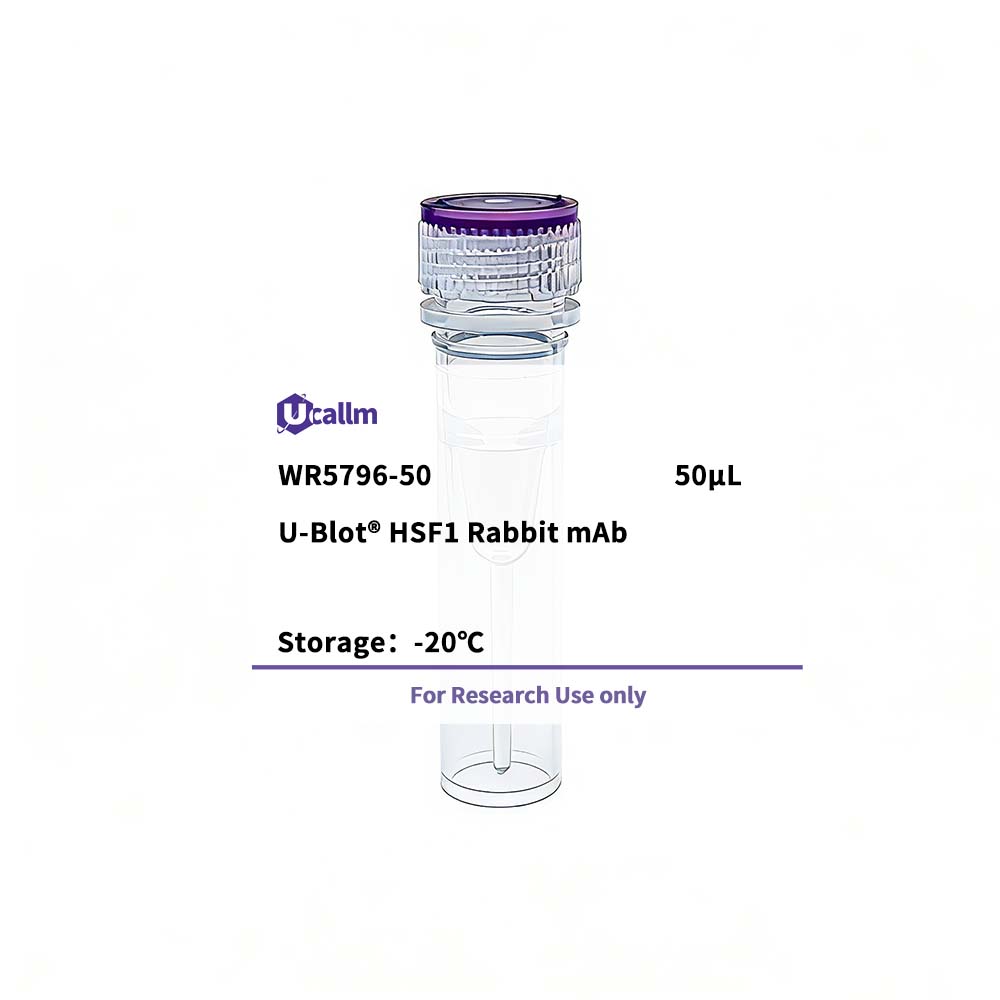
| Size | 50μL/100μL |
| Target | HSF1 |
| Reactivity | Human, Mouse, Rat |
| Applications | WB, IHC, IF, IP, ELISA |
| MW(Calculated) | 57kD |
| MW(Observed) | 80kD |
| Host Species | Rabbit |
| Isotype | IgG,Kappa |
| Conjugate/Modification | Unmodified |
| Recommended Dilution Ratio | IHC 1:200-1:500; WB 1:2000-1:10000; IF 1:200-1:1000; ELISA 1:5000-1:20000; IP 1:50-1:200; / Note: For IHC, we suggest antigen retrieval with TE buffer pH 9.0 (Cat#WT1004) |
| Formulation | PBS, 50% glycerol, 0.05% Proclin 300, 0.05%BSA |
| Purification | Recombinant Antibody expressed in animal component-free (ACF) media, purified via Protein A affinity chromatography. |
| Storage | -15°C to -25°C/1 year(Do not lower than -25°C) |
| Concentration | |
| Clonality | Monoclonal |
| Clone Number | RM1759R |
| Immunogen | The specific immunogen used to produce this antibody is proprietary information. |
| Specificity | Endogenous |
| Gene Name | HSF1 |
| Protein Name | Heat shock factor protein 1 |
| Other Name | HSF1; / HSTF1; / Heat shock factor protein 1; / HSF 1; / Heat shock transcription factor 1; / HSTF 1 |
| Species | Human |
| Gene ID | 3297 |
| Uniprot | Q00613, |
| Species.1 | Mouse |
| Gene ID.1 | 15499 |
| Uniprot.1 | P38532 |
| Species.2 | |
| Gene ID.2 | |
| Uniprot.2 | |
| Cellular Localization | Nucleus . Cytoplasm . Nucleus, nucleoplasm . Cytoplasm, perinuclear region . Cytoplasm, cytoskeleton, spindle pole . Cytoplasm, cytoskeleton, microtubule organizing center, centrosome . Chromosome, centromere, kinetochore . The monomeric form is cytoplasmic in unstressed cells (PubMed:8455624, PubMed:26159920). Predominantly nuclear protein in both unstressed and heat shocked cells (PubMed:10413683, PubMed:10359787). Translocates in the nucleus upon heat shock (PubMed:8455624). Nucleocytoplasmic shuttling protein (PubMed:26159920). Colocalizes with IER5 in the nucleus (PubMed:27354066). Colocalizes with BAG3 to the nucleus upon heat stress (PubMed:8455624, PubMed:26159920). Localizes in subnuclear granules called nuclear stress bodies (nSBs) upon heat shock (PubMed:11447121, PubMed:11514557, PubMed:10359787, PubMed:25963659, PubMed:10747973, PubMed:24581496, PubMed:19229036). Colocalizes with SYMPK and SUMO1 in nSBs upon heat shock (PubMed:11447121, PubMed:12665592, PubMed:11514557, PubMed:14707147, PubMed:10359787). Colocalizes with PRKACA/PKA in the nucleus and nSBs upon heat shock (PubMed:21085490). Relocalizes from the nucleus to the cytoplasm during the attenuation and recovery phase period of the heat shock response (PubMed:26159920). Translocates in the cytoplasm in a YWHAE- and XPO1/CRM1-dependent manner (PubMed:12917326). Together with histone H2AX, redistributed in discrete nuclear DNA damage-induced foci after ionizing radiation (IR) (PubMed:26359349). Colocalizes with calcium-responsive transactivator SS18L1 at kinetochore region on the mitotic chromosomes (PubMed:18794143). Colocalizes with gamma tubulin at centrosome (PubMed:18794143). Localizes at spindle pole in metaphase (PubMed:18794143). Colocalizes with PLK1 at spindle poles during prometaphase (PubMed:18794143). . |
| Tissue Expression | Adipose tissue,Brain,Epithelium,Muscle, |
| Signaling_pathway | |
| Research Areas | >>Legionellosis |
| Function | Function:DNA-binding protein that specifically binds heat shock promoter elements (HSE) and activates transcription. In higher eukaryotes, HSF is unable to bind to the HSE unless the cells are heat shocked.,PTM:Phosphorylated on multiple serine residues, a subset of which are involved in stress-related regulation of transcription activation. Constitutive phosphorylation represses transcriptional activity at normal temperatures. Levels increase on specific residues heat-shock and enhance HSF1 transactivation activity. Phosphorylation on Ser-307 derepresses activation on heat-stress and in combination with Ser-303 phosphorylation appears to be involved in recovery after heat-stress. Phosphorylated on Ser-230 by CAMK2, in vitro. Cadmium also enhances phosphorylation at this site. Phosphorylation on Ser-303 is a prerequisite for HSF1 sumoylation. Phosphorylation on Ser-121 inhibits transactivation and promotes HSP90 binding. Phosphorylation on Thr-142 also mediates transcriptional activity induced by heat.,PTM:Sumoylated BY SUMO1 AND SUMO2 on heat-shock. Heat-inducible sumoylation occurs after 15 min of heat-shock, after which levels decrease and at 4 hours, levels return to control levels. Sumoylation has no effect on HSE binding nor on transcriptional activity. Phosphorylation on Ser-303 is a prerequisite for sumoylation.,similarity:Belongs to the HSF family.,subcellular location:Cytoplasmic during normal growth. On activation, translocates to nuclear stress granules. Colocalizes with SUMO1 in nuclear stress granules.,subunit:Monomer. Under normal conditions, interacts with HSP90AA1 in the HSP90 multichaperone complex; the interaction prevents trimerization and activation of HSF1. On activation by heat-stress or by other factors such as metal ions, HSF1 is released from the complex, homotrimerizes, is hyperphosphorylated and translocated to the nucleus where, subsequently, it can activate transcription. Binds the complex through the regulatory domain. Interacts with SYMPK and CSTF2 in heat-stressed cells. Interacts with FKBP4 in the HSP90 multichaperone complex; the interaction is independent of the phosphorylation state of HSF1. Interacts with MAPKAPK2., |





