

Specifications
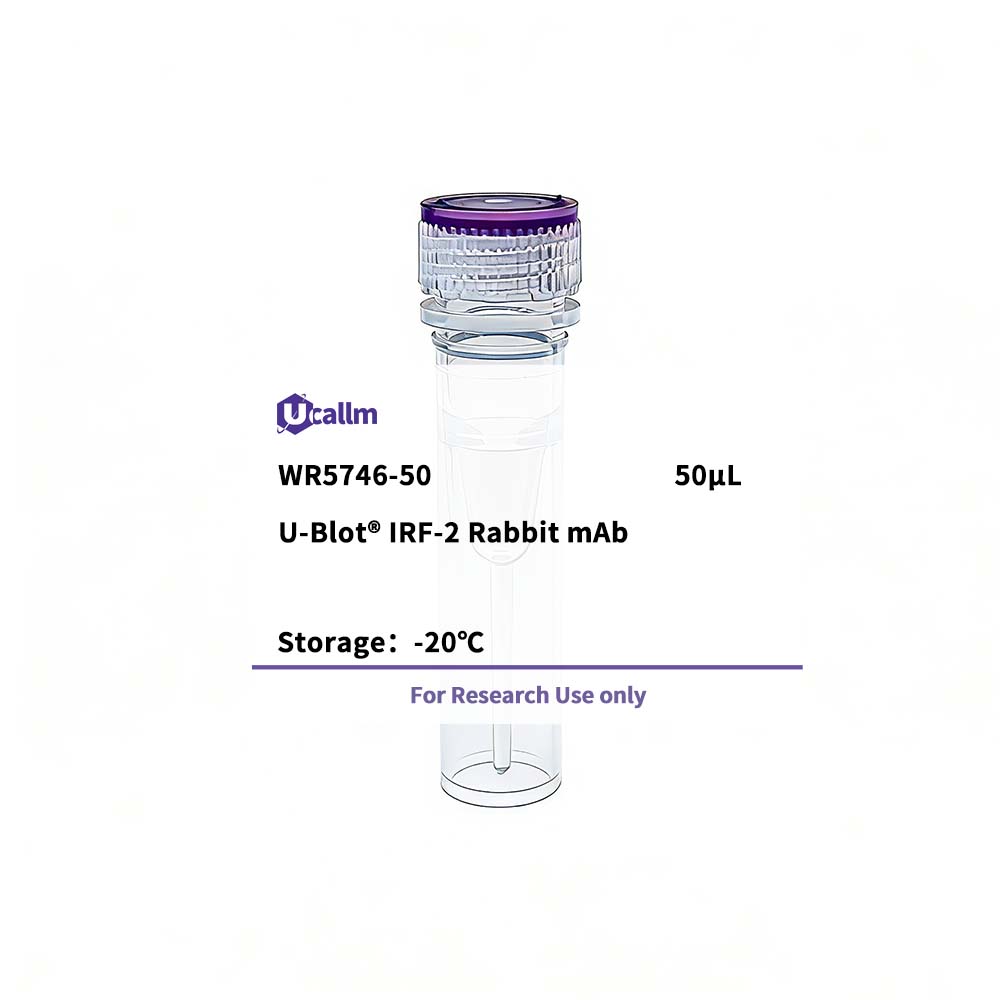
| Size | 50μL/100μL |
| Target | IRF-2 |
| Reactivity | Human, Mouse |
| Applications | WB, IHC, IF, ELISA |
| MW(Calculated) | 39kD |
| MW(Observed) | 50kD |
| Host Species | Rabbit |
| Isotype | IgG,Kappa |
| Conjugate/Modification | Unmodified |
| Recommended Dilution Ratio | IHC 1:200-1:1000; WB 1:2000-1:10000; IF 1:200-1:1000; ELISA 1:5000-1:20000; / Note: For IHC, we suggest antigen retrieval with TE buffer pH 9.0 (Cat#WT1004) |
| Formulation | PBS, 50% glycerol, 0.05% Proclin 300, 0.05%BSA |
| Purification | Recombinant Antibody expressed in animal component-free (ACF) media, purified via Protein A affinity chromatography. |
| Storage | -15°C to -25°C/1 year(Do not lower than -25°C) |
| Concentration | |
| Clonality | Monoclonal |
| Clone Number | RM1708R |
| Immunogen | The specific immunogen used to produce this antibody is proprietary information. |
| Specificity | Endogenous |
| Gene Name | IRF2 |
| Protein Name | Interferon regulatory factor 2 |
| Other Name | IRF2; / Interferon regulatory factor 2; / IRF-2 |
| Species | Human |
| Gene ID | 3660 |
| Uniprot | P14316, |
| Species.1 | Mouse |
| Gene ID.1 | 16363 |
| Uniprot.1 | P23906 |
| Species.2 | |
| Gene ID.2 | |
| Uniprot.2 | |
| Cellular Localization | Nucleus. |
| Tissue Expression | Expressed throughout the epithelium of the colon. Also expressed in lamina propria. |
| Signaling_pathway | |
| Research Areas | |
| Function | Function:Specifically binds to the upstream regulatory region of type I IFN and IFN-inducible MHC class I genes (the interferon consensus sequence (ICS)) and represses those genes. Also acts as an activator for several genes including H4 and IL7. Constitutively binds to the ISRE promoter to activate IL7. Involved in cell cycle regulation through binding the site II (HiNF-M) promoter region of H4 and activating transcription during cell growth. Antagonizes IRF1 transcriptional activation.,induction:By viruses and IFN.,PTM:Acetylated by CBP/ p300 during cell-growth. Acetylation on Lys-75 is required for stimulation of H4 promoter activity.,PTM:The major sites of sumoylation are Lys-137 and Lys-293. Sumoylation by SUMO1 increases its transcriptional repressor activity on IRF1 and diminishes its ability to activate ISRE and H4 promoter.,similarity:Belongs to the IRF family.,similarity:Contains 1 tryptophan pentad repeat DNA-binding domain.,subunit:Interacts with BRD7, IRF2BP1 and IRF2BP2. Interacts with CREBBP in growing cells; the interaction acetylates IRF2 and regulates IRF2-dependent H4 promoter activity.,tissue specificity:Expressed throughout the epithelium of the colon. Also expressed in lamina propria., |




