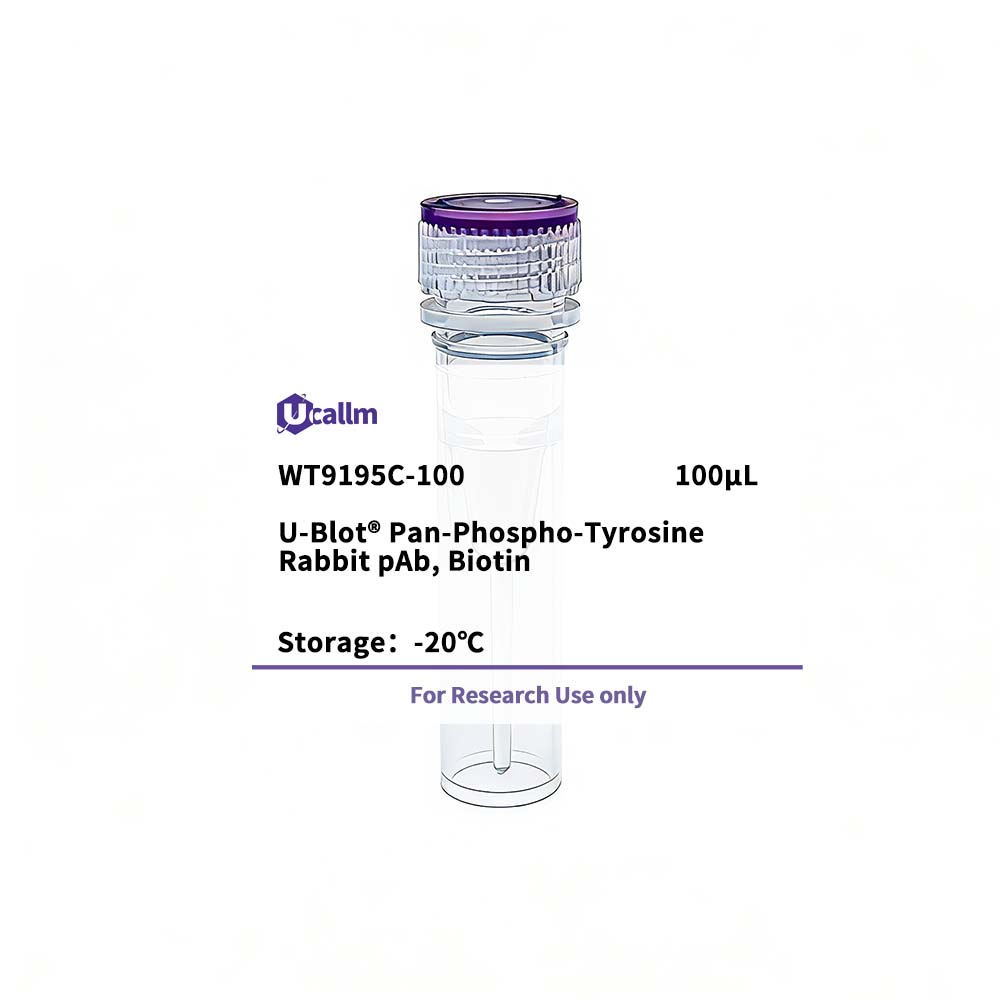
U-Blot® Pan-Phospho-Tyrosine Rabbit pAb, Biotin

$999.00

SKU: WT9195C-300
Enter the quantity you would like, or drag the panel to find the quantity and price that best for you
Bulk QuoteAuthorize OEM & ODM

Product details

The affinity purified rabbit anti-phospho-tyrosine antibody was conjugated to d-biotin via N-acetylation. The conjugates are useful for the detection, identification, and quantization of tyrosine-phosphorylated proteins and peptides. These conjugates have been utilized for non-radioactive tyrosine kinase assays.


Specifications

TargetPhospho-Tyrosine
ReactivitySpecies Independent
ApplicationELISA、WB、IP、IHC
MW(Calculated)Multiple
MW(Observed)Multiple
Host SpeciesRabbit
IsotypeIgG
ConjugateBiotin
ModificationTyrosine Phosphorylation
Modified siteTyr(Y)
Recommended dilution ratioELISA: 0.25 - 1.0 µg/mL;WB: 0.25 - 1.0 µg/mL;IP: 5 µg/mg protein;IHC: 10 µg/mL
Composition250 µg/mL in PBS, 50% glycerol
Purification processThe antibody was affinity purified with phospho-tyrosine immobilized on agarose.
Purity
StorageProduct is stable for several weeks at 4°C. For extended storage, aliquot content and store product at –20ºC. Avoid cycles of freezing and thawing
StabilityExpiration date is one year from date of shipping if properly stored.
ClonalPolyclonal
Clone Number
ImmunogenIodoacetylphosphotyamine-KLH conjugates
Sequence
Specificity
Gene name
Protein Name
Alternative nameP-Tyr
Organism-1
GeneID-1
SwissProt-1
Organism-2
GeneID-2
SwissProt-2
Organism-3
GeneID-3
SwissProt-3
Organism-4
GeneID-4
SwissProt-4
BackgroundPhospho-Tyrosine (pY) is a widely occurring post-translational modification on tyrosine residues in eukaryotic cells. This modification is catalyzed by protein tyrosine kinases (PTKs), which covalently attach a phosphate group to the phenolic hydroxyl group of tyrosine, and can be reversibly removed by protein tyrosine phosphatases (PTPs). Tyrosine phosphorylation serves as a core mechanism in cellular signal transduction, regulating cell proliferation, differentiation, apoptosis, migration, and metabolism. Dysregulation of tyrosine phosphorylation is closely associated with tumorigenesis, immune disorders, neurodegenerative diseases, and other pathological conditions, making it a critical target in cell signaling and therapeutic drug development.
Cellular Localization
Please login to post questions
Back to Top
Product has been added to your cart
