


U-Blot® POSTN Rabbit mAb
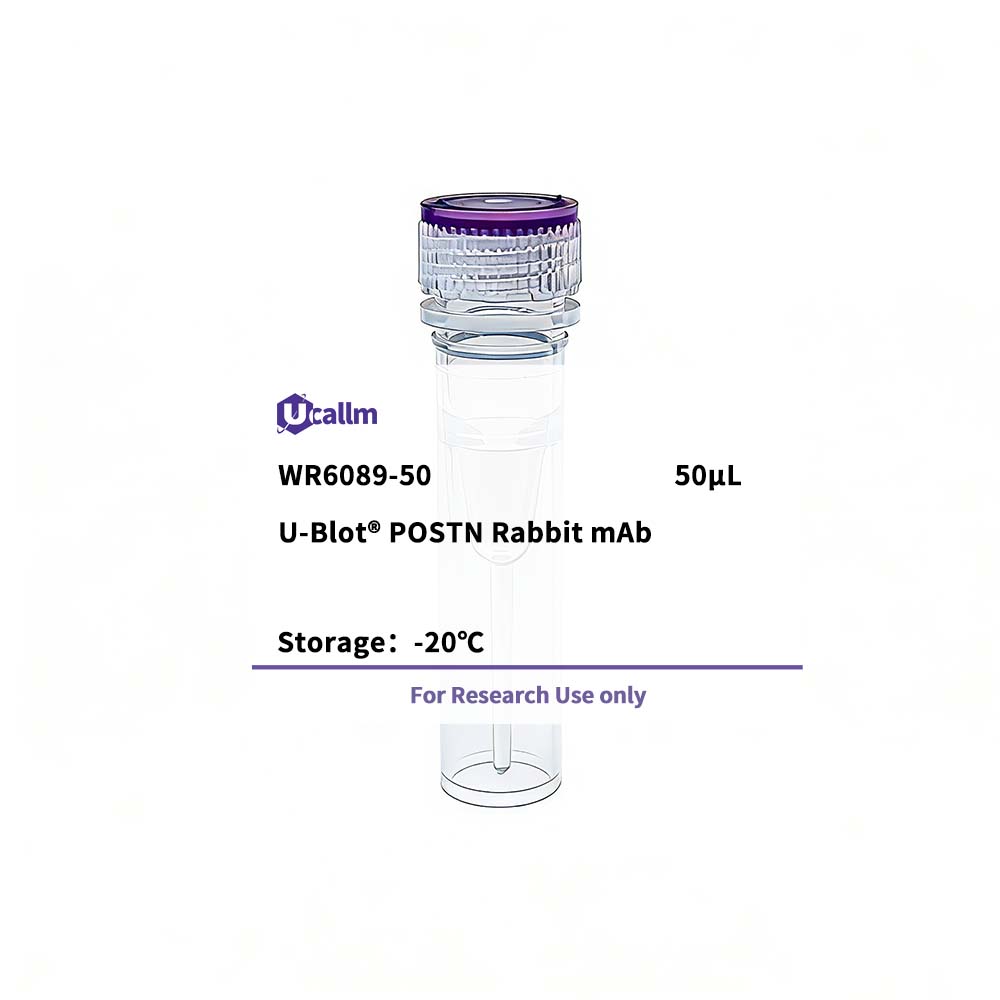
Ucallm_WR6089-50
Price range: $268.00 through $328.00
Product details
Background:This gene encodes a secreted extracellular matrix protein that functions in tissue development and regeneration , including wound healing , and ventricular remodeling following myocardial infarction. The encoded protein binds to integrins to support adhesion and migration of epithelial cells. This protein plays a role in cancer stem cell maintenance and metastasis. Mice lacking this gene exhibit cardiac valve disease , and skeletal and dental defects. Alternative splicing results in multiple transcript variants encoding different isoforms. [provided by RefSeq , Sep 2015] ,
Specifications
| Size | 50μL/100μL |
| Target | POSTN |
| Reactivity | Mouse, Rat |
| Applications | WB, IHC, IF, ELISA |
| MW(Calculated) | 93kD |
| MW(Observed) | 93kD |
| Host Species | Rabbit |
| Isotype | IgG, Kappa |
| Conjugate/Modification | Unmodified |
| Recommended Dilution Ratio | IHC 1:100-1:400; WB 1:2000-1:10000; IF 1:200-1:1000; ELISA 1:5000-1:20000 / Note: For IHC, we suggest antigen retrieval with TE buffer pH 9.0 (Cat#WT1004) |
| Formulation | PBS, 50% glycerol, 0.05% Proclin 300, 0.05%BSA |
| Purification | Recombinant Antibody expressed in animal component-free (ACF) media, purified via Protein A affinity chromatography. |
| Storage | -15°C to -25°C/1 year (Do not lower than -25°C) |
| Concentration | |
| Clonality | Monoclonal |
| Clone Number | RM2094R |
| Immunogen | The specific immunogen used to produce this antibody is proprietary information. |
| Specificity | Endogenous |
| Gene Name | POSTN OSF2 |
| Protein Name | Periostin (PN) (Osteoblast-specific factor 2) (OSF-2) |
| Other Name | |
| Species | Human |
| Gene ID | 10631 |
| Uniprot | Q15063 |
| Species.1 | |
| Gene ID.1 | |
| Uniprot.1 | |
| Species.2 | |
| Gene ID.2 | |
| Uniprot.2 | |
| Cellular Localization | Secreted |
| Tissue Expression | Widely expressed with highest levels in aorta , stomach , lower gastrointestinal tract , placenta , uterus , thyroid tissue and breast. Up-regulated in epithelial ovarian tumors. Not expressed in normal ovaries. Also highly expressed at the tumor periphery of lung carcinoma tissue but not within the tumor. Overexpressed in breast cancers. |
| Signaling_pathway | |
| Research Areas | |
| Function | Function:Binds to heparin. Induces cell attachment and spreading and plays a role in cell adhesion. May play a role in extracellular matrix mineralization. ,PTM:Gamma-carboxyglutamate residues are formed by vitamin K dependent carboxylation. These residues are essential for the binding of calcium. ,similarity:Contains 1 EMI domain. ,similarity:Contains 4 FAS1 domains. ,tissue specificity:Widely expressed with highest levels in aorta , stomach , lower gastrointestinal tract , placenta , uterus and breast. Up-regulated in epithelial ovarian tumors. Not expressed in normal ovaries. Also highly expressed at the tumor periphery of lung carcinoma tissue but not within the tumor. Overexpressed in breast cancers. , |
Please login to post questions
Related products



