SKU: WR5080 Categories: ,

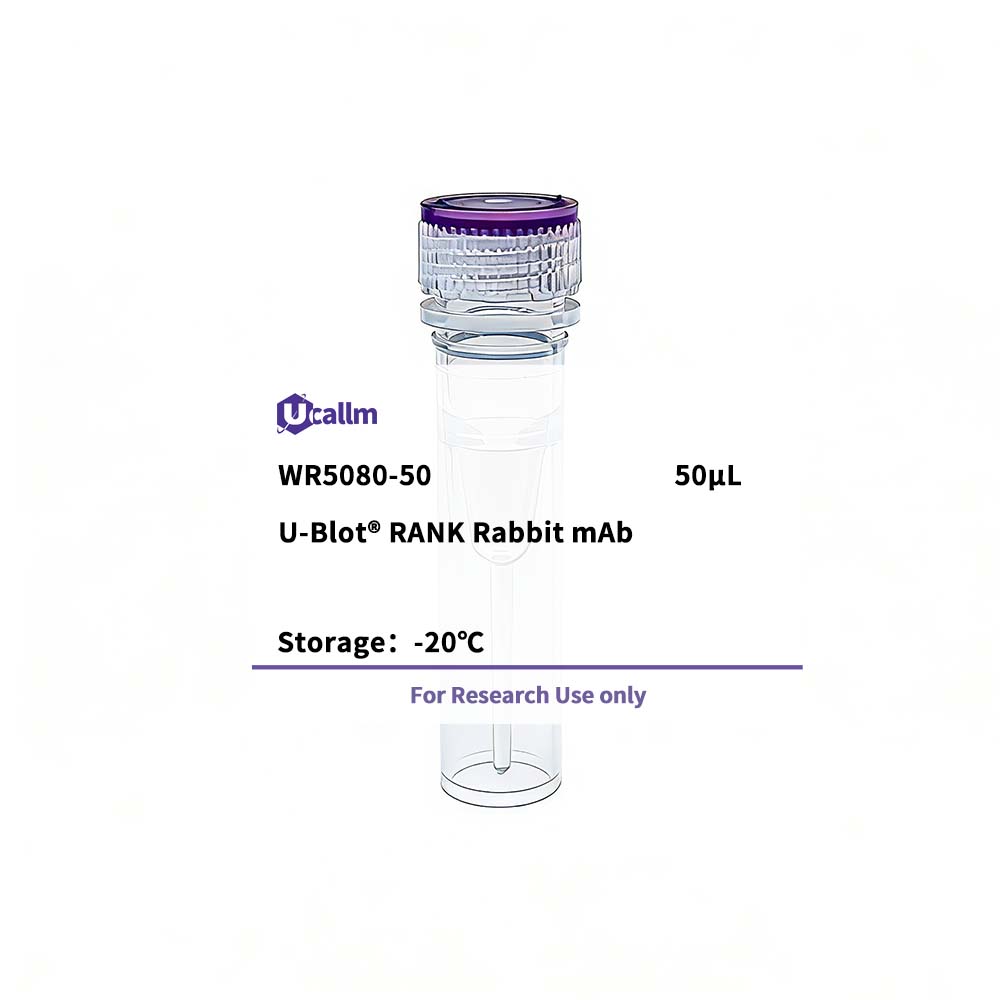
U-Blot® RANK Rabbit mAb

Price range: $268.00 through $328.00

SKU: WR5080-100
Enter the quantity you would like, or drag the panel to find the quantity and price that best for you
Bulk QuoteAuthorize OEM & ODM

Product details

Background:The protein encoded by this gene is a member of the TNF-receptor superfamily. This receptors can interact with various TRAF family proteins, through which this receptor induces the activation of NF-kappa B and MAPK8/JNK. This receptor and its ligand are important regulators of the interaction between T cells and dendritic cells. This receptor is also an essential mediator for osteoclast and lymph node development. Mutations at this locus have been associated with familial expansile osteolysis, autosomal recessive osteopetrosis, and Paget disease of bone. Alternatively spliced transcript variants have been described for this locus. [provided by RefSeq, Aug 2012],


Specifications

Size50μL/100μL
TargetRANK
ReactivityHuman, Mouse, Rat
ApplicationsWB, IHC, IF, ELISA
MW(Calculated)66kD
MW(Observed)70kD
Host SpeciesRabbit
IsotypeIgG,Kappa
Conjugate/ModificationUnmodified
Recommended Dilution RatioIHC 1:200-1:1000; WB 1:10000-1:50000; IF 1:200-1:1000; ELISA 1:5000-1:20000; / Note: For IHC, we suggest antigen retrieval with TE buffer pH 9.0 (Cat#WT1004)
FormulationPBS, 50% glycerol, 0.05% Proclin 300, 0.05%BSA
PurificationRecombinant Antibody expressed in animal component-free (ACF) media, purified via Protein A affinity chromatography.
Storage-15°C to -25°C/1 year(Do not lower than -25°C)
Concentration
ClonalityMonoclonal
Clone NumberRM1321R
ImmunogenThe specific immunogen used to produce this antibody is proprietary information.
SpecificityEndogenous
Gene NameTNFRSF11A RANK
Protein NameTumor necrosis factor receptor superfamily member 11A (Osteoclast differentiation factor receptor) (ODFR) (Receptor activator of NF-KB) (CD antigen CD265)
Other NameTumor necrosis factor receptor superfamily member 11A; / Osteoclast differentiation factor receptor; / ODFR; / Receptor activator of NF-KB; / CD antigen CD265
SpeciesHuman
Gene ID8792
UniprotQ9Y6Q6,
Species.1Mouse
Gene ID.121934
Uniprot.1O35305
Species.2
Gene ID.2
Uniprot.2
Cellular Localization[Isoform 1]: Cell membrane; Single-pass type I membrane protein .; [Isoform RANK-e5a]: Cell membrane; Single-pass type I membrane protein .
Tissue ExpressionUbiquitous expression with high levels in skeletal muscle, thymus, liver, colon, small intestine and adrenal gland.
Signaling_pathwayOrganismal Systems >> Endocrine system >> Prolactin signaling pathway;Organismal Systems >> Development and regeneration >> Osteoclast differentiation;Human Diseases >> Immune disease >> Rheumatoid arthritis;Environmental Information Processing >> Signal transduction >> NF-kappa B signaling pathway;Environmental Information Processing >> Signaling molecules and interaction >> Cytokine-cytokine receptor interaction
Research Areas>>Cytokine-cytokine receptor interaction; / >>NF-kappa B signaling pathway; / >>Osteoclast differentiation; / >>Prolactin signaling pathway; / >>Rheumatoid arthritis
FunctionDisease:Defects in TNFRSF11A are a cause of Paget disease of bone 2 (PDB2) [MIM:602080]; also known as familial Paget disease of bone. PDB2 is a bone-remodeling disorder with clinical similarities to FEO. Unlike FEO, however, affected individuals have involvement of the axial skeleton with lesions in the spine, pelvis and skull.,Disease:Defects in TNFRSF11A are the cause of familial expansile osteolysis (FEO) [MIM:174810]. FEO is a rare autosomal dominant bone disorder characterized by focal areas of increased bone remodeling. The osteolytic lesions develop usually in the long bones during early adulthood. FEO is often associated with early onset deafness and loss of dentition.,Disease:Defects in TNFRSF11A are the cause of osteopetrosis autosomal recessive type 7 (OPTB7) [MIM:612301]; also called osteoclast-poor osteopetrosis with hypogammaglobulinemia. Osteopetrosis is a rare genetic disease characterized by abnormally dense bone, due to defective resorption of immature bone. The disorder occurs in two forms: a severe autosomal recessive form occurring in utero, infancy, or childhood, and a benign autosomal dominant form occurring in adolescence or adulthood. OPTB7 is characterized by paucity of osteoclasts, suggesting a molecular defect in osteoclast development. OPTB7 is associated with hypogammaglobulinemia.,Function:Receptor for TNFSF11/RANKL/TRANCE/OPGL; essential for RANKL-mediated osteoclastogenesis. Involved in the regulation of interactions between T-cells and dendritic cells.,similarity:Contains 4 TNFR-Cys repeats.,subunit:Interacts with TRAF1, TRAF2, TRAF3, TRAF5 and TRAF6.,tissue specificity:Ubiquitous expression with high levels in skeletal muscle, thymus, liver, colon, small intestine and adrenal gland.,
Please login to post questions
Back to Top
Product has been added to your cart


