

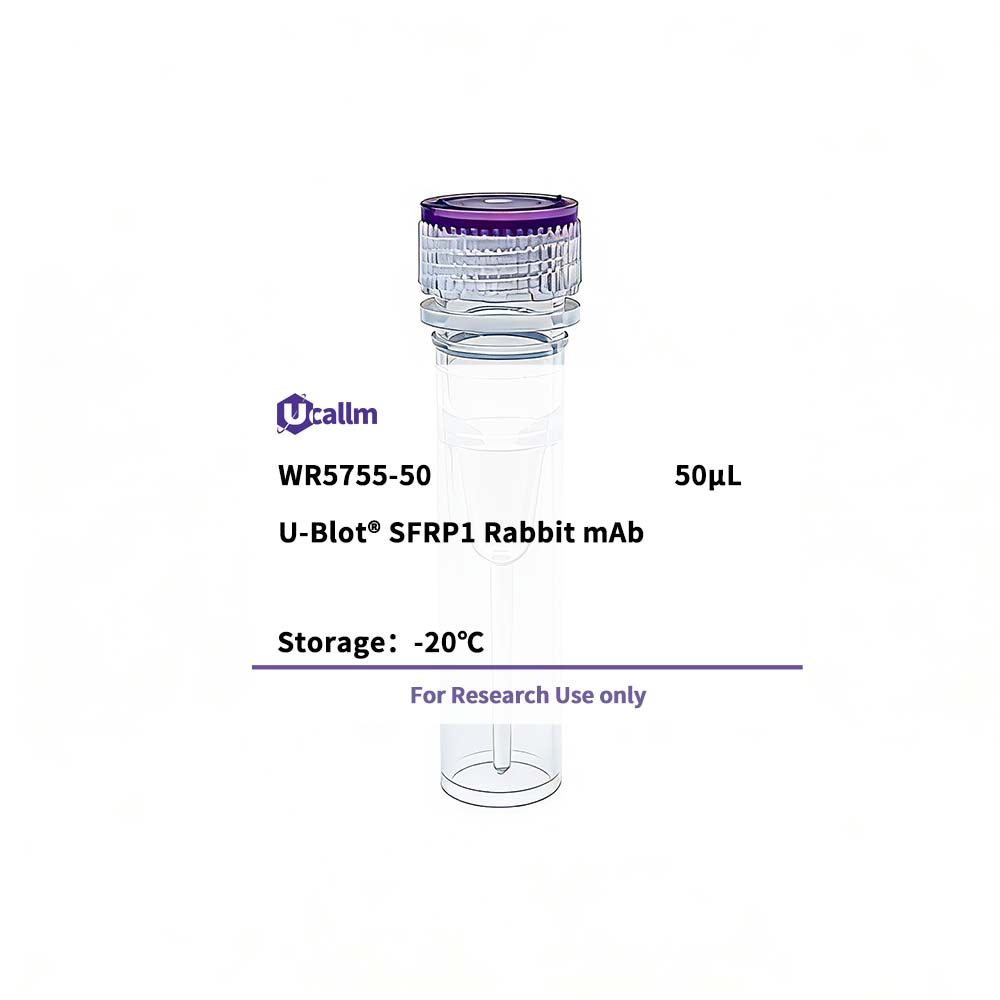
Specifications
| Size | 50μL/100μL |
| Target | SFRP1 |
| Reactivity | Human, Mouse, Rat |
| Applications | WB, IHC, IF, ELISA |
| MW(Calculated) | 35kD |
| MW(Observed) | 38kD |
| Host Species | Rabbit |
| Isotype | IgG,Kappa |
| Conjugate/Modification | Unmodified |
| Recommended Dilution Ratio | IHC 1:200-1:1000; WB 1:2000-1:10000; IF 1:200-1:1000; ELISA 1:5000-1:20000; / Note: For IHC, we suggest antigen retrieval with TE buffer pH 9.0 (Cat#WT1004) |
| Formulation | PBS, 50% glycerol, 0.05% Proclin 300, 0.05%BSA |
| Purification | Recombinant Antibody expressed in animal component-free (ACF) media, purified via Protein A affinity chromatography. |
| Storage | -15°C to -25°C/1 year(Do not lower than -25°C) |
| Concentration | |
| Clonality | Monoclonal |
| Clone Number | RM1717R |
| Immunogen | The specific immunogen used to produce this antibody is proprietary information. |
| Specificity | Endogenous |
| Gene Name | SFRP1 FRP FRP1 SARP2 |
| Protein Name | Secreted frizzled-related protein 1 (FRP-1) (sFRP-1) (Secreted apoptosis-related protein 2) (SARP-2) |
| Other Name | |
| Species | Human |
| Gene ID | 6422 |
| Uniprot | Q8N474, |
| Species.1 | Mouse |
| Gene ID.1 | |
| Uniprot.1 | Q8C4U3, |
| Species.2 | Rat |
| Gene ID.2 | |
| Uniprot.2 | Q9R168 |
| Cellular Localization | Secreted. Cell membrane or extracellular matrix-associated. Released by heparin-binding. |
| Tissue Expression | Widely expressed. Absent from lung, liver and peripheral blood leukocytes. Highest levels in heart and fetal kidney. Also expressed in testis, ovary, fetal brain and lung, leiomyomal cells, myometrial cells and vascular smooth muscle cells. Expressed in foreskin fibroblasts and in keratinocytes. |
| Signaling_pathway | Environmental Information Processing >> Signal transduction >> Wnt signaling pathway |
| Research Areas | >>Wnt signaling pathway |
| Function | Domain:The FZ domain is involved in binding with Wnt ligands.,Function:Soluble frizzled-related proteins (sFRPS) function as modulators of Wnt signaling through direct interaction with Wnts. They have a role in regulating cell growth and differentiation in specific cell types. SFRP1 decreases intracellular beta-catenin levels (By similarity). Has antiproliferative effects on vascular cells, in vitro and in vivo, and can induce, in vivo, an angiogenic response. In vascular cell cycle, delays the G1 phase and entry into the S phase (By similarity). In kidney development, inhibits tubule formation and bud growth in metanephroi (By similarity). Inhibits WNT1/WNT4-mediated TCF-dependent transcription.,induction:Down-regulated in colorectal and breast tumors. Up-regulated in uterine leiomyomas under high estrogenic conditions. Expression, in leiomyomal cells, also increased both under hypoxic and serum deprivation conditions.,mass spectrometry:Isoform N-glycosylated on Asn-173 PubMed:11741940,miscellaneous:May have therapeutic use in cardiac surgery.,similarity:Belongs to the secreted frizzled-related protein (sFRP) family.,similarity:Contains 1 FZ (frizzled) domain.,similarity:Contains 1 NTR domain.,subcellular location:Cell membrane or extracellular matrix-associated. Released by heparin-binding.,subunit:Interacts with WNT1, WNT2 and FRZD6. Interacts with WNT4 and WNT8.,tissue specificity:Widely expressed. Absent from lung, liver and peripheral blood leukocytes. Highest levels in heart and fetal kidney. Also expressed in testis, ovary, fetal brain and lung, leiomyomal cells, myometrial cells and vascular smooth muscle cells. Expressed in foreskin fibroblasts and in keratinocytes., |




