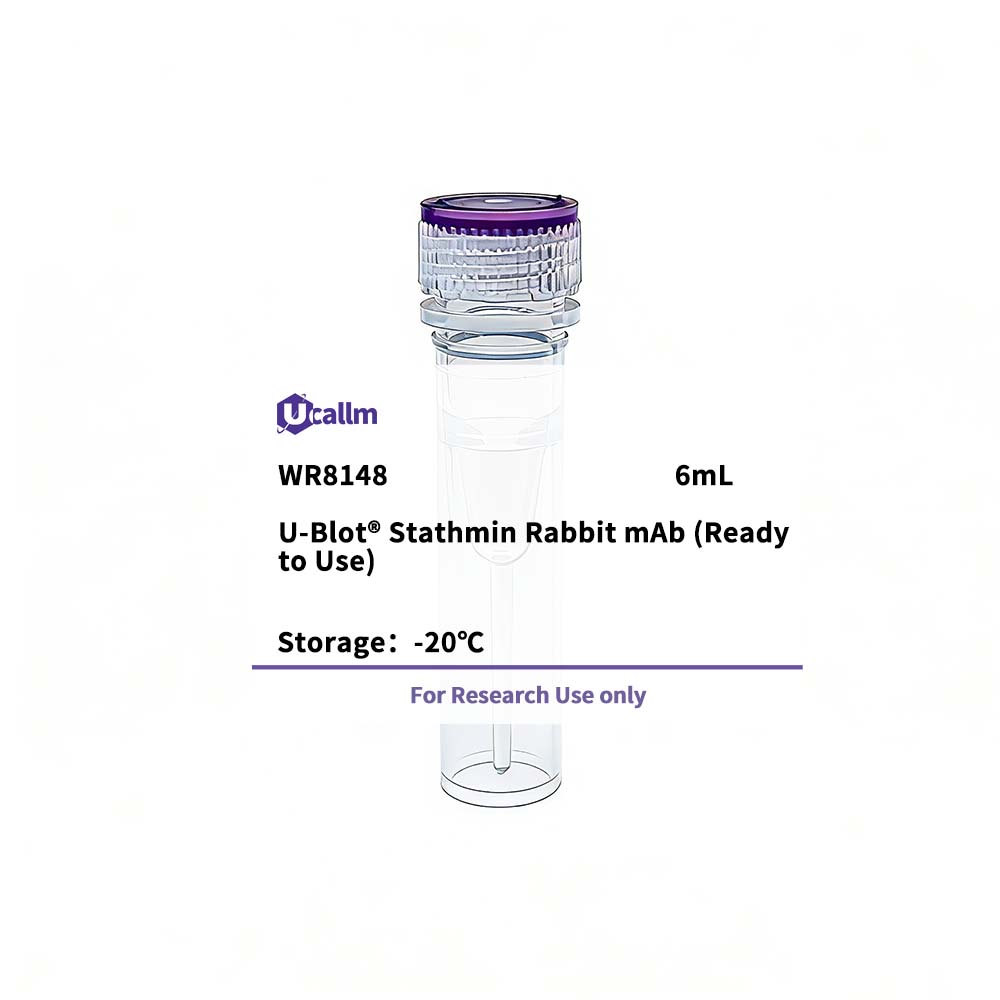
SKU: WR8148 Categories: ,

U-Blot® Stathmin Rabbit mAb (Ready to Use)

$168.00

SKU: WR8148
Enter the quantity you would like, or drag the panel to find the quantity and price that best for you
Bulk QuoteAuthorize OEM & ODM

Product details

Background:
This gene belongs to the stathmin family of genes. It encodes a ubiquitous cytosolic phosphoprotein proposed to function as an intracellular relay integrating regulatory signals of the cellular environment. The encoded protein is involved in the regulation of the microtubule filament system by destabilizing microtubules. It prevents assembly and promotes disassembly of microtubules. Multiple transcript variants encoding different isoforms have been found for this gene. [provided by RefSeq, Feb 2009],


Specifications

Size6mL
TargetStathmin 1
ReactivityHuman, Mouse, Rat
ApplicationsIHC
MW(Calculated)
MW(Observed)
Host SpeciesRabbit
IsotypeIgG1,Kappa
Conjugate/ModificationUnmodified
Recommended Dilution RatioReady to use for IHC / Note: For IHC, we suggest antigen retrieval with TE buffer pH 9.0 (Cat#WT1004)
FormulationThe prediluted ready-to-use antibody is diluted in phosphate buffer saline containing stabilizing protein and 0.05% Proclin 300
PurificationRecombinant Expression and Affinity purified
Storage2°C to 8°C/1 year,Ship by ice bag
Concentration
ClonalityMonoclonal
Clone NumberRM206R
ImmunogenSynthesized peptide derived from human Stathmin AA range:1-100
SpecificityThis antibody detects endogenous levels of Stathmin 1
Gene NameSTMN1
Protein NameC1orf215; Lag; LAP 18; LAP18; Leukemia associated phosphoprotein p18; Leukemia-associated phosphoprotein p18; Metablastin; Oncoprotein 18; OP 18; Op18; p18; p19; Phosphoprotein 19; Phosphoprotein p19; pp17; pp19; PR22; Pr22 protein; Prosolin; Protein Pr22; SMN; Stathmin; Stathmin1; STMN 1; Stmn1; STMN1_HUMAN
Other NameC1orf215; / Lag; / LAP 18; / LAP18; / Leukemia associated phosphoprotein p18; / Leukemia-associated phosphoprotein p18; / Metablastin; / Oncoprotein 18; / OP 18; / Op18; / p18; / p19; / Phosphoprotein 19; / Phosphoprotein p19; / pp17; / pp19; / PR22; / Pr22 protein; / Prosolin; / Protein Pr22; / SMN; / Stathmin; / Stathmin1; / STMN 1; / Stmn1; / STMN1_HUMAN
SpeciesHuman
Gene ID3925
UniprotP16949,
Species.1Mouse
Gene ID.116765
Uniprot.1P54227,
Species.2Rat
Gene ID.229332
Uniprot.2P13668
Cellular LocalizationCytoplasmic
Tissue ExpressionTonsil
Signaling_pathwayHuman Diseases >> Cancer: overview >> MicroRNAs in cancer;Environmental Information Processing >> Signal transduction >> MAPK signaling pathway
Research Areas>>MAPK signaling pathway; / >>MicroRNAs in cancer
FunctionDisease:Present in much greater abundance in cells from patients with acute leukemia of different subtypes than in normal peripheral blood lymphocytes, non-leukemic proliferating lymphoid cells, bone marrow cells, or cells from patients with chronic lymphoid or myeloid leukemia.,Function:Involved in the regulation of the microtubule (MT) filament system by destabilizing microtubules. Prevents assembly and promotes disassembly of microtubules. Phosphorylation at Ser-16 may be required for axon formation during neurogenesis. Involved in the control of the learned and innate fear.,PTM:Many different phosphorylated forms are observed depending on specific combinations among the sites which can be phosphorylated. MAPK is responsible for the phosphorylation of stathmin in response to NGF. Phosphorylation at Ser-16 seems to be required for neuron polarization (By similarity). Phosphorylation at Ser-63 reduces tubulin binding 10-fold and suppresses the MT polymerization inhibition activity.,similarity:Belongs to the stathmin family.,subunit:Binds to two alpha/beta-tubulin heterodimers. Interacts with KIST.,tissue specificity:Ubiquitous. Expression is strongest in fetal and adult brain, spinal cord, and cerebellum, followed by thymus, bone marrow, testis, and fetal liver. Expression is intermediate in colon, ovary, placenta, uterus, and trachea, and is readily detected at substantially lower levels in all other tissues examined. Lowest expression is found in adult liver.,
Please login to post questions
Back to Top
Product has been added to your cart



