SKU: WR5400 Categories: ,

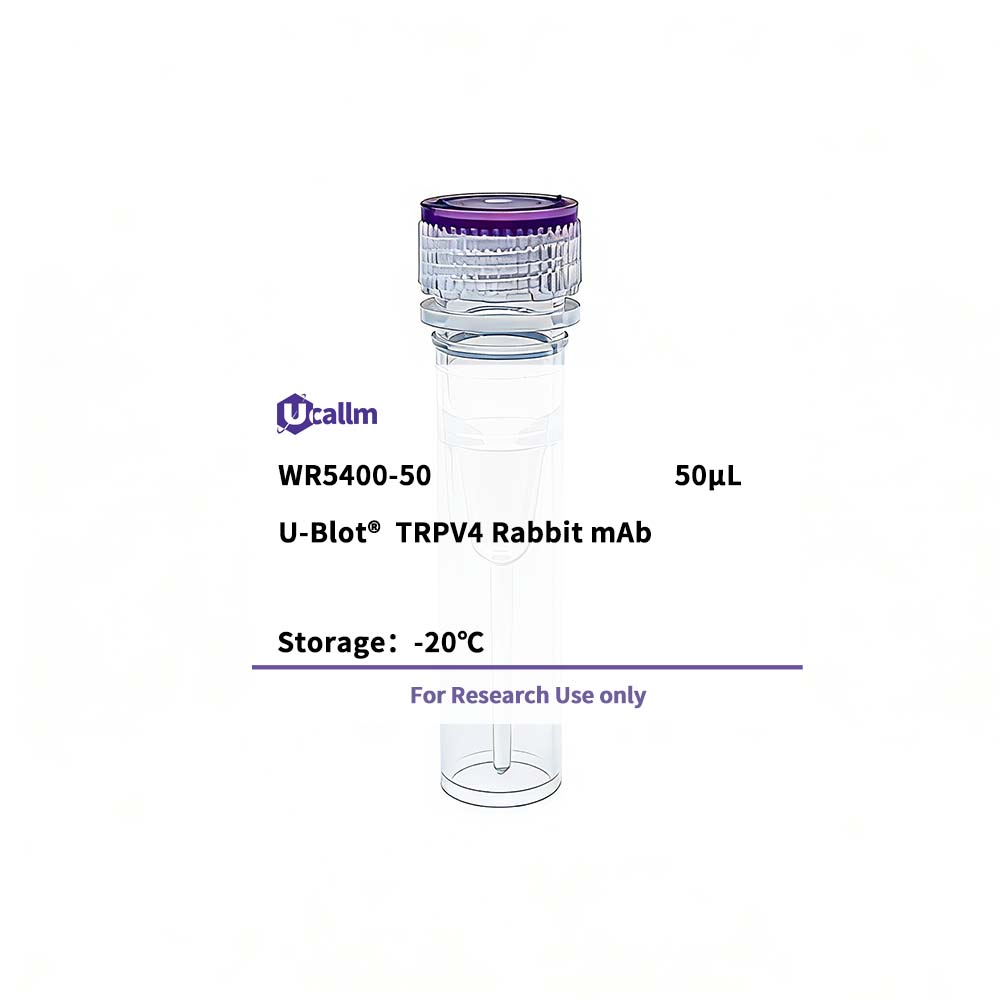
U-Blot® TRPV4 Rabbit mAb

Price range: $268.00 through $328.00

SKU: WR5400-50
Enter the quantity you would like, or drag the panel to find the quantity and price that best for you
Bulk QuoteAuthorize OEM & ODM

Product details

Background:transient receptor potential cation channel subfamily V member 4(TRPV4) Homo sapiens This gene encodes a member of the OSM9-like transient receptor potential channel (OTRPC) subfamily in the transient receptor potential (TRP) superfamily of ion channels. The encoded protein is a Ca2+-permeable, nonselective cation channel that is thought to be involved in the regulation of systemic osmotic pressure. Mutations in this gene are the cause of spondylometaphyseal and metatropic dysplasia and hereditary motor and sensory neuropathy type IIC. Multiple transcript variants encoding different isoforms have been found for this gene. [provided by RefSeq, Apr 2010],


Specifications

Size50μL/100μL
TargetTRPV4
ReactivityHuman
ApplicationsWB, IF, IP, ELISA
MW(Calculated)98kD
MW(Observed)90-100kD
Host SpeciesRabbit
IsotypeIgG,Kappa
Conjugate/ModificationUnmodified
Recommended Dilution RatioWB 1:1000-1:5000; IF 1:200-1:1000; ELISA 1:5000-1:20000; IP 1:50-1:200;
FormulationPBS, 50% glycerol, 0.05% Proclin 300, 0.05%BSA
PurificationRecombinant Antibody expressed in animal component-free (ACF) media, purified via Protein A affinity chromatography.
Storage-15°C to -25°C/1 year(Do not lower than -25°C)
Concentration
ClonalityMonoclonal
Clone NumberRM1647R
ImmunogenThe specific immunogen used to produce this antibody is proprietary information.
SpecificityEndogenous
Gene NameTRPV4
Protein NameTransient receptor potential cation channel subfamily V member 4
Other NameTRPV4; / VRL2; / VROAC; / Transient receptor potential cation channel subfamily V member 4; / TrpV4; / Osm-9-like TRP channel 4; / OTRPC4; / Transient receptor potential protein 12; / TRP12; / Vanilloid receptor-like channel 2; / Vanilloid receptor-like protein 2; / VRL-2; / Vanilloid receptor-related osmotically-activated channel; / VR-OAC
SpeciesHuman
Gene ID59341
UniprotQ9HBA0,
Species.1Mouse
Gene ID.163873
Uniprot.1Q9EPK8,
Species.2Rat
Gene ID.266026
Uniprot.2Q9ERZ8
Cellular LocalizationCell membrane . Apical cell membrane; Multi-pass membrane protein . Cell junction, adherens junction . Cell projection, cilium . Assembly of the putative homotetramer occurs primarily in the endoplasmic reticulum. .; [Isoform 1]: Cell membrane .; [Isoform 5]: Cell membrane .; [Isoform 2]: Endoplasmic reticulum .; [Isoform 4]: Endoplasmic reticulum .; [Isoform 6]: Endoplasmic reticulum .
Tissue ExpressionFound in the synoviocytes from patients with (RA) and without (CTR) rheumatoid arthritis (at protein level).
Signaling_pathwayCellular Processes >> Cell growth and death >> Cellular senescence;Organismal Systems >> Sensory system >> Inflammatory mediator regulation of TRP channels
Research Areas>>Cellular senescence; / >>Inflammatory mediator regulation of TRP channels; / >>Fluid shear stress and atherosclerosis
FunctionDisease:Defects in TRPV4 are the cause of brachyolmia type 3 [MIM:113500]; also called brachyrachia. The brachyolmias constitute a clinically and genetically heterogeneous group of skeletal dysplasias characterized by a short trunk, scoliosis and mild short stature. Type 3 brachyolmia is an autosomal dominant form with severe kyphoscoliosis and flattened, irregular cervical vertebrae.,Function:Non-selective calcium permeant cation channel probably involved in osmotic sensitivity and mechanosensitivity. Activation by exposure to hypotonicity within the physiological range exhibits an outward rectification. Also activated by low pH, citrate and phorbol esters. Increase of intracellular Ca(2+) potentiates currents. Channel activity seems to be regulated by a calmodulin-dependent mechanism with a negative feedback mechanism.,similarity:Belongs to the transient receptor family. TrpV subfamily.,similarity:Contains 3 ANK repeats.,subcellular location:Assembly of the putative homotetramer occurs primarily in the endoplasmic reticulum.,subunit:Homotetramer (Probable). Self-associates in a isoform-specific manner. Isoforms 1/A and 5/D but not isoform 2/B, 4/C and 6/E can oligomerize. Interacts with calmodulin. Interacts with Map7 and Src family Tyr protein kinases LYN, SRC, FYN, HCK, LCK and YES.,
Please login to post questions
Back to Top
Product has been added to your cart
