


U-Blot® YTHDC1 Rabbit mAb
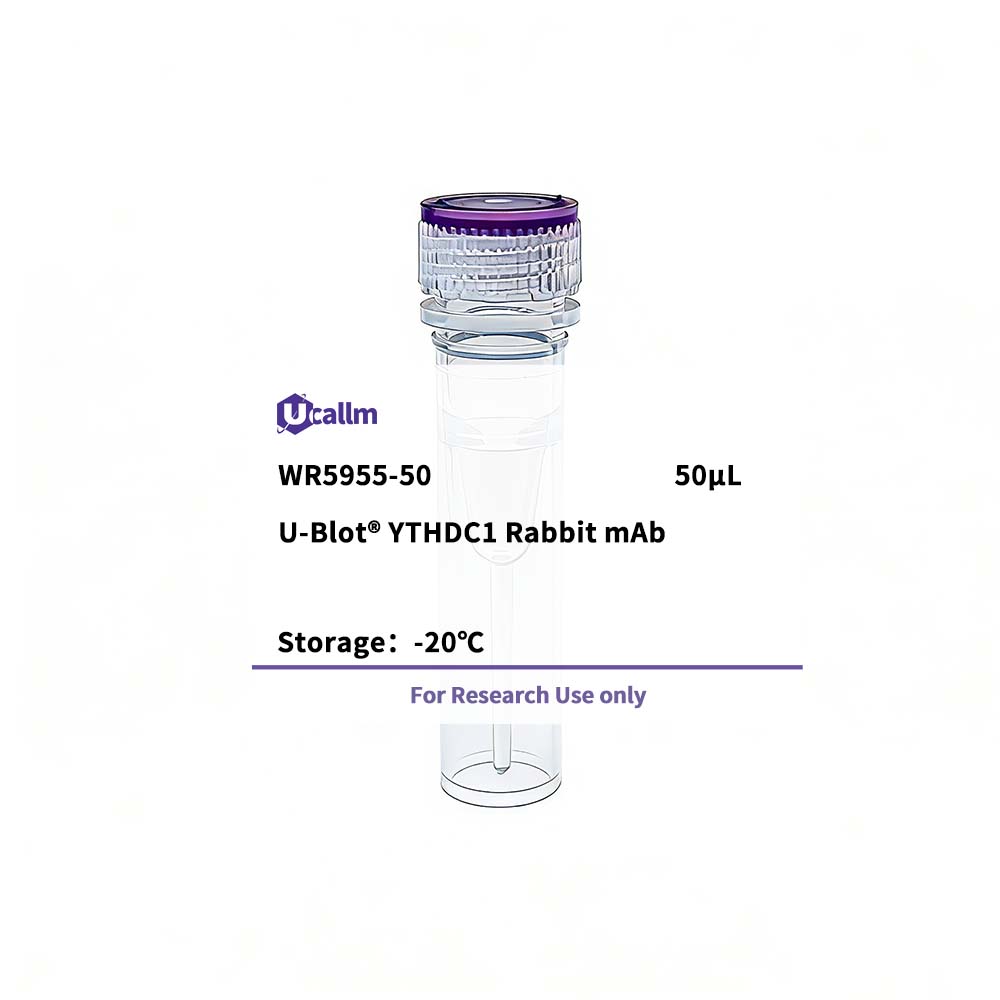
Ucallm_WR5955-50
Price range: $268.00 through $328.00
Product details
Background:
Specifications
| Size | 50μL/100μL |
| Target | YTHDC1 |
| Reactivity | Human, Mouse, Rat |
| Applications | WB, IHC, IF, ELISA |
| MW(Calculated) | 85kD |
| MW(Observed) | 110kD |
| Host Species | Rabbit |
| Isotype | IgG,Kappa |
| Conjugate/Modification | Unmodified |
| Recommended Dilution Ratio | IHC 1:200-1:1000; WB 1:2000-1:10000; IF 1:200-1:1000; ELISA 1:5000-1:20000; / Note: For IHC, we suggest antigen retrieval with TE buffer pH 9.0 (Cat#WT1004) |
| Formulation | PBS, 50% glycerol, 0.05% Proclin 300, 0.05%BSA |
| Purification | Recombinant Antibody expressed in animal component-free (ACF) media, purified via Protein A affinity chromatography. |
| Storage | -15°C to -25°C/1 year(Do not lower than -25°C) |
| Concentration | |
| Clonality | Monoclonal |
| Clone Number | RM1914R |
| Immunogen | The specific immunogen used to produce this antibody is proprietary information. |
| Specificity | Endogenous |
| Gene Name | YTHDC1 KIAA1966 YT521 |
| Protein Name | YTH domain-containing protein 1 (Putative splicing factor YT521) |
| Other Name | YTH domain-containing protein 1; / Putative splicing factor YT521 |
| Species | Human |
| Gene ID | 91746 |
| Uniprot | Q96MU7, |
| Species.1 | |
| Gene ID.1 | |
| Uniprot.1 | |
| Species.2 | Rat |
| Gene ID.2 | 170956 |
| Uniprot.2 | Q9QY02 |
| Cellular Localization | Nucleus . Nucleus speckle . Localizes to a novel subnuclear structure, the YT bodies. . |
| Tissue Expression | |
| Signaling_pathway | |
| Research Areas | |
| Function | Regulator of alternative splicing that specifically recognizes and binds N6-methyladenosine (m6A)-containing RNAs . M6A is a modification present at internal sites of mRNAs and some non-coding RNAs and plays a role in the efficiency of mRNA splicing, processing and stability . Acts as a key regulator of exon-inclusion or exon-skipping during alternative splicing via interaction with mRNA splicing factors SRSF3 and SRSF10 . Specifically binds m6A-containing mRNAs and promotes recruitment of SRSF3 to its mRNA-binding elements adjacent to m6A sites, leading to exon-inclusion during alternative splicing . In contrast, interaction with SRSF3 prevents interaction with SRSF10, a splicing factor that promotes exon skipping: this prevents SRSF10 from binding to its mRNA-binding sites close to m6A-containing regions, leading to inhibit exon skipping during alternative splicing . May also regulate alternative splice site selection . Also involved in nuclear export of m6A-containing mRNAs via interaction with SRSF3: interaction with SRSF3 facilitates m6A-containing mRNA-binding to both SRSF3 and NXF1, promoting mRNA nuclear export . Involved in S-adenosyl-L-methionine homeostasis by regulating expression of MAT2A transcripts, probably by binding m6A-containing MAT2A mRNAs (By similarity). Also recognizes and binds m6A on other RNA molecules . Involved in random X inactivation mediated by Xist RNA: recognizes and binds m6A-containing Xist and promotes transcription repression activity of Xist . Also recognizes and binds m6A-containing single-stranded DNA . Involved in germline development: required for spermatogonial development in males and oocyte growth and maturation in females, probably via its role in alternative splicing (By similarity). |
Please login to post questions
Related products





