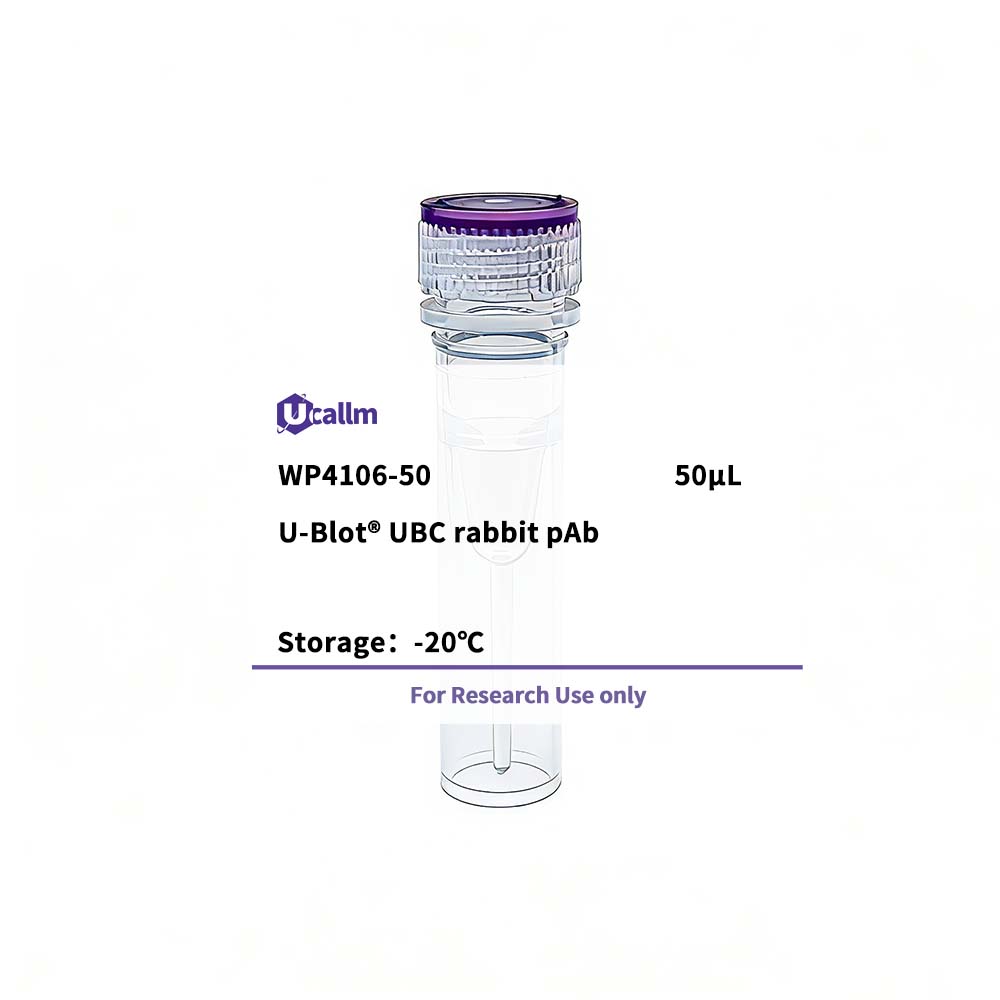
SKU: WP4106 Categories: ,

UBC rabbit pAb

Price range: $268.00 through $328.00

SKU: WP4106-100
Enter the quantity you would like, or drag the panel to find the quantity and price that best for you
Bulk QuoteAuthorize OEM & ODM

Product details

Background:

This gene represents a ubiquitin gene, ubiquitin C. The encoded protein is a polyubiquitin precursor. Conjugation of ubiquitin monomers or polymers can lead to various effects within a cell, depending on the residues to which ubiquitin is conjugated. Ubiquitination has been associated with protein degradation, DNA repair, cell cycle regulation, kinase modification, endocytosis, and regulation of other cell signaling pathways. [provided by RefSeq, Aug 2010],


Specifications

Size50μL/100μL
TargetUBC
ReactivityHuman, Mouse, Rat
ApplicationsWB
MW(Calculated)75kD
MW(Observed)
Host SpeciesRabbit
IsotypeIgG
Conjugate/ModificationUnmodified
Recommended Dilution RatioWB 1:500-2000
FormulationLiquid in PBS containing 50% glycerol, 0.5% BSA and 0.02% sodium azide.
PurificationThe antibody was affinity-purified from rabbit antiserum by affinity-chromatography using epitope-specific immunogen.
Storage-15°C to -25°C/1 year(Do not lower than -25°C)
Concentration1 mg/ml
ClonalityPolyclonal
Clone Number
ImmunogenSynthesized peptide derived from human UBC AA range: 160-210
SpecificityThis antibody detects endogenous levels of UBC at Human/Mouse/Rat
Gene NameUBC
Protein NameUBC
Other Name
SpeciesHuman
Gene ID
UniprotP0CG48,
Species.1Mouse
Gene ID.122190
Uniprot.1P0CG50,
Species.2Rat
Gene ID.250522
Uniprot.2Q63429
Cellular Localization[Ubiquitin]: Cytoplasm . Nucleus . Mitochondrion outer membrane; Peripheral membrane protein .
Tissue Expression
Signaling_pathway
Research Areas>>PPAR signaling pathway; / >>Ubiquitin mediated proteolysis; / >>Mitophagy - animal; / >>Parkinson disease; / >>Pathways of neurodegeneration - multiple diseases; / >>Shigellosis; / >>Kaposi sarcoma-associated herpesvirus infection
FunctionFunction:Protein modifier which can be covalently attached to target lysines either as a monomer or as a lysine-linked polymer. Attachment to proteins as a Lys-48-linked polymer usually leads to their degradation by proteasome. Attachment to proteins as a monomer or as an alternatively linked polymer does not lead to proteasomal degradation and may be required for numerous functions, including maintenance of chromatin structure, regulation of gene expression, stress response, ribosome biogenesis and DNA repair.,miscellaneous:This ribosomal protein is synthesized as a C-terminal extension protein (CEP) of ubiquitin.,miscellaneous:Ubiquitin is synthesized as a polyubiquitin precursor with exact head to tail repeats, the number of repeats differ between species and strains. In some species there is a final amino-acid after the last repeat, here in human a Val. Some ubiquitin genes contain a single copy of ubiquitin fused to a ribosomal protein (either L40 or S27a).,PTM:Several types of polymeric chains can be formed, depending on the lysine used for the assembly.,similarity:Belongs to the ribosomal protein S27Ae family.,similarity:Belongs to the ubiquitin family.,
Please login to post questions
Back to Top
Product has been added to your cart
