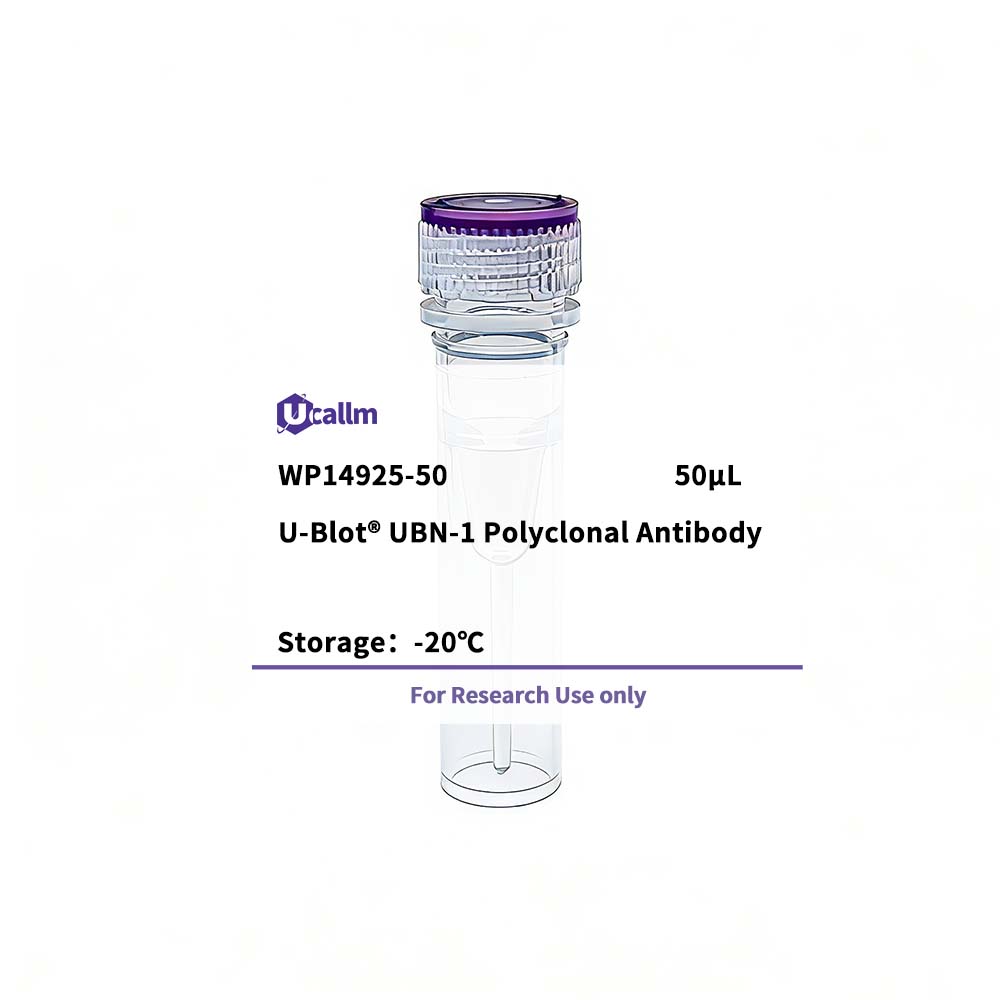
SKU: WP14925 Categories: ,

UBN-1 Polyclonal Antibody

Price range: $268.00 through $328.00

SKU: WP14925-100
Enter the quantity you would like, or drag the panel to find the quantity and price that best for you
Bulk QuoteAuthorize OEM & ODM

Product details

Background:

function:Acts as a novel regulator of senescence. Involved in the formation of senescence-associated heterochromatin foci (SAHF), which represses expression of proliferation-promoting genes. Binds to proliferation-promoting genes. May be required for replication-independent chromatin assembly., similarity:Belongs to the ubinuclein family., subcellular location:Localized as a nuclear speckled-like pattern in proliferating primary fibroblasts. Colocalizes with HIRA, PML and SP100 in PML bodies of senescent cells. Colocalizes with TJP1 and CLDN1. Detected along the upper granular cell layer of epidermis. When overexpressed, accumulates in the nucleus in cells showing defective cytokinesis., subunit:Component of a complex that includes at least ASF1A, CABIN1, HIRA, histone H3.3 and UBN1. Interacts with Epstein-Barr virus BZLF1. Interacts with HIRA (via WD repeat domain); the interaction is direct. Interacts with ASF1A, CEBPA, TJP1, TJP2 and TJP3., tissue specificity:Ubiquitous. Also expressed in numerous tumors and cancer cell lines.,

Specifications

TargetUBN-1
ReactivityHuman, Mouse
ApplicationsWB, IHC, IF, ELISA
MW(Calculated)122kD
MW(Observed)
Host SpeciesRabbit
IsotypeIgG
Conjugate/ModificationUnmodified
Modification
Recommended Dilution RatioWB 1:500-2000; IHC 1:100-1:300; IF 1:200-1:1000; ELISA 1:10000; Not yet tested in other applications. / Note: For IHC, we suggest antigen retrieval with TE buffer pH 9.0 (Cat#YS0004)
FormulationLiquid in PBS containing 50% glycerol, 0.5% BSA and 0.02% sodium azide.
Source
PurificationThe antibody was affinity-purified from rabbit antiserum by affinity-chromatography using epitope-specific immunogen.
Purity
Storage-15°C to -25°C/1 year(Do not lower than -25°C)
Concentration1 mg/ml
ClonalityPolyclonal
Clone Number
ImmunogenThe antiserum was produced against synthesized peptide derived from human Ubinuclein. AA range:161-210
Sequence
SpecificityUBN-1 Polyclonal Antibody detects endogenous levels of UBN-1 protein.
Gene NameUBN1
Protein NameUbinuclein-1
Other NameUBN1; / Ubinuclein-1; / HIRA-binding protein; / Protein VT4; / Ubiquitously expressed nuclear protein
SpeciesHuman
Gene ID-129855
UniprotQ9NPG3,
Species.1Mouse
Gene ID-2170644
Uniprot.1Q4G0F8
Species.2
Gene ID-3
Uniprot.2
Organism-4
Gene ID-4
SwissProt-4
Backgroundfunction:Acts as a novel regulator of senescence. Involved in the formation of senescence-associated heterochromatin foci (SAHF), which represses expression of proliferation-promoting genes. Binds to proliferation-promoting genes. May be required for replication-independent chromatin assembly.,similarity:Belongs to the ubinuclein family.,subcellular location:Localized as a nuclear speckled-like pattern in proliferating primary fibroblasts. Colocalizes with HIRA, PML and SP100 in PML bodies of senescent cells. Colocalizes with TJP1 and CLDN1. Detected along the upper granular cell layer of epidermis. When overexpressed, accumulates in the nucleus in cells showing defective cytokinesis.,subunit:Component of a complex that includes at least ASF1A, CABIN1, HIRA, histone H3.3 and UBN1. Interacts with Epstein-Barr virus BZLF1. Interacts with HIRA (via WD repeat domain); the interaction is direct. Interacts with ASF1A, CEBPA, TJP1, TJP2 and TJP3.,tissue specificity:Ubiquitous. Also expressed in numerous tumors and cancer cell lines.,
Cellular LocalizationNucleus, nucleoplasm. Nucleus, PML body. Cell junction, tight junction. Localized as a nuclear speckled-like pattern in proliferating primary fibroblasts. Colocalizes with HIRA, PML and SP100 in PML bodies of senescent cells. Colocalizes with TJP1 and CLDN1. Detected along the upper granular cell layer of epidermis. When overexpressed, accumulates in the nucleus in cells showing defective cytokinesis.
Tissue ExpressionUbiquitous. Also expressed in numerous tumors and cancer cell lines.
Signaling_pathway
Research Areas
FunctionFunction:Acts as a novel regulator of senescence. Involved in the formation of senescence-associated heterochromatin foci (SAHF), which represses expression of proliferation-promoting genes. Binds to proliferation-promoting genes. May be required for replication-independent chromatin assembly.,similarity:Belongs to the ubinuclein family.,subcellular location:Localized as a nuclear speckled-like pattern in proliferating primary fibroblasts. Colocalizes with HIRA, PML and SP100 in PML bodies of senescent cells. Colocalizes with TJP1 and CLDN1. Detected along the upper granular cell layer of epidermis. When overexpressed, accumulates in the nucleus in cells showing defective cytokinesis.,subunit:Component of a complex that includes at least ASF1A, CABIN1, HIRA, histone H3.3 and UBN1. Interacts with Epstein-Barr virus BZLF1. Interacts with HIRA (via WD repeat domain); the interaction is direct. Interacts with ASF1A, CEBPA, TJP1, TJP2 and TJP3.,tissue specificity:Ubiquitous. Also expressed in numerous tumors and cancer cell lines.,
RRID
Please login to post questions
Back to Top
Product has been added to your cart