

ULK1 Polyclonal Antibody
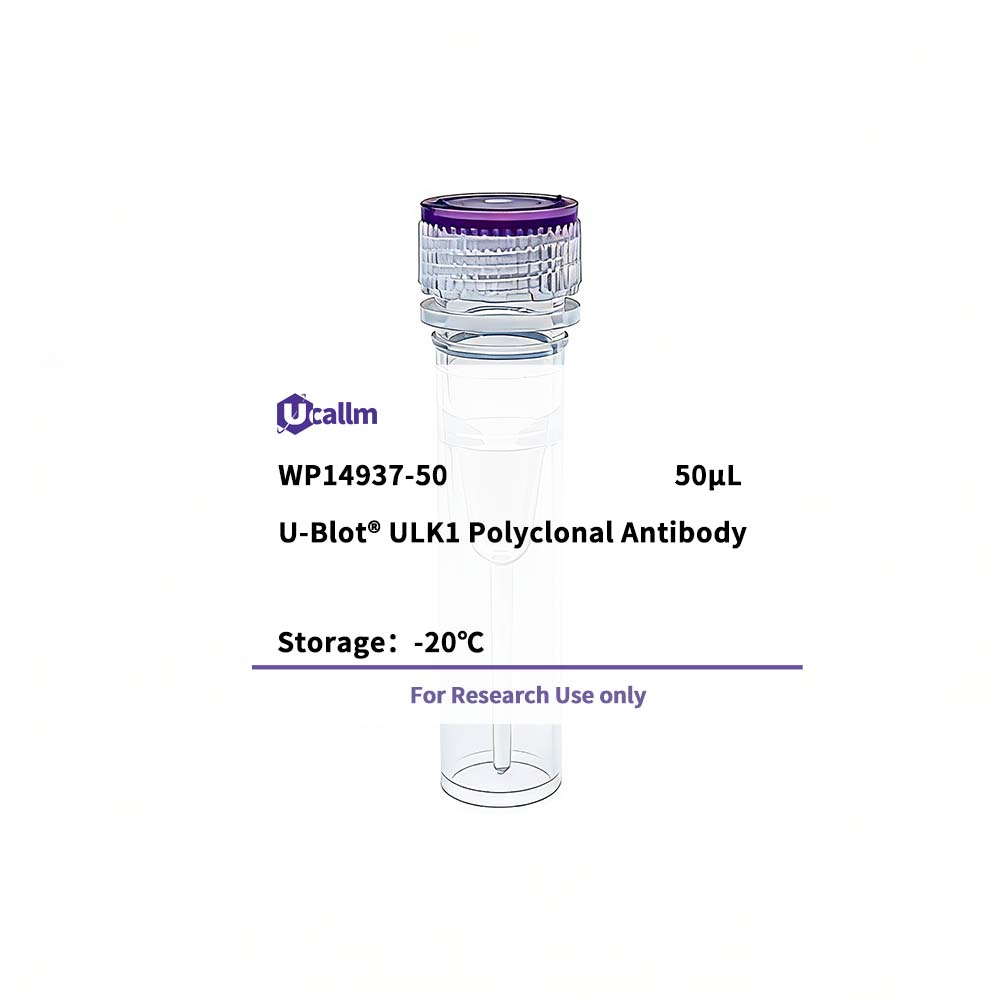
Ucallm_WP14937-50
Price range: $268.00 through $328.00
Product details
Background:
catalytic activity:ATP + a protein = ADP + a phosphoprotein., function:Involved in axon growth. Plays an essential role in neurite extension of cerebellar granule cells., similarity:Belongs to the protein kinase superfamily. Ser/Thr protein kinase family. APG1/unc-51/ULK1 subfamily., similarity:Contains 1 protein kinase domain., subunit:Interacts with GABARAP and GABARAPL2., tissue specificity:Ubiquitously expressed. Detected in the following adult tissues: skeletal muscle, heart, pancreas, brain, placenta, liver, kidney, and lung.,
Specifications
| Size | 50μL/100μL |
| Target | ULK1 |
| Reactivity | Human, Mouse |
| Applications | IHC, IF, WB, ELISA |
| MW(Calculated) | 113kD |
| MW(Observed) | |
| Host Species | Rabbit |
| Isotype | IgG |
| Conjugate/Modification | Unmodified |
| Recommended Dilution Ratio | WB 1:500-2000; IHC 1:100-1:300; ELISA 1:40000; IF 1:50-200 / Note: For IHC, we suggest antigen retrieval with TE buffer pH 9.0 (Cat#WT1004) |
| Formulation | Liquid in PBS containing 50% glycerol, 0.5% BSA and 0.02% sodium azide. |
| Purification | The antibody was affinity-purified from rabbit antiserum by affinity-chromatography using epitope-specific immunogen. |
| Storage | -15°C to -25°C/1 year(Do not lower than -25°C) |
| Concentration | 1 mg/ml |
| Clonality | Polyclonal |
| Clone Number | |
| Immunogen | Synthesized peptide derived from the C-terminal region of human ULK1. |
| Specificity | ULK1 Polyclonal Antibody detects endogenous levels of ULK1 protein. |
| Gene Name | ULK1 |
| Protein Name | Serine/threonine-protein kinase ULK1 |
| Other Name | ULK1; / KIAA0722; / Serine/threonine-protein kinase ULK1; / Autophagy-related protein 1 homolog; / ATG1; / hATG1; / Unc-51-like kinase 1 |
| Species | Human |
| Gene ID | 8408 |
| Uniprot | O75385, |
| Species.1 | Mouse |
| Gene ID.1 | 22241 |
| Uniprot.1 | O70405 |
| Species.2 | |
| Gene ID.2 | |
| Uniprot.2 | |
| Cellular Localization | Cytoplasm, cytosol . Preautophagosomal structure . Under starvation conditions, is localized to puncate structures primarily representing the isolation membrane that sequesters a portion of the cytoplasm resulting in the formation of an autophagosome. . |
| Tissue Expression | Ubiquitously expressed. Detected in the following adult tissues: skeletal muscle, heart, pancreas, brain, placenta, liver, kidney, and lung. |
| Signaling_pathway | Cellular Processes >> Transport and catabolism >> Autophagy - animal;Cellular Processes >> Transport and catabolism >> Mitophagy - animal;Organismal Systems >> Aging >> Longevity regulating pathway;Human Diseases >> Neurodegenerative disease >> Alzheimer disease;Human Diseases >> Neurodegenerative disease >> Amyotrophic lateral sclerosis;Human Diseases >> Neurodegenerative disease >> Huntington disease;Human Diseases >> Neurodegenerative disease >> Spinocerebellar ataxia;Human Diseases >> Neurodegenerative disease >> Pathways of neurodegeneration - multiple diseases;Environmental Information Processing >> Signal transduction >> AMPK signaling pathway;Environmental Information Processing >> Signal transduction >> mTOR signaling pathway |
| Research Areas | >>Mitophagy - animal; / >>Autophagy - animal; / >>mTOR signaling pathway; / >>AMPK signaling pathway; / >>Longevity regulating pathway; / >>Alzheimer disease; / >>Amyotrophic lateral sclerosis; / >>Huntington disease; / >>Spinocerebellar ataxia; / >>Pathways of neurodegeneration - multiple diseases |
| Function | Catalytic activity:ATP + a protein = ADP + a phosphoprotein.,Function:Involved in axon growth. Plays an essential role in neurite extension of cerebellar granule cells.,similarity:Belongs to the protein kinase superfamily. Ser/Thr protein kinase family. APG1/unc-51/ULK1 subfamily.,similarity:Contains 1 protein kinase domain.,subunit:Interacts with GABARAP and GABARAPL2.,tissue specificity:Ubiquitously expressed. Detected in the following adult tissues: skeletal muscle, heart, pancreas, brain, placenta, liver, kidney, and lung., |
Please login to post questions
Related products




