

Product details
Background:
USP30, a member of the ubiquitin-specific protease family (see USP1, MIM 603478), is a novel mitochondrial deubiquitinating (DUB) enzyme (Nakamura and Hirose, 2008 [PubMed 18287522]).[supplied by OMIM, Dec 2008],
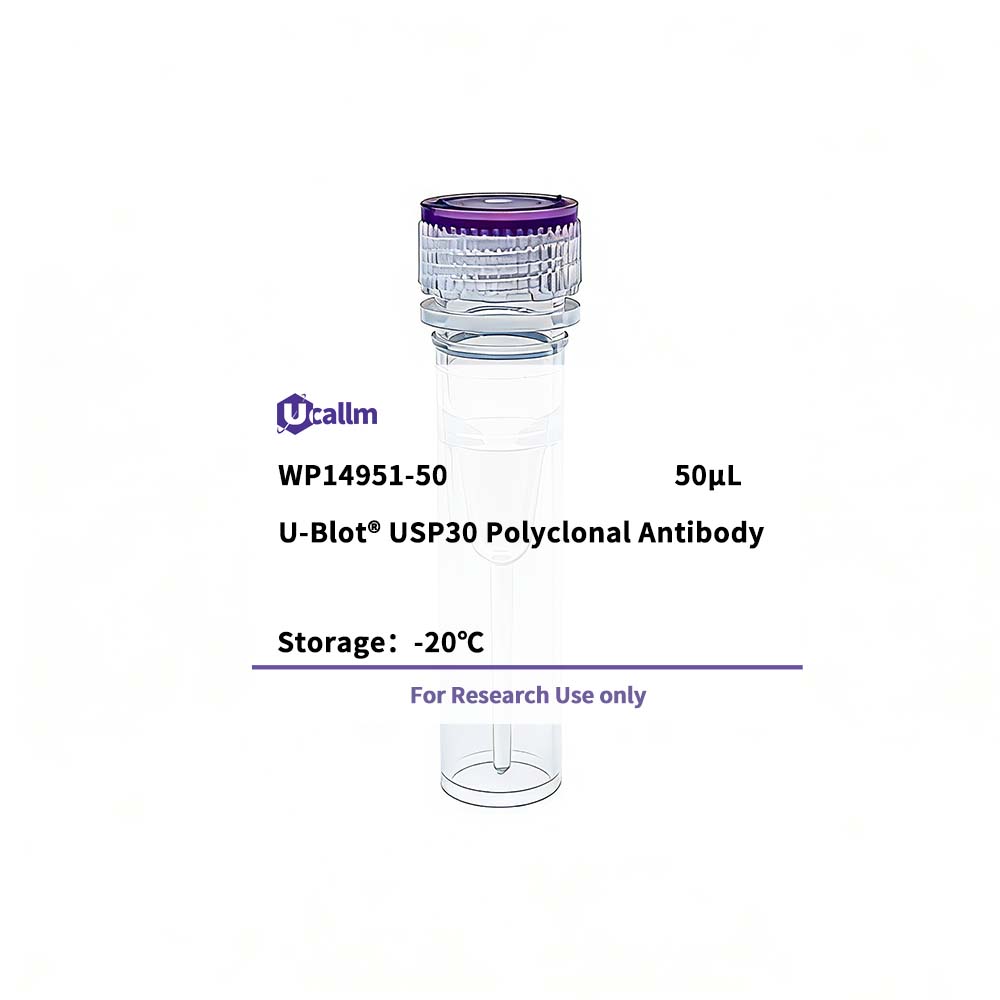
Price range: $268.00 through $328.00
Background:
USP30, a member of the ubiquitin-specific protease family (see USP1, MIM 603478), is a novel mitochondrial deubiquitinating (DUB) enzyme (Nakamura and Hirose, 2008 [PubMed 18287522]).[supplied by OMIM, Dec 2008],
| Size | 50μL/100μL |
| Target | USP30 |
| Reactivity | Human, Mouse, Rat |
| Applications | WB, ELISA |
| MW(Calculated) | |
| MW(Observed) | 60kD,unspecial bands(65kD,105kD,130kD)in Hela and HCT116 cell |
| Host Species | Rabbit |
| Isotype | IgG |
| Conjugate/Modification | Unmodified |
| Recommended Dilution Ratio | WB 1:500-1:2000; ELISA 1:10000; Not yet tested in other applications. |
| Formulation | Liquid in PBS containing 50% glycerol, 0.5% BSA and 0.02% sodium azide. |
| Purification | The antibody was affinity-purified from rabbit antiserum by affinity-chromatography using epitope-specific immunogen. |
| Storage | -15°C to -25°C/1 year(Do not lower than -25°C) |
| Concentration | 1 mg/ml |
| Clonality | Polyclonal |
| Clone Number | |
| Immunogen | The antiserum was produced against synthesized peptide derived from human USP30. AA range:31-80 |
| Specificity | USP30 Polyclonal Antibody detects endogenous levels of USP30 protein. |
| Gene Name | USP30 |
| Protein Name | Ubiquitin carboxyl-terminal hydrolase 30 |
| Other Name | USP30; / Ubiquitin carboxyl-terminal hydrolase 30; / Deubiquitinating enzyme 30; / Ubiquitin thioesterase 30; / Ubiquitin-specific-processing protease 30; / Ub-specific protease 30 |
| Species | Human |
| Gene ID | 84749 |
| Uniprot | Q70CQ3, |
| Species.1 | Mouse |
| Gene ID.1 | 100756 |
| Uniprot.1 | Q3UN04 |
| Species.2 | |
| Gene ID.2 | |
| Uniprot.2 | |
| Cellular Localization | Mitochondrion outer membrane . |
| Tissue Expression | Expressed in skeletal muscle, pancreas, liver and kidney. |
| Signaling_pathway | Cellular Processes >> Transport and catabolism >> Mitophagy - animal |
| Research Areas | >>Mitophagy - animal |
| Function | Catalytic activity:Ubiquitin C-terminal thioester + H(2)O = ubiquitin + a thiol.,Function:May participate in the maintenance of mitochondrial morphology.,similarity:Belongs to the peptidase C19 family.,tissue specificity:Expressed in skeletal muscle, pancreas, liver and kidney., |


