

VEGF-D Polyclonal Antibody
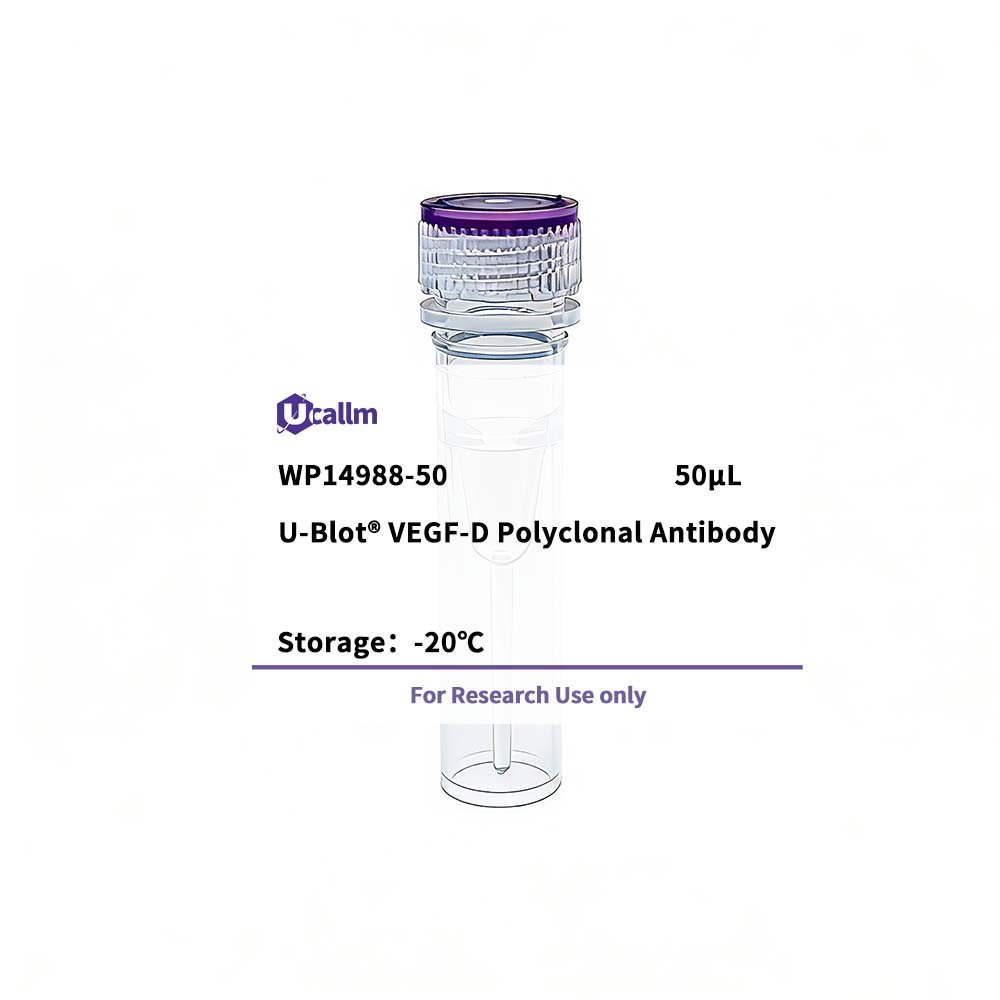
Ucallm_WP14988-50
Price range: $268.00 through $328.00
Product details
Background:
The protein encoded by this gene is a member of the platelet-derived growth factor/vascular endothelial growth factor (PDGF/VEGF) family and is active in angiogenesis, lymphangiogenesis, and endothelial cell growth. This secreted protein undergoes a complex proteolytic maturation, generating multiple processed forms which bind and activate VEGFR-2 and VEGFR-3 receptors. This protein is structurally and functionally similar to vascular endothelial growth factor C. Read-through transcription has been observed between this locus and the upstream PIR (GeneID 8544) locus. [provided by RefSeq, Feb 2011],
Specifications
| Size | 50μL/100μL |
| Target | VEGF-D |
| Reactivity | Human, Mouse, Rat, Monkey |
| Applications | WB, IHC, IF, ELISA |
| MW(Calculated) | |
| MW(Observed) | 35kD |
| Host Species | Rabbit |
| Isotype | IgG |
| Conjugate/Modification | Unmodified |
| Recommended Dilution Ratio | WB 1:500-1:2000; IHC 1:100-1:300; ELISA 1:40000; IF 1:50-200 / Note: For IHC, we suggest antigen retrieval with TE buffer pH 9.0 (Cat#WT1004) |
| Formulation | Liquid in PBS containing 50% glycerol, 0.5% BSA and 0.02% sodium azide. |
| Purification | The antibody was affinity-purified from rabbit antiserum by affinity-chromatography using epitope-specific immunogen. |
| Storage | -15°C to -25°C/1 year(Do not lower than -25°C) |
| Concentration | 1 mg/ml |
| Clonality | Polyclonal |
| Clone Number | |
| Immunogen | The antiserum was produced against synthesized peptide derived from human VEGF-D. AA range:153-202 |
| Specificity | VEGF-D Polyclonal Antibody detects endogenous levels of VEGF-D protein. |
| Gene Name | FIGF |
| Protein Name | Vascular endothelial growth factor D |
| Other Name | FIGF; / VEGFD; / Vascular endothelial growth factor D; / VEGF-D; / c-Fos-induced growth factor; / FIGF |
| Species | Human |
| Gene ID | 2277 |
| Uniprot | O43915, |
| Species.1 | Mouse |
| Gene ID.1 | 14205 |
| Uniprot.1 | P97946, |
| Species.2 | Rat |
| Gene ID.2 | 360457 |
| Uniprot.2 | O35251 |
| Cellular Localization | Secreted. |
| Tissue Expression | Highly expressed in lung, heart, small intestine and fetal lung, and at lower levels in skeletal muscle, colon, and pancreas. |
| Signaling_pathway | Cellular Processes >> Cellular community - eukaryotes >> Focal adhesion;Organismal Systems >> Endocrine system >> Relaxin signaling pathway;Human Diseases >> Cancer: overview >> Pathways in cancer;Environmental Information Processing >> Signal transduction >> MAPK signaling pathway;Environmental Information Processing >> Signal transduction >> Ras signaling pathway;Environmental Information Processing >> Signal transduction >> Rap1 signaling pathway;Environmental Information Processing >> Signal transduction >> TNF signaling pathway;Environmental Information Processing >> Signal transduction >> Calcium signaling pathway;Environmental Information Processing >> Signal transduction >> PI3K-Akt signaling pathway |
| Research Areas | >>MAPK signaling pathway; / >>Ras signaling pathway; / >>Rap1 signaling pathway; / >>Calcium signaling pathway; / >>PI3K-Akt signaling pathway; / >>Focal adhesion; / >>TNF signaling pathway; / >>Relaxin signaling pathway; / >>AGE-RAGE signaling pathway in diabetic complications; / >>Pathways in cancer |
| Function | Function:Growth factor active in angiogenesis, lymphangiogenesis and endothelial cell growth, stimulating their proliferation and migration and also has effects on the permeability of blood vessels. May function in the formation of the venous and lymphatic vascular systems during embryogenesis, and also in the maintenance of differentiated lymphatic endothelium in adults. Binds and activates VEGFR-2 (Flk1) and VEGFR-3 (Flt4) receptors.,PTM:Undergoes a complex proteolytic maturation which generates a variety of processed secreted forms with increased activity toward VEGFR-3 and VEGFR-2. VEGF-D first form an antiparallel homodimer linked by disulfide bonds before secretion. The fully processed VEGF-D is composed mostly of two VEGF homology domains (VHDs) bound by non-covalent interactions.,similarity:Belongs to the PDGF/VEGF growth factor family.,subunit:Homodimer; non-covalent and antiparallel.,tissue specificity:Highly expressed in lung, heart, small intestine and fetal lung, and at lower levels in skeletal muscle, colon, and pancreas., |
Please login to post questions
Related products




