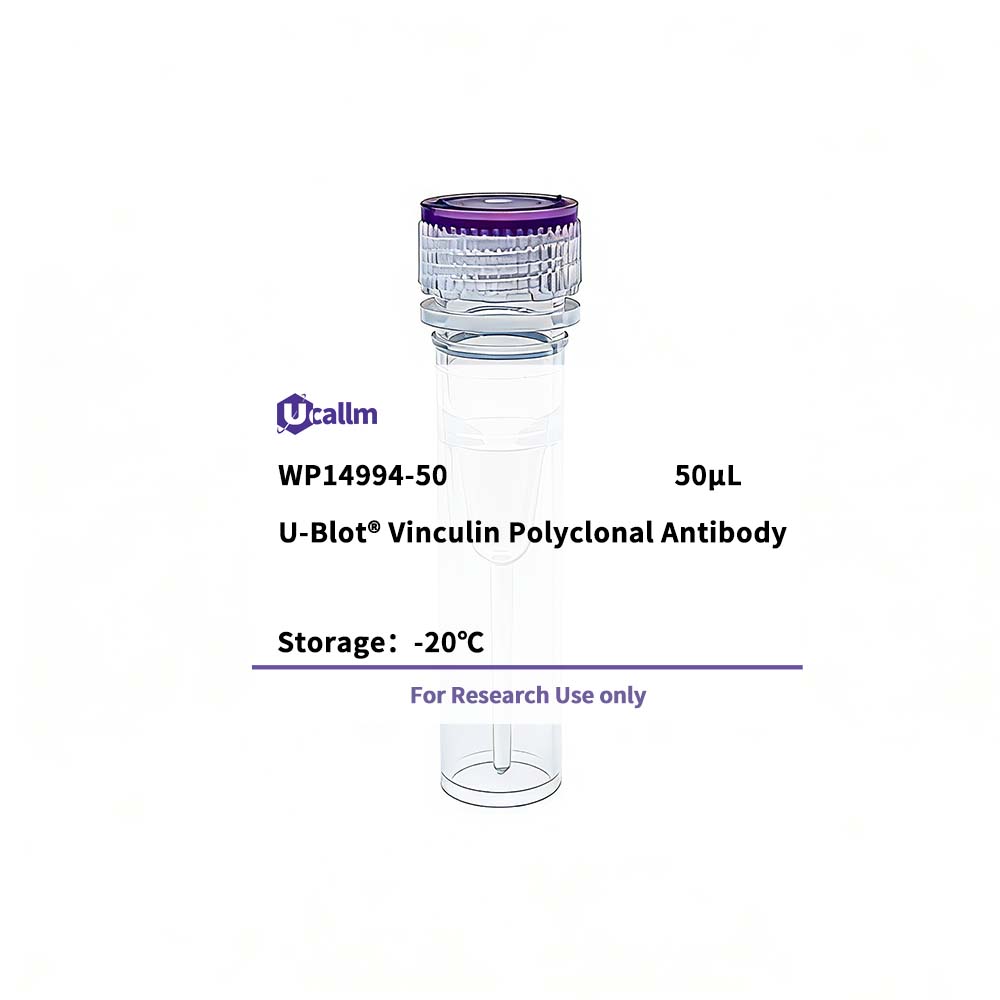
SKU: WP14994 Categories: ,

Vinculin Polyclonal Antibody

Price range: $268.00 through $328.00

SKU: WP14994-100
Enter the quantity you would like, or drag the panel to find the quantity and price that best for you
Bulk QuoteAuthorize OEM & ODM

Product details

Background:

Vinculin is a cytoskeletal protein associated with cell-cell and cell-matrix junctions, where it is thought to function as one of several interacting proteins involved in anchoring F-actin to the membrane. Defects in VCL are the cause of cardiomyopathy dilated type 1W. Dilated cardiomyopathy is a disorder characterized by ventricular dilation and impaired systolic function, resulting in congestive heart failure and arrhythmia. Multiple alternatively spliced transcript variants have been found for this gene, but the biological validity of some variants has not been determined. [provided by RefSeq, Jul 2008],


Specifications

Size50μL/100μL
TargetVinculin
ReactivityHuman, Mouse, Rat
ApplicationsWB, IHC, IF, ELISA
MW(Calculated)
MW(Observed)123kD
Host SpeciesRabbit
IsotypeIgG
Conjugate/ModificationUnmodified
Recommended Dilution RatioWB 1:500-1:2000; IHC: 1:100-300; ELISA 1:20000; IF 1:100-300; Not yet tested in other applications. / Note: For IHC, we suggest antigen retrieval with TE buffer pH 9.0 (Cat#WT1004)
FormulationLiquid in PBS containing 50% glycerol, 0.5% BSA and 0.02% sodium azide.
PurificationThe antibody was affinity-purified from rabbit antiserum by affinity-chromatography using epitope-specific immunogen.
Storage-15°C to -25°C/1 year(Do not lower than -25°C)
Concentration1 mg/ml
ClonalityPolyclonal
Clone Number
ImmunogenThe antiserum was produced against synthesized peptide derived from human Vinculin. AA range:786-835
SpecificityVinculin Polyclonal Antibody detects endogenous levels of Vinculin protein.
Gene NameVCL
Protein NameVinculin
Other NameVCL; / Vinculin; / Metavinculin
SpeciesHuman
Gene ID7414
UniprotP18206,
Species.1Mouse
Gene ID.122330
Uniprot.1Q64727,
Species.2Rat
Gene ID.2305679
Uniprot.2P85972
Cellular LocalizationCell membrane; Peripheral membrane protein; Cytoplasmic side . Cell junction, adherens junction . Cell junction, focal adhesion . Cytoplasm, cytoskeleton . Cell membrane, sarcolemma; Peripheral membrane protein; Cytoplasmic side . Recruitment to cell-cell junctions occurs in a myosin II-dependent manner. Interaction with CTNNB1 is necessary for its localization to the cell-cell junctions. .
Tissue ExpressionMetavinculin is muscle-specific.
Signaling_pathwayCellular Processes >> Cellular community - eukaryotes >> Focal adhesion;Cellular Processes >> Cellular community - eukaryotes >> Adherens junction;Cellular Processes >> Cell motility >> Regulation of actin cytoskeleton;Organismal Systems >> Immune system >> Leukocyte transendothelial migration
Research Areas>>Focal adhesion; / >>Adherens junction; / >>Leukocyte transendothelial migration; / >>Regulation of actin cytoskeleton; / >>Bacterial invasion of epithelial cells; / >>Shigellosis; / >>Amoebiasis
FunctionDisease:Defects in VCL are the cause of cardiomyopathy dilated type 1W (CMD1W) [MIM:611407]. Dilated cardiomyopathy is a disorder characterized by ventricular dilation and impaired systolic function, resulting in congestive heart failure and arrhythmia. Patients are at risk of premature death.,Function:Involved in cell adhesion. May be involved in the attachment of the actin-based microfilaments to the plasma membrane. May also play important roles in cell morphology and locomotion.,online information:Vinculin entry,PTM:Aceylated; mainly by myristic acid but also small amount of palmitic acid.,PTM:Phosphorylated; on serines, threonines and tyrosines. Phosphorylation on Tyr-1133 in activated platelets affects head-tail interactions and cell spreading but has no effect on actin binding nor on localization to focal adhesion plaques.,similarity:Belongs to the vinculin/alpha-catenin family.,subcellular location:Cytoplasmic face of adhesion plaques.,subunit:Exhibits self-association properties. Interacts with NRAP and SORBS1 (By similarity). Interacts with TLN1. Interacts with SYNM.,tissue specificity:Metavinculin is muscle-specific.,
Please login to post questions
Back to Top
Product has been added to your cart
