


VTCN1 rabbit pAb
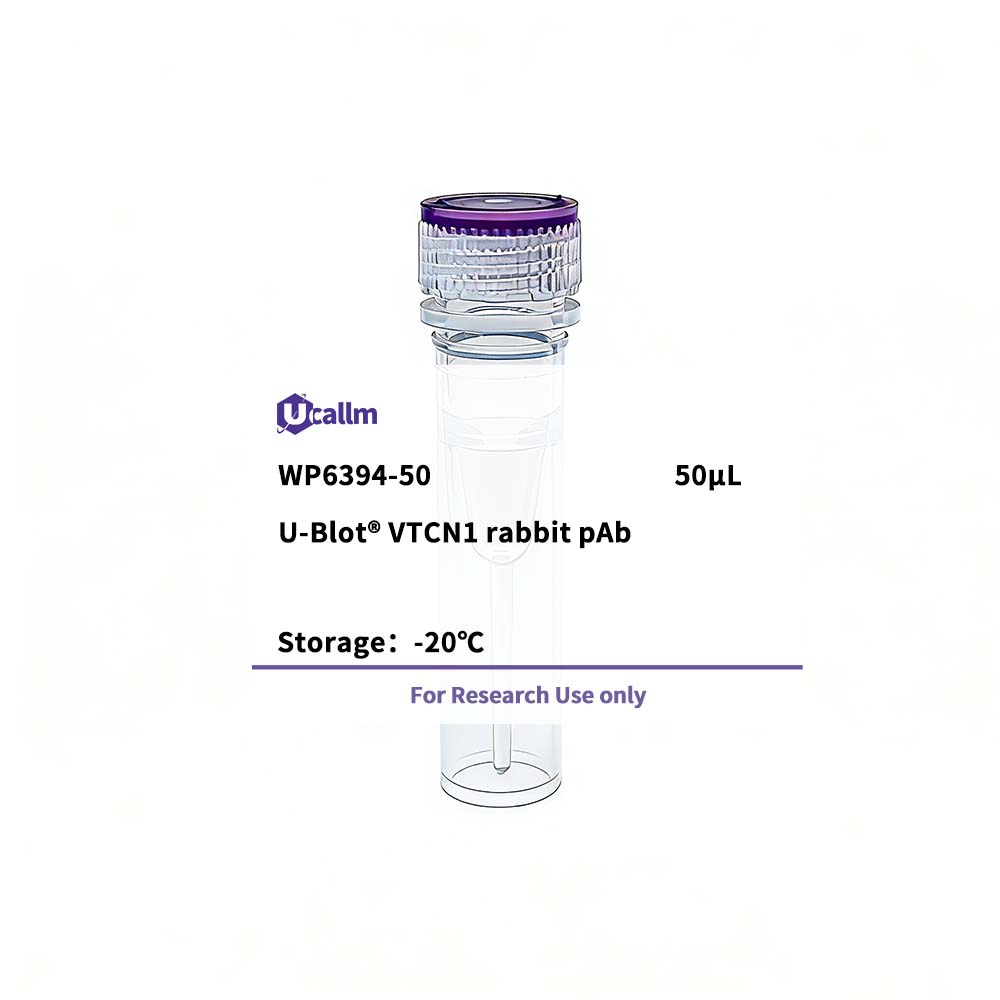
Ucallm_WP6394-50
Price range: $268.00 through $328.00
Product details
Background:
Specifications
| Size | 50μL/100μL |
| Target | VTCN1 |
| Reactivity | Human, Mouse, Rat |
| Applications | WB |
| MW(Calculated) | 31kD |
| MW(Observed) | |
| Host Species | Rabbit |
| Isotype | IgG |
| Conjugate/Modification | Unmodified |
| Recommended Dilution Ratio | WB 1:500-2000 |
| Formulation | Liquid in PBS containing 50% glycerol, 0.5% BSA and 0.02% sodium azide. |
| Purification | The antibody was affinity-purified from rabbit antiserum by affinity-chromatography using epitope-specific immunogen. |
| Storage | -15°C to -25°C/1 year(Do not lower than -25°C) |
| Concentration | 1 mg/ml |
| Clonality | Polyclonal |
| Clone Number | |
| Immunogen | Synthesized peptide derived from human VTCN1 |
| Specificity | This antibody detects endogenous levels of VTCN1 at Human, Mouse,Rat |
| Gene Name | VTCN1 B7H4 UNQ659/PRO1291 |
| Protein Name | V-set domain-containing T-cell activation inhibitor 1 (B7h.5) (Immune costimulatory protein B7-H4) (Protein B7S1) (T-cell costimulatory molecule B7x) |
| Other Name | |
| Species | Human |
| Gene ID | 79679 |
| Uniprot | Q7Z7D3, |
| Species.1 | Mouse |
| Gene ID.1 | 242122 |
| Uniprot.1 | Q7TSP5, |
| Species.2 | Rat |
| Gene ID.2 | 295322 |
| Uniprot.2 | Q501W4 |
| Cellular Localization | Cell membrane; Single-pass type I membrane protein . Expressed at the cell surface. A soluble form has also been detected. . |
| Tissue Expression | Overexpressed in breast, ovarian, endometrial, renal cell (RCC) and non-small-cell lung cancers (NSCLC). Expressed on activated T- and B-cells, monocytes and dendritic cells, but not expressed in most normal tissues (at protein level). Widely expressed, including in kidney, liver, lung, ovary, placenta, spleen and testis. |
| Signaling_pathway | Environmental Information Processing >> Signaling molecules and interaction >> Cell adhesion molecules |
| Research Areas | |
| Function | Negatively regulates T-cell-mediated immune response by inhibiting T-cell activation, proliferation, cytokine production and development of cytotoxicity. When expressed on the cell surface of tumor macrophages, plays an important role, together with regulatory T-cells (Treg), in the suppression of tumor-associated antigen-specific T-cell immunity. Involved in promoting epithelial cell transformation. |
Please login to post questions
Related products



