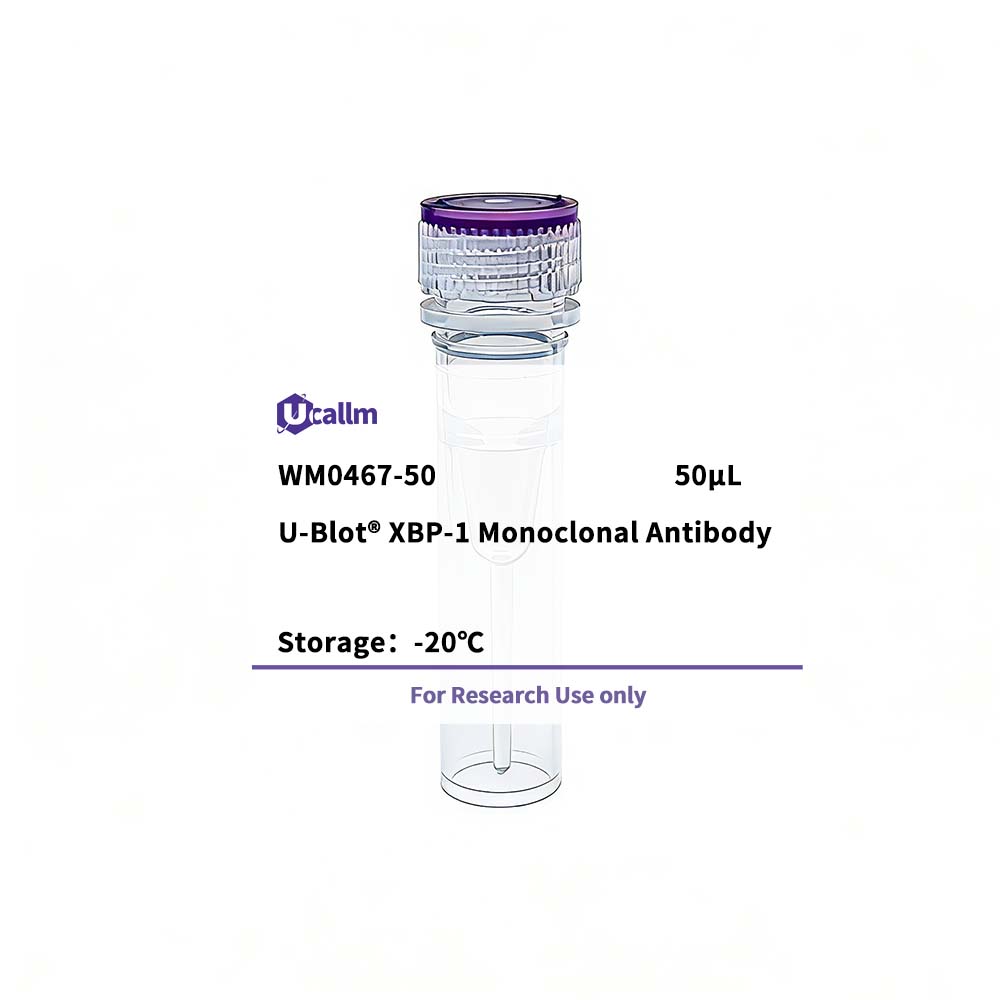
SKU: WM0467 Categories: ,

XBP-1 Monoclonal Antibody

Price range: $268.00 through $328.00

SKU: WM0467-50
Enter the quantity you would like, or drag the panel to find the quantity and price that best for you
Bulk QuoteAuthorize OEM & ODM

Product details

Background:
This gene encodes a transcription factor that regulates MHC class II genes by binding to a promoter element referred to as an X box. This gene product is a bZIP protein, which was also identified as a cellular transcription factor that binds to an enhancer in the promoter of the T cell leukemia virus type 1 promoter. It may increase expression of viral proteins by acting as the DNA binding partner of a viral transactivator. It has been found that upon accumulation of unfolded proteins in the endoplasmic reticulum (ER), the mRNA of this gene is processed to an active form by an unconventional splicing mechanism that is mediated by the endonuclease inositol-requiring enzyme 1 (IRE1). The resulting loss of 26 nt from the spliced mRNA causes a frame-shift and an isoform XBP1(S), which is the functionally active transcription factor. The isoform encoded by the unspliced mRNA, XBP1(U), is constitutively e


Specifications

Size50μL/100μL
TargetXBP1
ReactivityHuman
ApplicationsWB, ELISA
MW(Calculated)29kD
MW(Observed)
Host SpeciesMouse
Isotype
Conjugate/ModificationUnmodified
Recommended Dilution RatioWB 1:500-1:2000; ELISA 1:10000; Not yet tested in other applications.
FormulationLiquid in PBS containing 50% glycerol, 0.5% BSA and 0.02% sodium azide.
PurificationAffinity purification
Storage-15°C to -25°C/1 year(Do not lower than -25°C)
Concentration
ClonalityMonoclonal
Clone Number18E7
ImmunogenPurified recombinant fragment of human XBP-1 expressed in E. Coli.
SpecificityXBP-1 Monoclonal Antibody detects endogenous levels of XBP-1 protein.
Gene NameXBP1
Protein NameX-box-binding protein 1
Other NameXBP1; / TREB5; / XBP2; / X-box-binding protein 1; / XBP-1; / Tax-responsive element-binding protein 5
SpeciesHuman
Gene ID7494
UniprotP17861,
Species.1Mouse
Gene ID.1
Uniprot.1O35426
Species.2
Gene ID.2
Uniprot.2
Cellular LocalizationEndoplasmic reticulum . Colocalizes with ERN1 and KDR in the endoplasmic reticulum in endothelial cells in a vascular endothelial growth factor (VEGF)-dependent manner (PubMed:23529610). .; [Isoform 1]: Nucleus . Cytoplasm . Endoplasmic reticulum membrane; Single-pass type II membrane protein . Endoplasmic reticulum membrane; Peripheral membrane protein . Membrane; Peripheral membrane protein . Shows no preferential localization to either the nucleus or the cytoplasm (By similarity). Shuttles between the nucleus and the cytoplasm in a CRM1-dependent manner (PubMed:16461360). Localizes predominantly at the endoplasmic reticulum membrane as a membrane-spanning protein; whereas may be only marginally localized on the cytosolic side of the ER membrane as a peripheral membrane (PubMed:19394296, PubMed:25190803). .; [Isoform 2]: Nucleus . Cytoplasm . Localizes predominantly in the nucleus. Colocalizes in the nucleus with SIRT1. Translocates into the nucleus in a PIK3R-, ER stress-induced- and/or insulin-dependent manner (By similarity). .; [X-box-binding protein 1, cytoplasmic form]: Cytoplasm . Nucleus . Localizes in the cytoplasm and nucleus after HM13/SPP-mediated intramembranaire proteolytic cleavage of isoform 1 (PubMed:25239945). .
Tissue ExpressionExpressed in plasma cells in rheumatoid synovium (PubMed:11460154). Over-expressed in primary breast cancer and metastatic breast cancer cells (PubMed:25280941). Isoform 1 and isoform 2 are expressed at higher level in proliferating as compared to confluent quiescent endothelial cells (PubMed:19416856).
Signaling_pathwayHuman Diseases >> Neurodegenerative disease >> Alzheimer disease;Human Diseases >> Neurodegenerative disease >> Parkinson disease;Human Diseases >> Neurodegenerative disease >> Amyotrophic lateral sclerosis;Human Diseases >> Neurodegenerative disease >> Spinocerebellar ataxia;Human Diseases >> Neurodegenerative disease >> Pathways of neurodegeneration - multiple diseases
Research Areas>>Protein processing in endoplasmic reticulum; / >>Non-alcoholic fatty liver disease; / >>Alzheimer disease; / >>Parkinson disease; / >>Amyotrophic lateral sclerosis; / >>Spinocerebellar ataxia; / >>Pathways of neurodegeneration - multiple diseases; / >>Lipid and atherosclerosis
FunctionDisease:Genetic variations in XBP1 could be associated with susceptibility to major affective disorder type 7 (MAFD7) [MIM:612371]. Major affective disorders represent a class of mental disorders characterized by a disturbance in mood as their predominant feature.,Function:Transcription factor essential for hepatocyte growth, the differentiation of plasma cells, the immunoglobulin secretion, and the unfolded protein response (UPR). Acts during endoplasmic reticulum stress (ER) by activating unfolded protein response (UPR) target genes via direct binding to the UPR element (UPRE). Binds DNA preferably to the CRE-like element 5'-GATGACGTG[TG]N(3)[AT]T-3', and also to some TPA response elements (TRE). Binds to the HLA DR-alpha promoter. Binds to the Tax-responsive element (TRE) of HTLV-I.,induction:Up-regulated by ATF6 via direct binding to the ERSE in response to endoplasmic reticulum stress.,similarity:Belongs to the bZIP family.,similarity:Contains 1 bZIP domain.,
Please login to post questions
Back to Top
Product has been added to your cart
