SKU: WR4525 Categories: ,

U-Blot® XIAP Rabbit mAb

Price range: $268.00 through $328.00

SKU: WR4525-50
Enter the quantity you would like, or drag the panel to find the quantity and price that best for you
Bulk QuoteAuthorize OEM & ODM

Product details

Background:This gene encodes a protein that belongs to a family of apoptotic suppressor proteins. Members of this family share a conserved motif termed, baculovirus IAP repeat, which is necessary for their anti-apoptotic function. This protein functions through binding to tumor necrosis factor receptor-associated factors TRAF1 and TRAF2 and inhibits apoptosis induced by menadione, a potent inducer of free radicals, and interleukin 1-beta converting enzyme. This protein also inhibits at least two members of the caspase family of cell-death proteases, caspase-3 and caspase-7. Mutations in this gene are the cause of X-linked lymphoproliferative syndrome. Alternate splicing results in multiple transcript variants. Pseudogenes of this gene are found on chromosomes 2 and 11.[provided by RefSeq, Feb 2011],

Specifications

Size50μL/100μL
TargetXIAP
ReactivityHuman, Mouse, Rat
ApplicationsWB, IF, ELISA
MW(Calculated)57kD
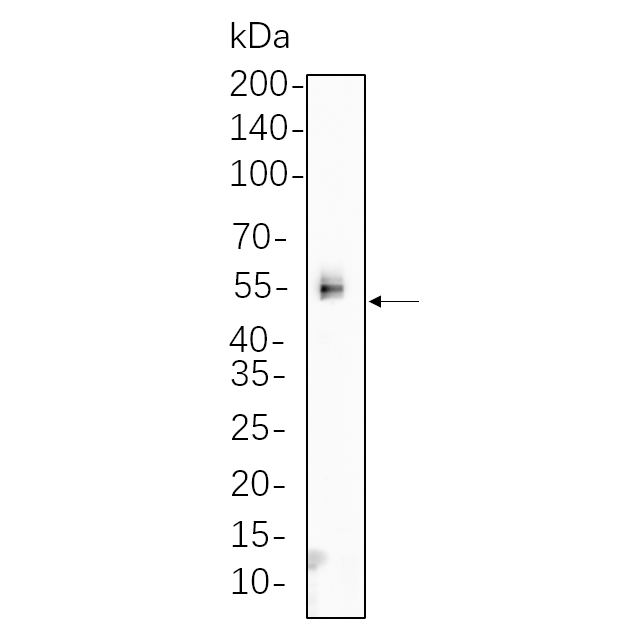
MW(Observed)57kD
Host SpeciesRabbit
IsotypeIgG,Kappa
Conjugate/ModificationUnmodified
Recommended Dilution RatioWB 1:500-1:2000; IF 1:200-1:1000; ELISA 1:5000-1:20000;
FormulationPBS, 50% glycerol, 0.05% Proclin 300, 0.05%BSA
PurificationRecombinant Antibody expressed in animal component-free (ACF) media, purified via Protein A affinity chromatography.
Storage-15°C to -25°C/1 year(Do not lower than -25°C)
Concentration
ClonalityMonoclonal
Clone NumberRM0653R
ImmunogenThe specific immunogen used to produce this antibody is proprietary information.
SpecificityEndogenous
Gene NameXIAP
Protein NameE3 ubiquitin-protein ligase XIAP
Other NameXIAP; / API3; / BIRC4; / IAP3; / E3 ubiquitin-protein ligase XIAP; / Baculoviral IAP repeat-containing protein 4; / IAP-like protein; / ILP; / hILP; / Inhibitor of apoptosis protein 3; / IAP-3; / hIAP-3; / hIAP3; / X-linked inhibitor of apoptosis protein; / X-linked I
SpeciesHuman
Gene ID1111
UniprotP98170,
Species.1Mouse
Gene ID.111798
Uniprot.1Q60989,
Species.2Rat
Gene ID.2140583
Uniprot.2Q91ZN7
Cellular LocalizationCytoplasm,Nucleus
Tissue ExpressionExpressed ubiquitously with the most abundant expression in thymus, testis, small intestine and colon.
Signaling_pathwayCellular Processes >> Cell growth and death >> Cell cycle;Cellular Processes >> Cell growth and death >> p53 signaling pathway;Cellular Processes >> Cell growth and death >> Cellular senescence
Research Areas>>Cell cycle; / >>p53 signaling pathway; / >>Cellular senescence; / >>Human T-cell leukemia virus 1 infection; / >>Human immunodeficiency virus 1 infection; / >>Viral carcinogenesis
FunctionDisease:Defects in XIAP are the cause of lymphoproliferative syndrome X-linked type 2 (XLP2) [MIM:300635]. XLP is a rare immunodeficiency characterized by extreme susceptibility to infection with Epstein-Barr virus (EBV). Symptoms include severe or fatal mononucleosis, acquired hypogammaglobulinemia, pancytopenia and malignant lymphoma.,Domain:The first BIR domain is involved in interaction with MAP3K7IP1 and is important for dimerization. The second BIR domain is sufficient to inhibit caspase-3 and caspase-7, while the third BIR is involved in caspase-9 inhibition. The interactions with SMAC and PRSS25 are mediated by the second and third BIR domains.,Function:Apoptotic suppressor. Has E3 ubiquitin-protein ligase activity. Mediates the proteasomal degradation of target proteins, such as caspase-3, SMAC or AIFM1. Inhibitor of caspase-3, -7 and -9. Mediates activation of MAP3K7/TAK1, leading to the activation of NF-kappa-B.,online information:XIAP mutation db,PTM:Phosphorylation by PKB/AKT protects XIAP against ubiquitination and protects the protein against proteasomal degradation.,PTM:Ubiquitinated and degraded by the proteasome in apoptotic cells.,similarity:Belongs to the IAP family.,similarity:Contains 1 RING-type zinc finger.,similarity:Contains 3 BIR repeats.,subunit:Monomer, and homodimer. Interacts with SMAC and with PRSS25; these interactions inhibit apoptotic suppressor activity. Interacts with MAP3K7IP1 and AIFM1. Interaction with SMAC hinders binding of MAP3K7IP1 and AIFM1. Interacts with TCF25.,tissue specificity:Ubiquitous, except peripheral blood leukocytes.,
Please login to post questions

Back to Top
Product has been added to your cart

