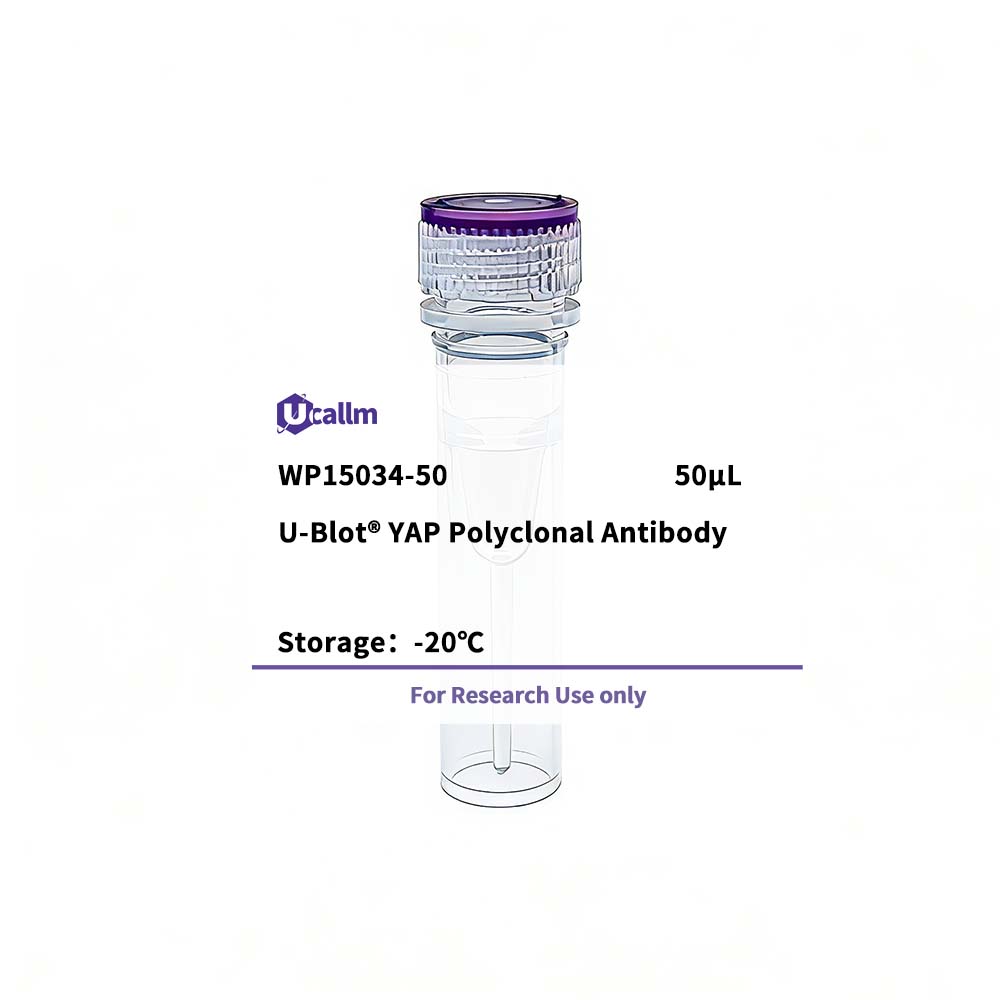
SKU: WP15034 Categories: ,

YAP Polyclonal Antibody

Price range: $268.00 through $328.00

SKU: WP15034-100
Enter the quantity you would like, or drag the panel to find the quantity and price that best for you
Bulk QuoteAuthorize OEM & ODM

Product details

Background:

This gene encodes a downstream nuclear effector of the Hippo signaling pathway which is involved in development, growth, repair, and homeostasis. This gene is known to play a role in the development and progression of multiple cancers as a transcriptional regulator of this signaling pathway and may function as a potential target for cancer treatment. Alternative splicing results in multiple transcript variants encoding different isoforms. [provided by RefSeq, Aug 2013],

Specifications

Size50μL/100μL
TargetYAP
ReactivityHuman, Mouse, Rat
ApplicationsWB, IHC, IF, ELISA
MW(Calculated)
MW(Observed)67kD
Host SpeciesRabbit
IsotypeIgG
Conjugate/ModificationUnmodified
Recommended Dilution RatioWB 1:500-1:2000; IHC 1:100-1:300; IF 1:200-1:1000; ELISA 1:5000; Not yet tested in other applications. / Note: For IHC, we suggest antigen retrieval with TE buffer pH 9.0 (Cat#WT1004)
FormulationLiquid in PBS containing 50% glycerol, 0.5% BSA and 0.02% sodium azide.
PurificationThe antibody was affinity-purified from rabbit antiserum by affinity-chromatography using epitope-specific immunogen.
Storage-15°C to -25°C/1 year(Do not lower than -25°C)
Concentration1 mg/ml
ClonalityPolyclonal
Clone Number
ImmunogenThe antiserum was produced against synthesized peptide derived from human YAP. AA range:281-330
SpecificityYAP Polyclonal Antibody detects endogenous levels of YAP protein.
Gene NameYAP1
Protein NameYorkie homolog
Other NameYAP1; / YAP65; / Yorkie homolog; / 65 kDa Yes-associated protein; / YAP65
SpeciesHuman
Gene ID10413
UniprotP46937,
Species.1Mouse
Gene ID.122601
Uniprot.1P46938,
Species.2Rat
Gene ID.2363014
Uniprot.2Q2EJA0
Cellular LocalizationCytoplasm . Nucleus . Both phosphorylation and cell density can regulate its subcellular localization (PubMed:18158288, PubMed:20048001). Phosphorylation sequesters it in the cytoplasm by inhibiting its translocation into the nucleus (PubMed:18158288, PubMed:20048001). At low density, predominantly nuclear and is translocated to the cytoplasm at high density (PubMed:18158288, PubMed:20048001, PubMed:25849865). PTPN14 induces translocation from the nucleus to the cytoplasm (PubMed:22525271). Localized mainly to the nucleus in the early stages of embryo development with expression becoming evident in the cytoplasm at the blastocyst and epiblast stages (By similarity). .
Tissue ExpressionIncreased expression seen in some liver and prostate cancers. Isoforms lacking the transactivation domain found in striatal neurons of patients with Huntington disease (at protein level).
Signaling_pathwayEnvironmental Information Processing >> Signal transduction >> Hippo signaling pathway;Environmental Information Processing >> Signal transduction >> Hippo signaling pathway - multiple species
Research Areas>>Hippo signaling pathway; / >>Hippo signaling pathway - multiple species
FunctionPTM:Phosphorylated upon DNA damage, probably by ATM or ATR.,similarity:Contains 1 WW domain.,subunit:Binds to the SH3 domain of the YES kinase. Binds to WBP1 and WBP2. Binds, in vitro, through the WW1 domain, to neural isoforms of ENAH that contain the PPSY motif.,
Please login to post questions
Back to Top
Product has been added to your cart
