SKU: WR4527 Categories: ,

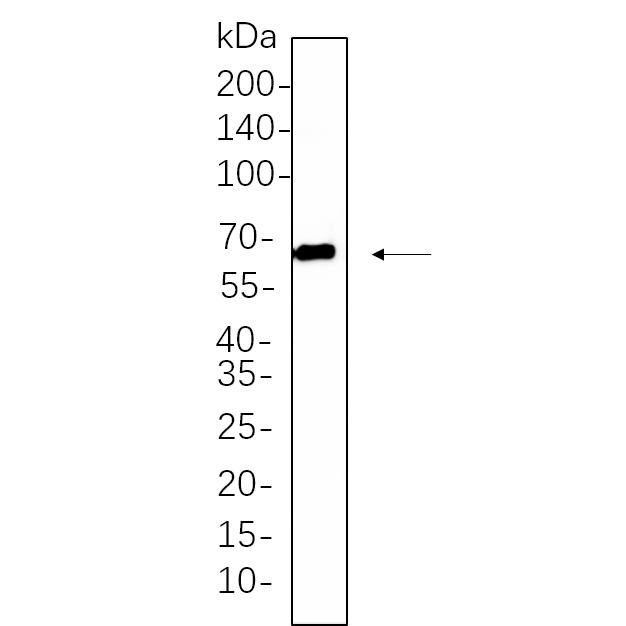
U-Blot® Yes1 Rabbit mAb

Price range: $268.00 through $328.00

SKU: WR4527-50
Enter the quantity you would like, or drag the panel to find the quantity and price that best for you
Bulk QuoteAuthorize OEM & ODM

Product details

Background:This gene is the cellular homolog of the Yamaguchi sarcoma virus oncogene. The encoded protein has tyrosine kinase activity and belongs to the src family of proteins. This gene lies in close proximity to thymidylate synthase gene on chromosome 18, and a corresponding pseudogene has been found on chromosome 22. [provided by RefSeq, Jul 2008],

Specifications

Size50μL/100μL
Targetc-Yes
ReactivityHuman, Rat
ApplicationsWB, IHC, IF, IP, ELISA
MW(Calculated)61kD
MW(Observed)61kD
Host SpeciesRabbit
IsotypeIgG,Kappa
Conjugate/ModificationUnmodified
Recommended Dilution RatioWB 1:2000-1:10000; IF 1:200-1:1000; ELISA 1:5000-1:20000; IP 1:50-1:200;
FormulationPBS, 50% glycerol, 0.05% Proclin 300, 0.05%BSA
PurificationRecombinant Antibody expressed in animal component-free (ACF) media, purified via Protein A affinity chromatography.
Storage-15°C to -25°C/1 year(Do not lower than -25°C)
Concentration
ClonalityMonoclonal
Clone NumberRM0670R
ImmunogenThe specific immunogen used to produce this antibody is proprietary information.
SpecificityEndogenous
Gene NameYES1
Protein NameProto-oncogene tyrosine-protein kinase Yes
Other NameYES1; / YES; / Tyrosine-protein kinase Yes; / Proto-oncogene c-Yes; / p61-Yes
SpeciesHuman
Gene ID7525
UniprotP07947
Species.1
Gene ID.1
Uniprot.1
Species.2
Gene ID.2
Uniprot.2
Cellular LocalizationCell membrane. Cytoplasm, cytoskeleton, microtubule organizing center, centrosome. Cytoplasm, cytosol. Newly synthesized protein initially accumulates in the Golgi region and traffics to the plasma membrane through the exocytic pathway.
Tissue ExpressionExpressed ubiquitously. Platelets, neurons and osteoclasts express 5-fold to 200-fold higher levels than most other tissues.; [Isoform 1]: Expressed in spleen and liver.; [Isoform 2]: Expressed in brain.; [Isoform 3]: Expressed in brain.
Signaling_pathwayCellular Processes >> Cellular community - eukaryotes >> Adherens junction
Research Areas>>EGFR tyrosine kinase inhibitor resistance; / >>Endocrine resistance; / >>ErbB signaling pathway; / >>Rap1 signaling pathway; / >>Chemokine signaling pathway; / >>Mitophagy - animal; / >>Endocytosis; / >>Axon guidance; / >>VEGF signaling pathway; / >>Focal adhesion; / >>Adherens junction; / >>Tight junction; / >>Gap junction; / >>Platelet activation; / >>Neutrophil extracellular trap formation; / >>C-type lectin receptor signaling pathway; / >>GABAergic synapse; / >>Inflammatory mediator regulation of TRP channels; / >>Regulation of actin cytoskeleton; / >>GnRH signaling pathway; / >>Estrogen signaling pathway; / >>Prolactin signaling pathway; / >>Thyroid hormone signaling pathway; / >>Oxytocin signaling pathway; / >>Relaxin signaling pathway; / >>Bacterial invasion of epithelial cells; / >>Epithelial cell signaling in Helicobacter pylori infection; / >>Pathogenic Escherichia coli infection; / >>Shigellosis; / >>Yersinia infection; / >>Tuberculosis; / >>Hepatitis B; / >>Human cytomegalovirus infection; / >>Kaposi sarcoma-associated herpesvirus infection; / >>Herpes simplex virus 1 infection; / >>Viral carcinogenesis; / >>Proteoglycans in cancer; / >>Chemical carcinogenesis - receptor activation; / >>Chemical carcinogenesis - reactive oxygen species; / >>Bladder cancer; / >>Lipid and atherosclerosis; / >>Fluid shear stress and atherosclerosis
FunctionCatalytic activity:ATP + a [protein]-L-tyrosine = ADP + a [protein]-L-tyrosine phosphate.,Function:Promotes infectivity of Neisseria gonorrhoeae in epithelial cells by phosphorylating MCP/CD46.,PTM:Autophosphorylated.,similarity:Belongs to the protein kinase superfamily. Tyr protein kinase family. SRC subfamily.,similarity:Contains 1 protein kinase domain.,similarity:Contains 1 SH2 domain.,similarity:Contains 1 SH3 domain.,subcellular location:In epithelial cells infected with Neisseria gonorrhoeae, forms aggregates beneath bacterial microcolonies.,
Please login to post questions

Back to Top
Product has been added to your cart
