

Product details
Background:
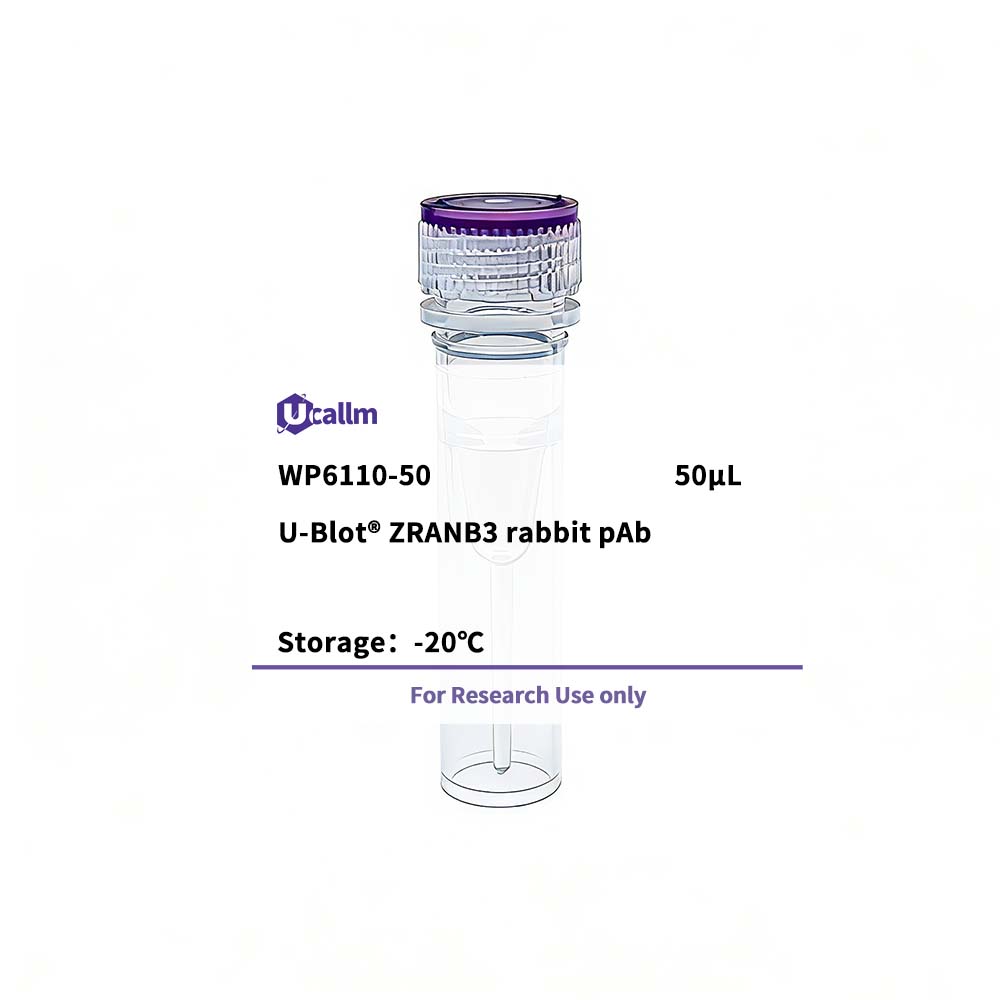
Price range: $268.00 through $328.00
Background:
| Size | 50μL/100μL |
| Target | ZRANB3 |
| Reactivity | Human, Mouse |
| Applications | WB |
| MW(Calculated) | 119kD |
| MW(Observed) | |
| Host Species | Rabbit |
| Isotype | IgG |
| Conjugate/Modification | Unmodified |
| Recommended Dilution Ratio | WB 1:500-2000 |
| Formulation | Liquid in PBS containing 50% glycerol, 0.5% BSA and 0.02% sodium azide. |
| Purification | The antibody was affinity-purified from rabbit antiserum by affinity-chromatography using epitope-specific immunogen. |
| Storage | -15°C to -25°C/1 year(Do not lower than -25°C) |
| Concentration | 1 mg/ml |
| Clonality | Polyclonal |
| Clone Number | |
| Immunogen | Synthesized peptide derived from human ZRANB3 |
| Specificity | This antibody detects endogenous levels of ZRANB3 at Human, Mouse |
| Gene Name | ZRANB3 |
| Protein Name | DNA annealing helicase and endonuclease ZRANB3 (Annealing helicase 2) (AH2) (Zinc finger Ran-binding domain-containing protein 3) [Includes: DNA annealing helicase ZRANB3 (EC 3.6.4.-); Endonuclease ZRANB3 (EC 3.1.-.-)] |
| Other Name | |
| Species | Human |
| Gene ID | 84083 |
| Uniprot | Q5FWF4, |
| Species.1 | Mouse |
| Gene ID.1 | 226409 |
| Uniprot.1 | Q6NZP1 |
| Species.2 | |
| Gene ID.2 | |
| Uniprot.2 | |
| Cellular Localization | Nucleus . Chromosome . Following DNA damage, recruited to sites of DNA damage and stalled replication forks by polyubiquitinated PCNA (PubMed:22704558, PubMed:22705370, PubMed:22759634). . |
| Tissue Expression | |
| Signaling_pathway | |
| Research Areas | |
| Function | DNA annealing helicase and endonuclease required to maintain genome stability at stalled or collapsed replication forks by facilitating fork restart and limiting inappropriate recombination that could occur during template switching events . Recruited to the sites of stalled DNA replication by polyubiquitinated PCNA and acts as a structure-specific endonuclease that cleaves the replication fork D-loop intermediate, generating an accessible 3'-OH group in the template of the leading strand, which is amenable to extension by DNA polymerase . In addition to endonuclease activity, also catalyzes the fork regression via annealing helicase activity in order to prevent disintegration of the replication fork and the formation of double-strand breaks . |


