

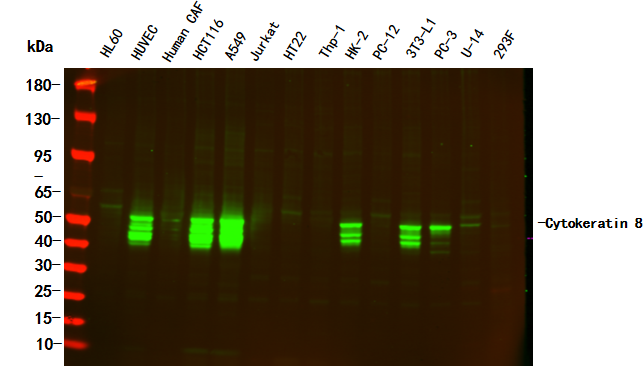
Background:keratin 8(KRT8) Homo sapiens This gene is a member of the type II keratin family clustered on the long arm of chromosome 12. Type I and type II keratins heteropolymerize to form intermediate-sized filaments in the cytoplasm of epithelial cells. The product of this gene typically dimerizes with keratin 18 to form an intermediate filament in simple single-layered epithelial cells. This protein plays a role in maintaining cellular structural integrity and also functions in signal transduction and cellular differentiation. Mutations in this gene cause cryptogenic cirrhosis. Alternatively spliced transcript variants have been found for this gene.
If you’re researching epithelial cell structural integrity, signal transduction, or cryptogenic cirrhosis linked to Cytokeratin 8 (KRT8) mutations, you need an antibody that performs consistently across epithelial cell models. The Cytokeratin 8 Rabbit Monoclonal Antibody (WR4080) is validated across 14 human/mouse/rat cell lines (HL60, HUVEC, HCT116, etc.)—no more inconsistent signal across your epithelial cell panels—with a cost-saving 1:2500 dilution that preserves detection strength.
Critically, it hits the exact 54 kDa band (predicted = observed), so you’re detecting the functional KRT8-KRT18 intermediate filament complex that maintains epithelial cell structure (key to your research focus). Search “Cytokeratin 8 Rabbit Monoclonal Antibody WR4080” or “Cytokeratin 8 antibody for epithelial cell structure & cryptogenic cirrhosis” to access protocols, request samples, and advance your KRT8 studies without antibody troubleshooting.
Leave a Comment
Your email address will not be published. Required fields are marked *