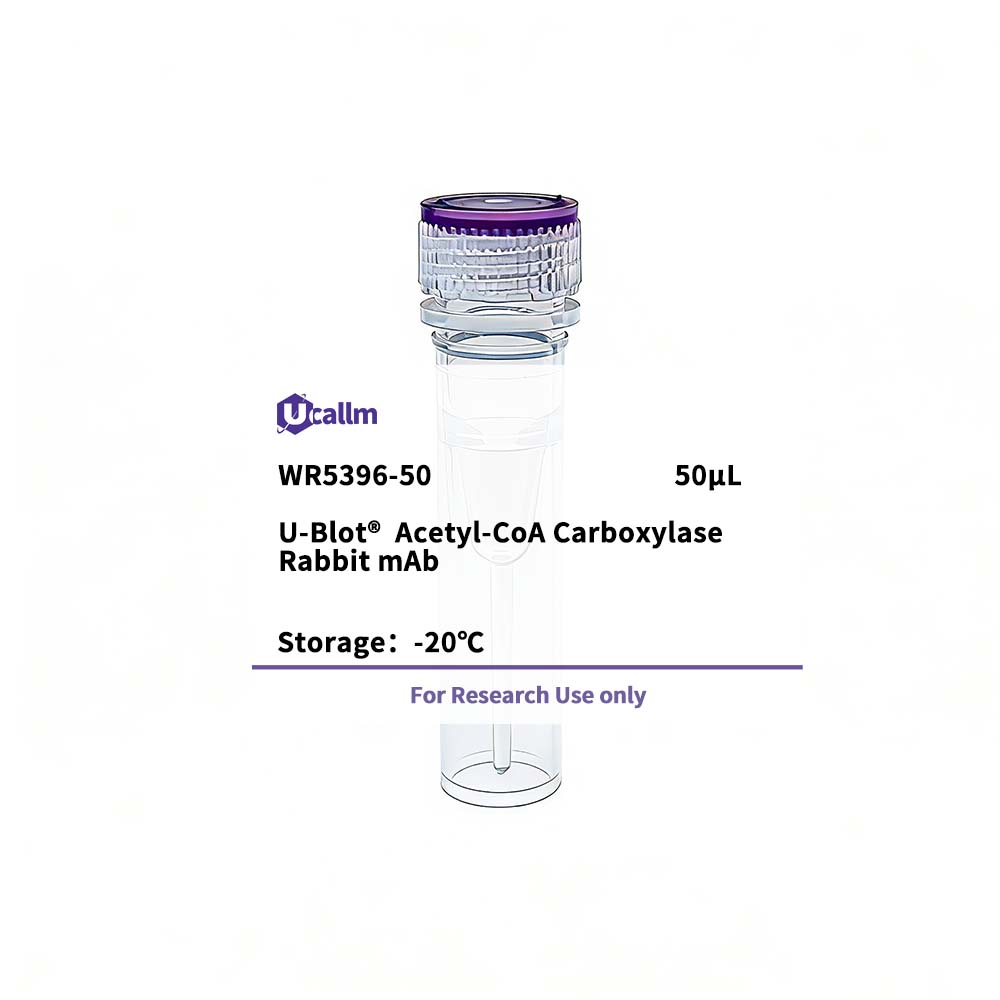
SKU: WR5396 Categories: ,

U-Blot® Acetyl-CoA Carboxylase Rabbit mAb

Price range: $268.00 through $328.00

SKU: WR5396-50
Enter the quantity you would like, or drag the panel to find the quantity and price that best for you
Bulk QuoteAuthorize OEM & ODM

Product details

Background:Acetyl-CoA carboxylase (ACC) is a complex multifunctional enzyme system. ACC is a biotin-containing enzyme which catalyzes the carboxylation of acetyl-CoA to malonyl-CoA, the rate-limiting step in fatty acid synthesis. ACC-beta is thought to control fatty acid oxidation by means of the ability of malonyl-CoA to inhibit carnitine-palmitoyl-CoA transferase I, the rate-limiting step in fatty acid uptake and oxidation by mitochondria. ACC-beta may be involved in the regulation of fatty acid oxidation, rather than fatty acid biosynthesis. There is evidence for the presence of two ACC-beta isoforms. [provided by RefSeq, Jul 2008],

Specifications

Size50μL/100μL
TargetACC
ReactivityHuman, Mouse, Rat
ApplicationsWB, IHC, IF, IP, ELISA
MW(Calculated)277kD
MW(Observed)277kD
Host SpeciesRabbit
IsotypeIgG,Kappa
Conjugate/ModificationUnmodified
Recommended Dilution RatioIHC 1:200-1:1000; WB 1:2000-1:10000; IF 1:200-1:1000; ELISA 1:5000-1:20000; IP 1:50-1:200; / Note: For IHC, we suggest antigen retrieval with TE buffer pH 9.0 (Cat#WT1004)
FormulationPBS, 50% glycerol, 0.05% Proclin 300, 0.05%BSA
PurificationRecombinant Antibody expressed in animal component-free (ACF) media, purified via Protein A affinity chromatography.
Storage-15°C to -25°C/1 year(Do not lower than -25°C)
Concentration
ClonalityMonoclonal
Clone NumberRM1642R
ImmunogenThe specific immunogen used to produce this antibody is proprietary information.
SpecificityEndogenous
Gene NameACACB; ACACA
Protein NameACC,Acetyl-CoA carboxylase 2; ACC-beta; Acetyl-CoA carboxylase 1; ACC1
Other NameACACA; / ACAC; / ACC1; / ACCA; / Acetyl-CoA carboxylase 1; / ACC1; / ACC-alpha; / ACACB,Acetyl CoA carboxylase 2,ACC beta,ACC2,ACCB,AcetylCoA carboxylase 2,ACCbeta,ACCβ,ACC β,
SpeciesHuman
Gene ID31,32
UniprotO00763;Q13085,
Species.1Mouse
Gene ID.1107476
Uniprot.1Q5SWU9,
Species.2Rat
Gene ID.260581
Uniprot.2P11497
Cellular LocalizationMitochondrion
Tissue ExpressionWidely expressed with highest levels in heart, skeletal muscle, liver, adipose tissue, mammary gland, adrenal gland and colon (PubMed:9099716). Isoform 3 is expressed in skeletal muscle, adipose tissue and liver (at protein level) (PubMed:19190759). Isoform 3 is detected at high levels in adipose tissue with lower levels in heart, liver, skeletal muscle and testis (PubMed:19190759).
Signaling_pathway
Research Areas>>Fatty acid biosynthesis; / >>Pyruvate metabolism; / >>Propanoate metabolism; / >>Metabolic pathways; / >>AMPK signaling pathway; / >>Insulin signaling pathway; / >>Adipocytokine signaling pathway; / >>Glucagon signaling pathway; / >>Insulin resistance; / >>Alcoholic liver disease
FunctionCatalytic activity:ATP + acetyl-CoA + HCO(3)(-) = ADP + phosphate + malonyl-CoA.,Catalytic activity:ATP + biotin-carboxyl-carrier protein + CO(2) = ADP + phosphate + carboxybiotin-carboxyl-carrier protein.,cofactor:Binds 2 manganese ions per subunit.,cofactor:Biotin.,enzyme regulation:Activated by citrate. Inhibited by malonyl-CoA.,Function:ACC-beta may be involved in the provision of malonyl-CoA or in the regulation of fatty acid oxidation, rather than fatty acid biosynthesis. Carries out three functions: biotin carboxyl carrier protein, biotin carboxylase and carboxyltransferase.,pathway:Lipid metabolism; malonyl-CoA biosynthesis; malonyl-CoA from acetyl-CoA: step 1/1.,similarity:Contains 1 ATP-grasp domain.,similarity:Contains 1 biotin carboxylation domain.,similarity:Contains 1 biotinyl-binding domain.,similarity:Contains 1 carboxyltransferase domain.,subcellular location:May associate with membranes.,tissue specificity:Predominantly expressed in the heart, skeletal muscles and liver.,
Please login to post questions
Back to Top
Product has been added to your cart


