


Tris-Buffered Saline (TBS) is a crucial component in Western Blot protocols, serving as a washing buffer and diluent for immunoassays. We will guide you through the process of preparing TBS buffer, a fundamental technique in protein analysis.
TBS buffer is isotonic and non-toxic to cells, making it ideal for molecular biology applications. The proper preparation of TBS buffer directly impacts experimental outcomes, and we will cover both basic 1X TBS buffer preparation and concentrated 10X stock solutions.
By understanding the critical chemical components, including Tris base and sodium chloride, you will be able to maintain optimal pH and ionic strength in your experiments.
Key Takeaways
- Understand the importance of TBS buffer in Western Blot protocols.
- Learn how to prepare 1X and 10X TBS buffer solutions.
- Discover the roles of Tris base and sodium chloride in maintaining optimal pH and ionic strength.
- Troubleshoot common issues related to buffer preparation.
- Optimize your Western Blot experiments with reliable TBS buffer.
Understanding TBS Buffer and Its Importance
Tris-buffered saline, or TBS, plays a pivotal role in maintaining the stability of proteins during western blotting. TBS buffer is a versatile solution composed primarily of Tris base and sodium chloride.
What is TBS Buffer?
TBS buffer maintains a stable pH environment, typically between 7.4-7.6, which is crucial for protein stability. The chemical composition of TBS creates an isotonic environment that preserves protein structure and antibody-antigen interactions.
Role in Western Blotting Protocols
In western blot protocols, TBS serves multiple critical functions, including membrane blocking, antibody dilution, and washing steps. These functions help remove unbound reagents, reducing background noise.
Advantages of TBS Over Other Buffers
We often prefer TBS over phosphate-buffered saline (PBS) in western blotting, particularly when working with phospho-specific antibodies. The addition of detergents like Tween-20 to create TBST enhances the buffer’s effectiveness in reducing non-specific binding.
Materials and Reagents Needed for TBS Buffer Preparation
TBS buffer preparation involves several key components and laboratory equipment. To start, you will need to gather the necessary chemical reagents of analytical grade.
Essential Chemicals
The primary buffering component is Tris base (tris(hydroxymethyl)aminomethane), which maintains pH stability. For 1X TBS, you need 12.1 g of Tris.
Tris Base
Tris base is crucial for its buffering capabilities, ensuring the pH remains stable during experiments.
Sodium Chloride
Sodium chloride is essential for maintaining proper ionic strength, affecting protein solubility and interactions. You need 8 g of Sodium Chloride (NaCl) for 1X TBS.
Optional: Potassium Chloride
While optional, potassium chloride can be added to mimic physiological conditions, beneficial for certain sensitive protein applications.
Laboratory Equipment Required
You will need an analytical balance for precise weighing, a pH meter for accurate pH adjustment, graduated cylinders for volume measurements, and appropriate storage containers.
Safety Considerations
When handling these chemicals, wear personal protective equipment (gloves, lab coat, safety glasses) and work in a well-ventilated area, especially when using concentrated HCl for pH adjustments.
How to Make TBS Buffer: Step-by-Step Instructions
Accurate preparation of TBS buffer is essential for successful western blotting. We will guide you through the process, ensuring you understand each step.
Preparing 1X TBS Buffer
To prepare 1X TBS buffer directly, you need to weigh 12.1g of Tris base and 8g of sodium chloride. Dissolve these components in approximately 800mL of distilled water.
Weighing and Measuring Components
Ensure accurate measurements to avoid any discrepancies in your buffer.
Dissolving and pH Adjustment
Adjust the pH of the solution to 7.4-7.6 using HCl. Note that Tris buffering capacity is temperature-dependent.
Making 10X TBS Stock Solution
For laboratories performing frequent western blotting experiments, a 10X TBS stock solution is more efficient. To prepare 1L of 10X TBS, dissolve 24g Tris and 88g NaCl in 900mL of distilled water.
Concentration Calculations
To dilute the 10X stock to 1X, use the formula: required volume = (desired concentration / stock concentration) * final volume.
Storage Guidelines
Store the 10X TBS stock solution in a suitable container at room temperature or 4°C. The shelf-life is typically several months.
Preparing TBST (TBS with Tween20)
To prepare TBST, add 0.05-0.1% Tween20 to TBS. This step is crucial for reducing background in western blotting.
By following these steps, you can ensure the accurate preparation of TBS buffer and TBST, critical components in western blotting protocols.
Applications of TBS Buffer in Western Blotting
TBS buffer is utilized in several key steps of Western blotting, including membrane blocking, antibody dilution, washing steps, and protein detection.
Membrane Blocking
Membrane blocking is a critical step where TBS buffer, typically supplemented with 5% milk or BSA, prevents non-specific antibody binding to the membrane surface. For instance, a blocking buffer can be prepared by mixing 7.5 g of nonfat dry milk with 150 ml of 1X TBST.
Antibody Dilution
Antibody dilution buffers based on TBS or TBST are essential for maintaining antibody stability and specificity. You can dilute primary and secondary antibodies using 1X TBST.
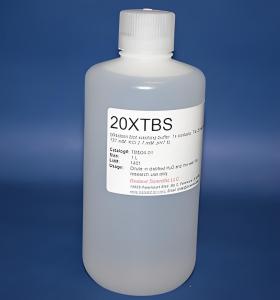
tbs buffer
Washing Steps
Washing steps using TBST are crucial for removing unbound antibodies and reducing background noise. Optimal washing protocols involve using 1X TBST at room temperature.
Protein Detection
The composition of TBS-based buffers can significantly affect protein detection sensitivity. TBS buffer interacts favorably with various detection methods, including chemiluminescence and fluorescence.
| Step | Buffer Used | Temperature |
|---|---|---|
| Membrane Blocking | 1X TBST with 5% nonfat dry milk | Room Temperature |
| Antibody Dilution | 1X TBST | 4°C |
| Washing Steps | 1X TBST | Room Temperature |
By understanding the applications of TBS buffer in Western blotting, you can optimize your experimental protocols to achieve better results.
Conclusion: Best Practices for TBS Buffer Preparation
In conclusion, preparing TBS buffer accurately is crucial for successful Western blotting experiments. You must maintain consistent buffer composition across experiments to ensure reproducible results. We emphasize the importance of proper quality control, storage, and avoiding common pitfalls like incorrect pH adjustment or contamination. By following these best practices and adapting TBS formulations for specialized applications, you can optimize your Western blotting outcomes. Proper TBS preparation impacts antibody binding, washing efficiency, and signal development, ultimately affecting your experimental results.
References and further readings:
1.KSun, Y., Ip, P., & Chakrabartty, A. (2017). Simple Elimination of Background Fluorescence in Formalin-Fixed Human Brain Tissue for Immunofluorescence Microscopy. Journal of Visualized Experiments, 127.
https://pmc.ncbi.nlm.nih.gov/articles/PMC5614400/2.Bandopadhyay, R. (2016). Sequential Extraction of Soluble and Insoluble Alpha-Synuclein from Parkinsonian Brains. Journal of Visualized Experiments, 107.
https://pmc.ncbi.nlm.nih.gov/articles/PMC4781043/3.Toth, M., & Fridman, R. (2001). Assessment of Gelatinases (MMP-2 and MMP-9) by Gelatin Zymography. Metastasis Research Protocols: Volume I.
https://link.springer.com/protocol/10.1385/1-59259-136-1:163
FAQ
What is the ideal concentration of Tris in TBS buffer?
The typical concentration of Tris in TBS buffer is 20-50 mM. We recommend using 25 mM Tris for most Western blotting applications.
Can I use TBS buffer for other laboratory applications besides Western blotting?
Yes, you can use TBS buffer for other applications, such as immunoprecipitation and ELISA. However, you should optimize the buffer composition according to your specific needs.
How do I store TBS buffer after preparation?
You should store TBS buffer at 4°C to prevent degradation and contamination. We recommend preparing fresh 1X TBS buffer weekly and storing 10X stock solution at room temperature.
What is the role of Tween20 in TBST?
Tween20 is a non-ionic detergent that reduces non-specific binding of antibodies to the membrane, improving the signal-to-noise ratio in Western blotting.
Can I substitute Tween20 with other detergents in TBST?
While Tween20 is commonly used, you can substitute it with other non-ionic detergents like NP-40 or Triton X-100. However, the optimal concentration may vary.
What are the advantages of using TBS over PBS in Western blotting?
TBS is generally preferred over PBS because it provides a more stable environment for antibody-antigen interactions, resulting in better signal detection.
Leo Bios
Hello, I’m Leo Bios. As an assistant lecturer, I teach cellular and
molecular biology to undergraduates at a regional US Midwest university. I started as a research tech in
a biotech startup over a decade ago, working on molecular diagnostic tools. This practical experience
fuels my teaching and writing, keeping me engaged in biology’s evolution.

Leave a Comment
Your email address will not be published. Required fields are marked *