SKU: WR4114 Categories: ,

U-Blot® FOXO1A Rabbit mAb

Price range: $268.00 through $328.00

SKU: WR4114-50
Enter the quantity you would like, or drag the panel to find the quantity and price that best for you
Bulk QuoteAuthorize OEM & ODM

Product details

Background:This gene belongs to the forkhead family of transcription factors which are characterized by a distinct forkhead domain. The specific function of this gene has not yet been determined; however, it may play a role in myogenic growth and differentiation. Translocation of this gene with PAX3 has been associated with alveolar rhabdomyosarcoma. [provided by RefSeq, Jul 2008],

Specifications

Size50μL/100μL
TargetFoxO1
ReactivityHuman, Mouse, Rat
ApplicationsWB, IHC, IF, ELISA
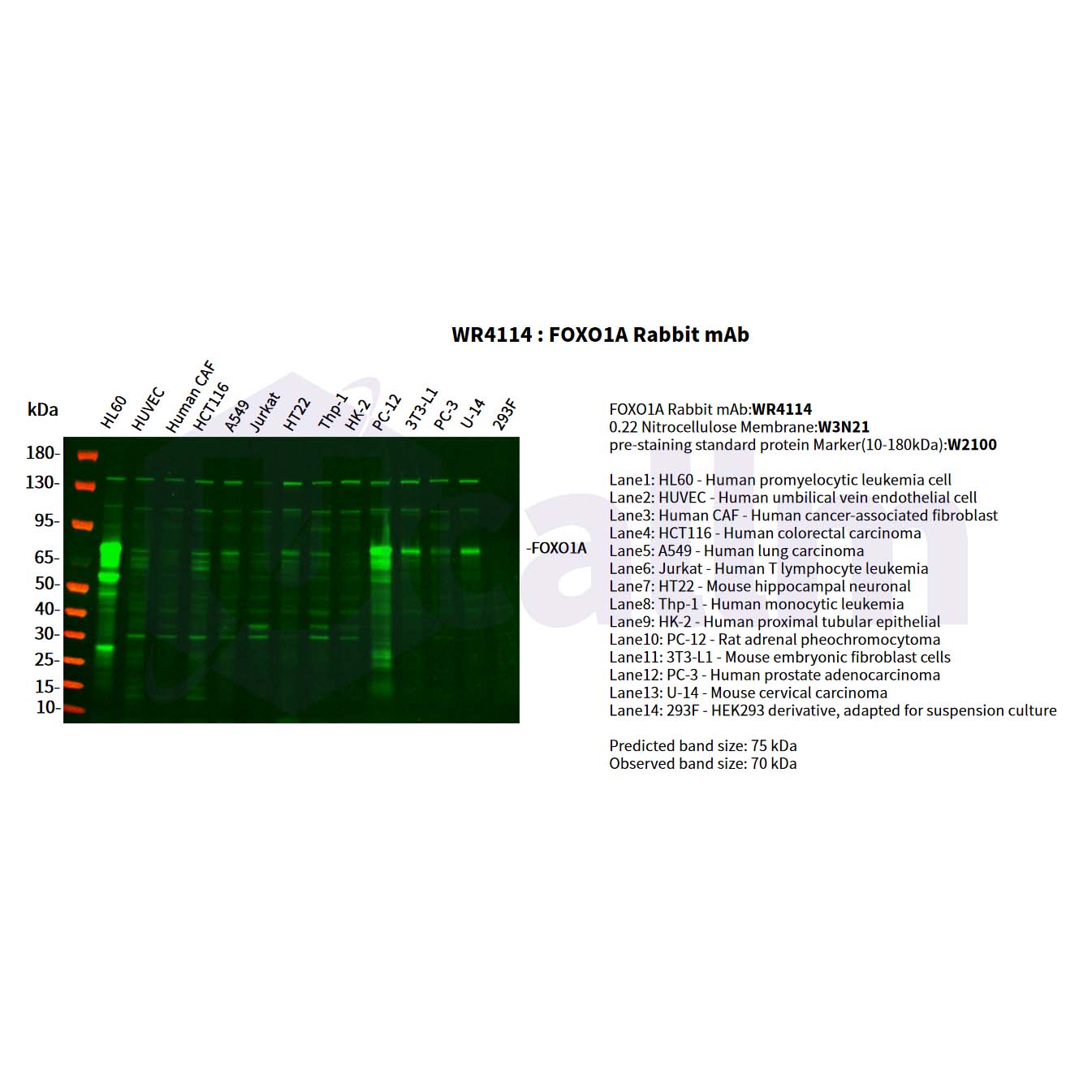
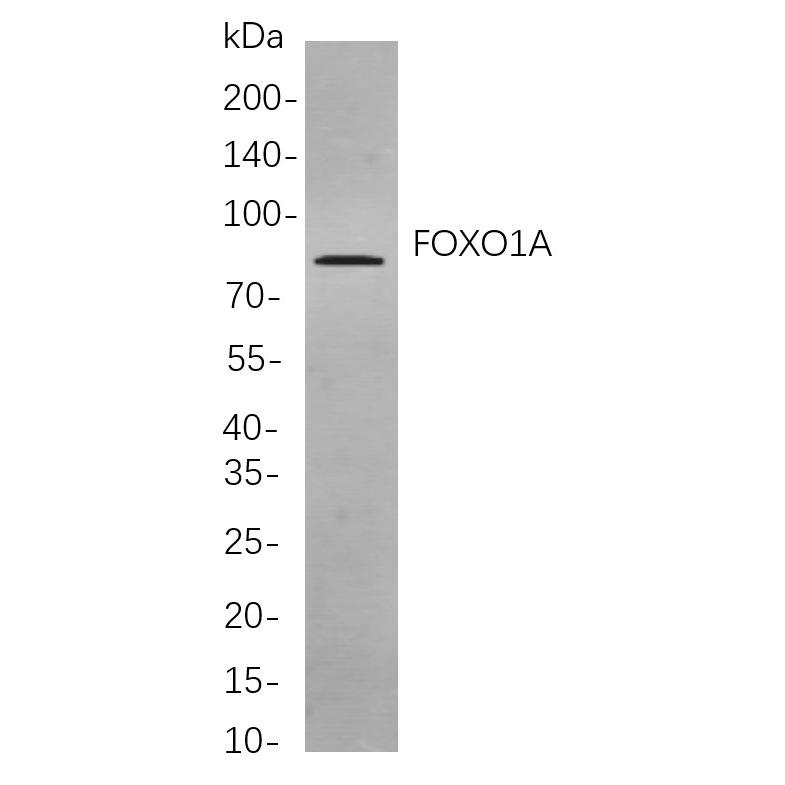
MW(Calculated)70kD
MW(Observed)75kD
Host SpeciesRabbit
IsotypeIgG,Kappa
Conjugate/ModificationUnmodified
Recommended Dilution RatioIHC 1:400-1000; WB 1:1000-5000; IF 1:200-1000; ELISA 1:5000-20000; / Note: For IHC, we suggest antigen retrieval with TE buffer pH 9.0 (Cat#WT1004)
FormulationPBS, 50% glycerol, 0.05% Proclin 300, 0.05%BSA
PurificationRecombinant Antibody expressed in animal component-free (ACF) media, purified via Protein A affinity chromatography.
Storage-15°C to -25°C/1 year(Do not lower than -25°C)
Concentration
ClonalityMonoclonal
Clone NumberRM0213R
ImmunogenThe specific immunogen used to produce this antibody is proprietary information.
SpecificityEndogenous
Gene NameFOXO1
Protein NameForkhead box protein O1
Other NameFOXO1; / FKHR; / FOXO1A; / Forkhead box protein O1; / Forkhead box protein O1A; / Forkhead in rhabdomyosarcoma
SpeciesHuman
Gene ID2308
UniprotQ12778,
Species.1Mouse
Gene ID.156458
Uniprot.1Q9R1E0,
Species.2Rat
Gene ID.284482
Uniprot.2G3V7R4
Cellular LocalizationNucleus
Tissue ExpressionUbiquitous.
Signaling_pathwayCellular Processes >> Cell growth and death >> Cellular senescence;Organismal Systems >> Endocrine system >> Insulin signaling pathway;Organismal Systems >> Endocrine system >> Glucagon signaling pathway;Organismal Systems >> Endocrine system >> Thyroid hormone signaling pathway;Organismal Systems >> Aging >> Longevity regulating pathway;Organismal Systems >> Aging >> Longevity regulating pathway - multiple species;Human Diseases >> Cancer: overview >> Pathways in cancer;Human Diseases >> Cancer: overview >> Transcriptional misregulation in cancer;Human Diseases >> Cancer: specific types >> Prostate cancer;Environmental Information Processing >> Signal transduction >> FoxO signaling pathway;Environmental Information Processing >> Signal transduction >> AMPK signaling pathway
Research Areas>>FoxO signaling pathway; / >>AMPK signaling pathway; / >>Longevity regulating pathway; / >>Longevity regulating pathway - multiple species; / >>Cellular senescence; / >>Insulin signaling pathway; / >>Thyroid hormone signaling pathway; / >>Glucagon signaling pathway; / >>Insulin resistance; / >>AGE-RAGE signaling pathway in diabetic complications; / >>Alcoholic liver disease; / >>Shigellosis; / >>Human papillomavirus infection; / >>Pathways in cancer; / >>Transcriptional misregulation in cancer; / >>Prostate cancer
FunctionDisease:Chromosomal aberrations involving FOXO1 are a cause of rhabdomyosarcoma 2 (RMS2) [MIM:268220]; also known as alveolar rhabdomyosarcoma. Translocation (2; 13)(q35; q14) with PAX3; translocation t(1; 13)(p36; q14) with PAX7. The resulting protein is a transcriptional activator.,Function:Transcription factor.,PTM:Phosphorylated by AKT1; insulin-induced (By similarity). IGF1 rapidly induces phosphorylation of Ser-256, Thr-24, and Ser-319. Phosphorylation of Ser-256 decreases DNA-binding activity and promotes the phosphorylation of Thr-24, and Ser-319, permitting phosphorylation of Ser-322 and Ser-325, probably by CK1, leading to nuclear exclusion and loss of function. Phosphorylation of Ser-329 is independent of IGF1 and leads to reduced function. Phosphorylated upon DNA damage, probably by ATM or ATR.,similarity:Contains 1 fork-head DNA-binding domain.,subcellular location:Shuttles between cytoplasm and nucleus.,subunit:Interacts with LRPPRC.,tissue specificity:Ubiquitous.,
Please login to post questions

Back to Top
Product has been added to your cart
