SKU: WR4432 Categories: ,

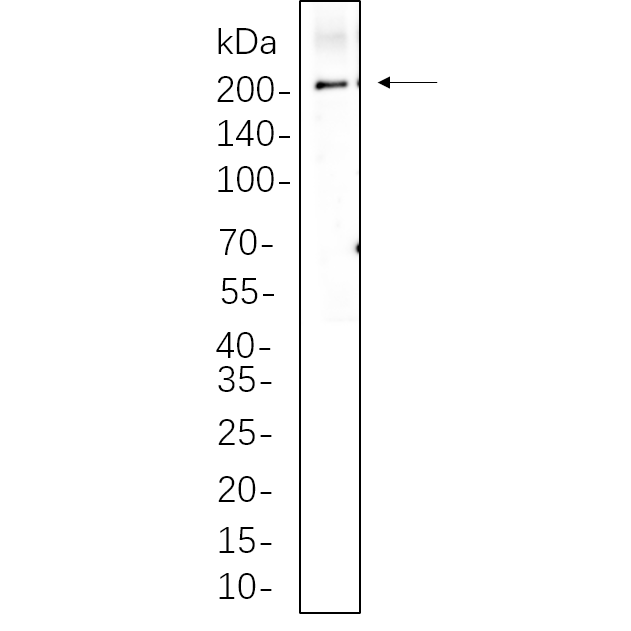
U-Blot® SPTBN1 Rabbit mAb

Price range: $268.00 through $328.00

SKU: WR4432-50
Enter the quantity you would like, or drag the panel to find the quantity and price that best for you
Bulk QuoteAuthorize OEM & ODM

Product details

Background:Spectrin is an actin crosslinking and molecular scaffold protein that links the plasma membrane to the actin cytoskeleton, and functions in the determination of cell shape, arrangement of transmembrane proteins, and organization of organelles. It is composed of two antiparallel dimers of alpha- and beta- subunits. This gene is one member of a family of beta-spectrin genes. The encoded protein contains an N-terminal actin-binding domain, and 17 spectrin repeats which are involved in dimer formation. Multiple transcript variants encoding different isoforms have been found for this gene. [provided by RefSeq, Jul 2008],

Specifications

Size50μL/100μL
TargetSPTBN1
ReactivityHuman, Mouse, Rat
ApplicationsWB, IHC, IF, ELISA
MW(Calculated)275kD
MW(Observed)275kD
Host SpeciesRabbit
IsotypeIgG,Kappa
Conjugate/ModificationUnmodified
Recommended Dilution RatioIHC 1:200-1:1000; WB 1:2000-1:10000; IF 1:200-1:1000; ELISA 1:5000-1:20000; / Note: For IHC, we suggest antigen retrieval with TE buffer pH 9.0 (Cat#WT1004)
FormulationPBS, 50% glycerol, 0.05% Proclin 300, 0.05%BSA
PurificationRecombinant Antibody expressed in animal component-free (ACF) media, purified via Protein A affinity chromatography.
Storage-15°C to -25°C/1 year(Do not lower than -25°C)
Concentration
ClonalityMonoclonal
Clone NumberRM0426R
ImmunogenThe specific immunogen used to produce this antibody is proprietary information.
SpecificityEndogenous
Gene NameSPTBN1
Protein NameSpectrin beta chain non-erythrocytic 1
Other NameSPTBN1; / SPTB2; / Spectrin beta chain; / non-erythrocytic 1; / Beta-II spectrin; / Fodrin beta chain; / Spectrin, non-erythroid beta chain 1
SpeciesHuman
Gene ID4040
UniprotQ01082,
Species.1Mouse
Gene ID.120742
Uniprot.1Q62261
Species.2
Gene ID.2
Uniprot.2
Cellular LocalizationCytoplasm, Membrane
Tissue ExpressionWidely coexpressed with LRP5 during embryogenesis and in adult tissues.
Signaling_pathwayHuman Diseases >> Cancer: overview >> Pathways in cancer;Human Diseases >> Cancer: specific types >> Hepatocellular carcinoma;Human Diseases >> Cancer: specific types >> Gastric cancer;Human Diseases >> Cancer: specific types >> Breast cancer;Human Diseases >> Neurodegenerative disease >> Alzheimer disease;Human Diseases >> Neurodegenerative disease >> Pathways of neurodegeneration - multiple diseases;Environmental Information Processing >> Signal transduction >> Wnt signaling pathway;Environmental Information Processing >> Signal transduction >> mTOR signaling pathway
Research Areas>>mTOR signaling pathway; / >>Wnt signaling pathway; / >>Parathyroid hormone synthesis, secretion and action; / >>Alzheimer disease; / >>Pathways of neurodegeneration - multiple diseases; / >>Pathways in cancer; / >>Breast cancer; / >>Hepatocellular carcinoma; / >>Gastric cancer
FunctionFunction:Fodrin, which seems to be involved in secretion, interacts with calmodulin in a calcium-dependent manner and is thus candidate for the calcium-dependent movement of the cytoskeleton at the membrane.,PTM:Isoform 2 is phosphorylated on Ser-8 and Ser-10.,similarity:Belongs to the spectrin family.,similarity:Contains 1 PH domain.,similarity:Contains 17 spectrin repeats.,similarity:Contains 2 CH (calponin-homology) domains.,subcellular location:Colocalizes with ANK2 in a distinct intracellular compartment of neonatal cardiomyocytes.,subunit:Like erythrocyte spectrin, the spectrin-like proteins are capable to form dimers which can further associate to tetramers. The short form cannot bind to the axonal protein fodaxin. Interacts with ANK2.,tissue specificity:Isoform 2 is present in brain, lung and kidney (at protein level).,
Please login to post questions

Back to Top
Product has been added to your cart
