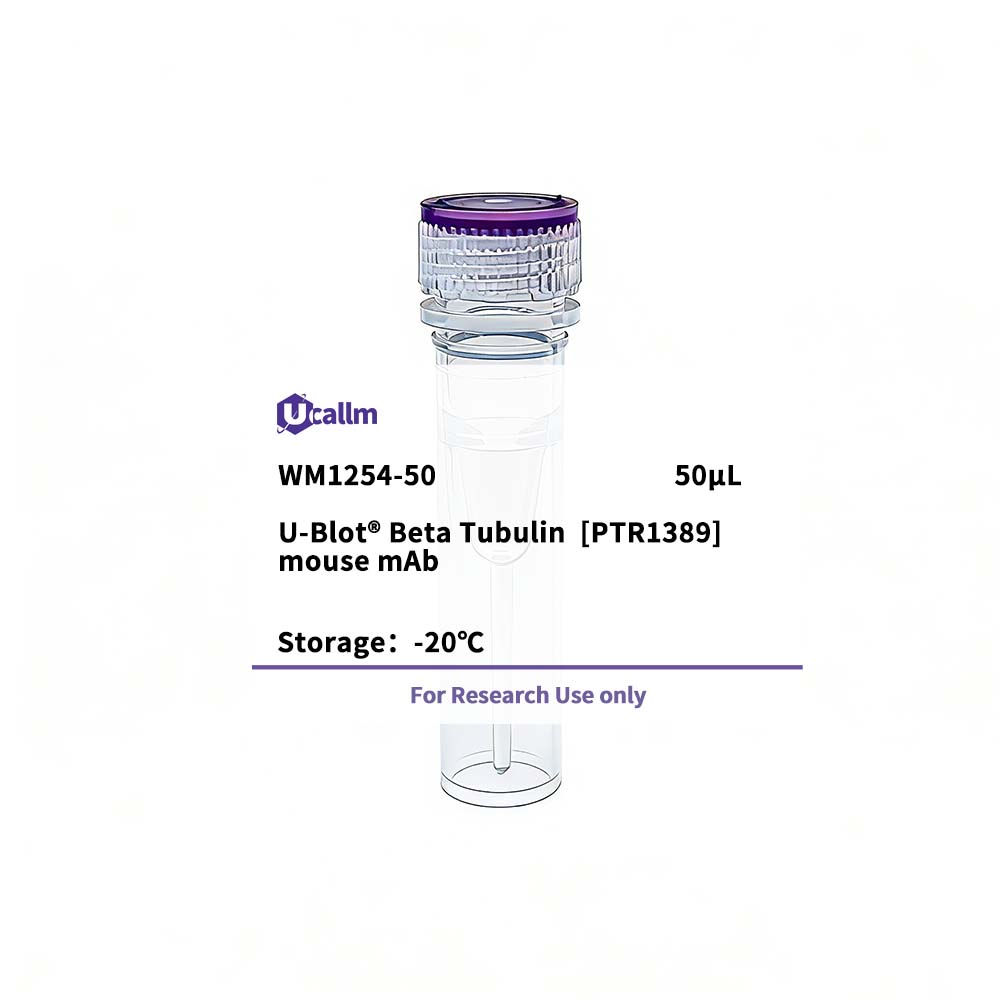
SKU: WM1254 Categories: ,

Beta Tubulin [PTR1389] mouse mAb

Price range: $268.00 through $328.00

SKU: WM1254-50
Enter the quantity you would like, or drag the panel to find the quantity and price that best for you
Bulk QuoteAuthorize OEM & ODM

Product details

Background:
This gene encodes a beta tubulin protein. This protein forms a dimer with alpha tubulin and acts as a structural component of microtubules. Mutations in this gene cause cortical dysplasia, complex, with other brain malformations 6. Alternative splicing results in multiple splice variants. There are multiple pseudogenes for this gene on chromosomes 1, 6, 7, 8, 9, and 13. [provided by RefSeq, Jun 2014],

Specifications

Size50μL/100μL
TargetTubulin β
ReactivityHuman, Mouse, Rat, Pig
ApplicationsWB, IF, ELISA
MW(Calculated)50kD
MW(Observed)50kD
Host SpeciesMouse
IsotypeIgG1,kappa
Conjugate/ModificationUnmodified
Recommended Dilution RatioWB 1:500-2000; IF 1:100-500; ELISA 1:1000-5000;
FormulationPBS, 50% glycerol, 0.05% Proclin 300, 0.05%BSA
PurificationThe antibody was affinity-purified from ascites by affinity-chromatography using specific immunogen.
Storage-15°C to -25°C/1 year(Do not lower than -25°C)
Concentration
ClonalityMonoclonal
Clone NumberRMMR1389
ImmunogenAA range: 400-500
SpecificityThis antibody detects endogenous levels of Beta Tubulin protein.
Gene NameTUBB
Protein NameTubulin beta chain (Tubulin beta-5 chain)
Other NameTubulin beta chain (Tubulin beta-5 chain)
SpeciesHuman
Gene ID203068
UniprotP07437,
Species.1Mouse
Gene ID.1
Uniprot.1P99024,
Species.2Rat
Gene ID.2
Uniprot.2P69897
Cellular LocalizationCytoplasm
Tissue ExpressionUbiquitously expressed with highest levels in spleen, thymus and immature brain.
Signaling_pathwayCellular Processes >> Transport and catabolism >> Phagosome;Cellular Processes >> Cellular community - eukaryotes >> Gap junction;Human Diseases >> Neurodegenerative disease >> Alzheimer disease;Human Diseases >> Neurodegenerative disease >> Parkinson disease;Human Diseases >> Neurodegenerative disease >> Amyotrophic lateral sclerosis;Human Diseases >> Neurodegenerative disease >> Huntington disease;Human Diseases >> Neurodegenerative disease >> Prion disease;Human Diseases >> Neurodegenerative disease >> Pathways of neurodegeneration - multiple diseases
Research Areas>>Phagosome; / >>Gap junction; / >>Alzheimer disease; / >>Parkinson disease; / >>Amyotrophic lateral sclerosis; / >>Huntington disease; / >>Prion disease; / >>Pathways of neurodegeneration - multiple diseases; / >>Pathogenic Escherichia coli infection; / >>Salmonella infection
FunctionDomain:The highly acidic C-terminal region may bind cations such as calcium.,Function:Tubulin is the major constituent of microtubules. It binds two moles of GTP, one at an exchangeable site on the beta chain and one at a non-exchangeable site on the alpha-chain.,online information:Tubulin entry,similarity:Belongs to the tubulin family.,subunit:Dimer of alpha and beta chains.,tissue specificity:Ubiquitously expressed with highest levels in spleen, thymus and immature brain.,
Please login to post questions
Back to Top
Product has been added to your cart
