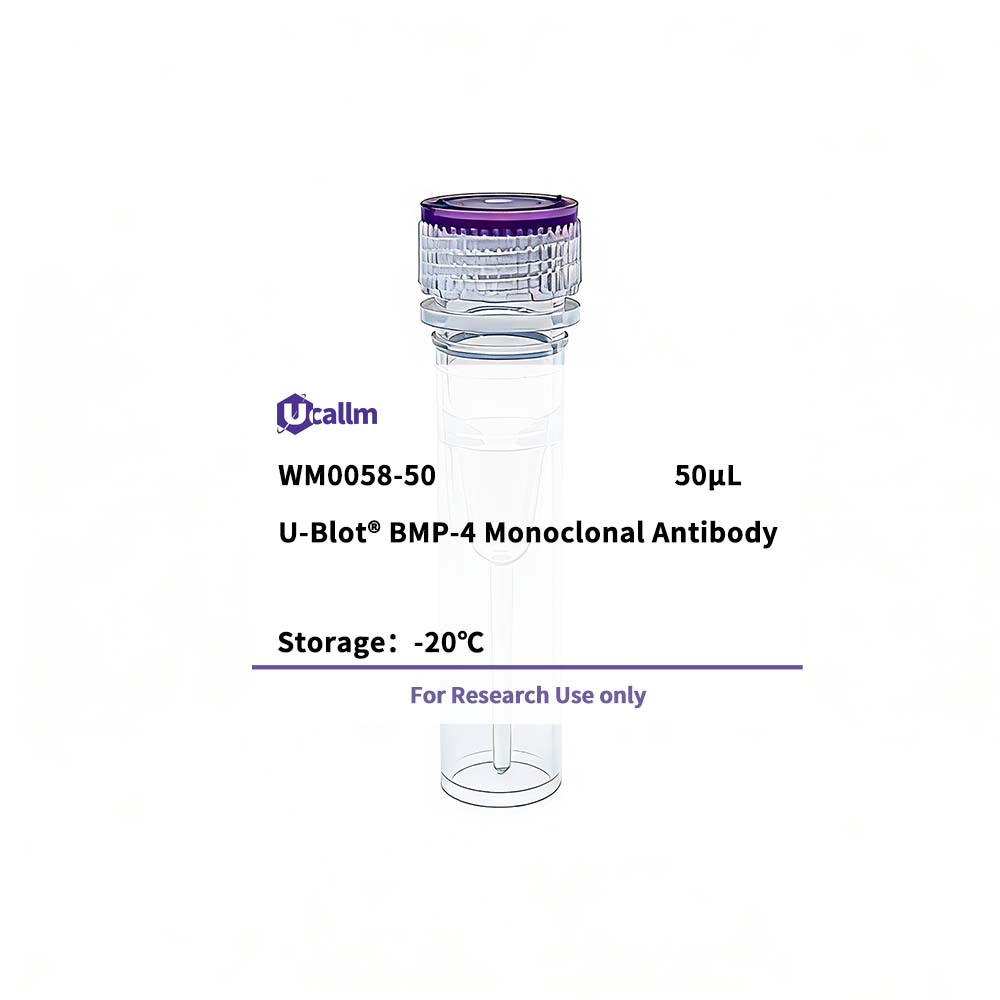
SKU: WM0058 Categories: ,

BMP-4 Monoclonal Antibody

Price range: $268.00 through $328.00

SKU: WM0058-50
Enter the quantity you would like, or drag the panel to find the quantity and price that best for you
Bulk QuoteAuthorize OEM & ODM

Product details

Background:
This gene encodes a secreted ligand of the TGF-beta (transforming growth factor-beta) superfamily of proteins. Ligands of this family bind various TGF-beta receptors leading to recruitment and activation of SMAD family transcription factors that regulate gene expression. The encoded preproprotein is proteolytically processed to generate each subunit of the disulfide-linked homodimer. This protein regulates heart development and adipogenesis. Mutations in this gene are associated with orofacial cleft and microphthalmia in human patients. The encoded protein may also be involved in the pathology of multiple cardiovascular diseases and human cancers. [provided by RefSeq, Jul 2016],

Specifications

Size50μL/100μL
TargetBMP-4
ReactivityHuman
ApplicationsWB, ELISA
MW(Calculated)47kD
MW(Observed)
Host SpeciesMouse
Isotype
Conjugate/ModificationUnmodified
Recommended Dilution RatioWB 1:500-1:2000; ELISA 1:10000; Not yet tested in other applications.
FormulationLiquid in PBS containing 50% glycerol, 0.5% BSA and 0.02% sodium azide.
PurificationAffinity purification
Storage-15°C to -25°C/1 year(Do not lower than -25°C)
Concentration
ClonalityMonoclonal
Clone Number20H4
ImmunogenPurified recombinant fragment of human BMP-4 expressed in E. Coli.
SpecificityBMP-4 Monoclonal Antibody detects endogenous levels of BMP-4 protein.
Gene NameBMP4 BMP2B DVR4
Protein NameBone morphogenetic protein 4
Other NameBMP4; / BMP2B; / DVR4; / Bone morphogenetic protein 4; / BMP-4; / Bone morphogenetic protein 2B; / BMP-2B
SpeciesHuman
Gene ID652
UniprotP12644
Species.1
Gene ID.1
Uniprot.1
Species.2
Gene ID.2
Uniprot.2
Cellular LocalizationSecreted, extracellular space, extracellular matrix.
Tissue ExpressionExpressed in the lung and lower levels seen in the kidney. Present also in normal and neoplastic prostate tissues, and prostate cancer cell lines.
Signaling_pathwayCellular Processes >> Cellular community - eukaryotes >> Signaling pathways regulating pluripotency of stem cells;Organismal Systems >> Endocrine system >> Thyroid hormone signaling pathway;Human Diseases >> Cancer: overview >> Pathways in cancer;Human Diseases >> Cancer: specific types >> Basal cell carcinoma;Environmental Information Processing >> Signal transduction >> TGF-beta signaling pathway;Environmental Information Processing >> Signal transduction >> Hippo signaling pathway;Environmental Information Processing >> Signaling molecules and interaction >> Cytokine-cytokine receptor interaction
Research Areas>>Cytokine-cytokine receptor interaction; / >>TGF-beta signaling pathway; / >>Hippo signaling pathway; / >>Signaling pathways regulating pluripotency of stem cells; / >>Thyroid hormone signaling pathway; / >>Pathways in cancer; / >>Basal cell carcinoma; / >>Fluid shear stress and atherosclerosis
FunctionDisease:Defects in BMP4 are the cause of microphthalmia syndromic type 6 (MCOPS6) [MIM:607932]; also known as microphthalmia and pituitary anomalies or microphthalmia with brain and digit developmental anomalies. Microphthalmia is a clinically heterogeneous disorder of eye formation, ranging from small size of a single eye to complete bilateral absence of ocular tissues (anophthalmia). In many cases, microphthalmia/anophthalmia occurs in association with syndromes that include non-ocular abnormalities. MCOPS6 is characterized by microphthalmia/anophthalmia associated with facial, genital, skeletal, neurologic and endocrine anomalies.,Function:Induces cartilage and bone formation. Also act in mesoderm induction, tooth development, limb formation and fracture repair.,online information:Bone morphogenetic protein 4 entry,similarity:Belongs to the TGF-beta family.,subunit:Homodimer; disulfide-linked (By similarity). Interacts with GREM2 (By similarity) and SOSTDC1. Part of a complex consisting of TWSG1 and CHRD.,tissue specificity:Expressed in the lung and lower levels seen in the kidney. Present also in normal and neoplastic prostate tissues, and prostate cancer cell lines.,
Please login to post questions
Back to Top
Product has been added to your cart