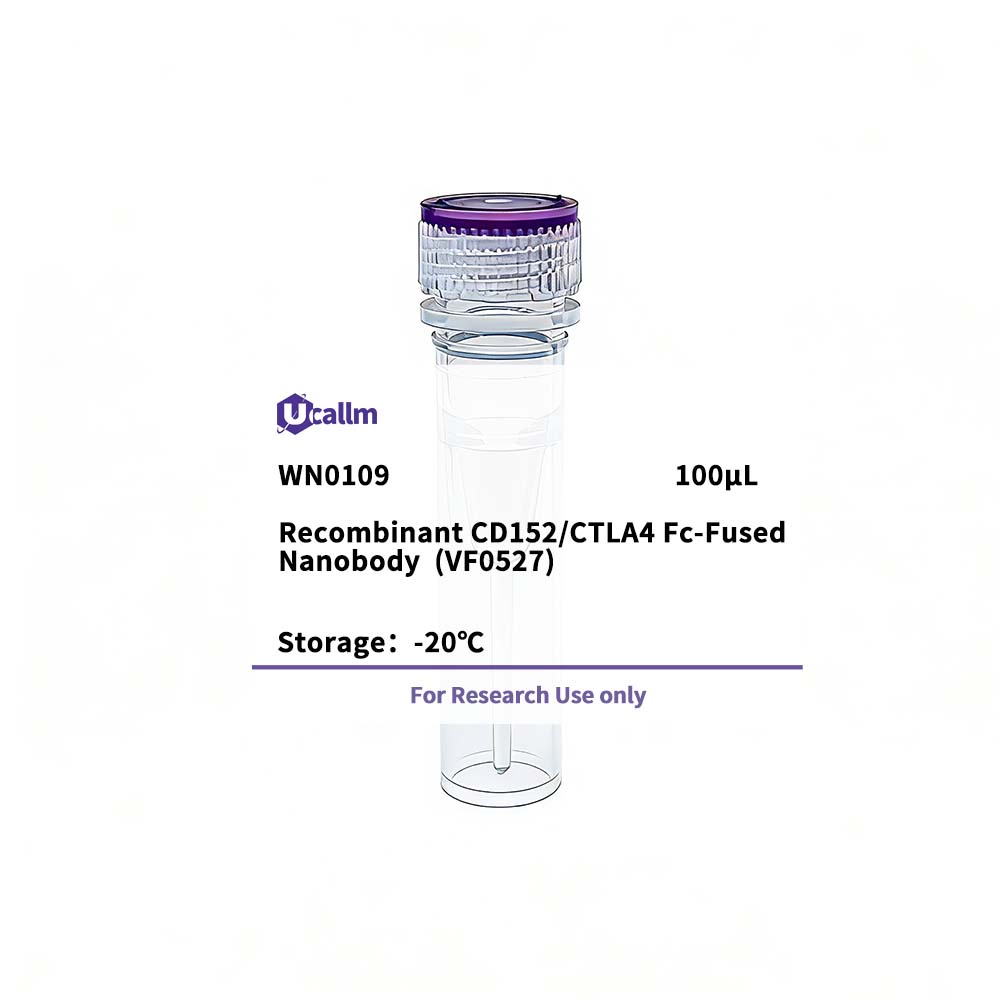
SKU: WN0109 Categories: ,

Recombinant CD152/CTLA4 Fc-Fused Nanobody (VF0527)

$365.00

SKU: WN0109
Enter the quantity you would like, or drag the panel to find the quantity and price that best for you
Bulk QuoteAuthorize OEM & ODM

Product details

Background:This gene is a member of the immunoglobulin superfamily and encodes a protein which transmits an inhibitory signal to T cells. The protein contains a V domain, a transmembrane domain, and a cytoplasmic tail. Alternate transcriptional splice variants, encoding different isoforms, have been characterized. The membrane-bound isoform functions as a homodimer interconnected by a disulfide bond, while the soluble isoform functions as a monomer. Mutations inThis gene have been associated with insulin-dependent diabetes mellitus, Graves disease, Hashimoto thyroiditis, celiac disease, systemic lupus erythematosus, thyroid-associated orbitopathy, and other autoimmune diseases. [provided by RefSeq, Jul 2008]

Specifications

Size100μL
TargetCD152
ReactivityHuman
ApplicationsELISA
MW(Calculated)
MW(Observed)
Host Species
IsotypeIgG2a,Kappa
Conjugate/ModificationUnmodified
Recommended Dilution RatioELISA 1:5000-100000
FormulationPhosphate-buffered solution
PurificationRecombinant Expression and Affinity purified
Storage-15°C to -25°C/1 year(Avoid freeze / thaw cycles)
ConcentrationPlease check the information on the tube
Clonality
Clone NumberVF0184
ImmunogenPurified recombinant Human CD152
SpecificityThis recombinant monoclonal antibody can detects endogenous levels of CD152/CTLA4 protein.
Gene NameCTLA4 CD152
Protein NameCytotoxic T-lymphocyte protein 4 (Cytotoxic T-lymphocyte-associated antigen 4) (CTLA-4) (CD antigen CD152)
Other NameCytotoxic T-lymphocyte protein 4; / Cytotoxic T-lymphocyte-associated antigen 4; / CTLA-4; / CD antigen CD152
SpeciesHuman
Gene ID1493
UniprotP16410
Species.1
Gene ID.1
Uniprot.1
Species.2
Gene ID.2
Uniprot.2
Cellular LocalizationCell membrane; Single-pass type I membrane protein . Exists primarily an intracellular antigen whose surface expression is tightly regulated by restricted trafficking to the cell surface and rapid internalization.
Tissue Expression[Isoform 3]: In testis, detected in spermatogonia in the basal layer and in interstitial Leydig cells but not in Sertoli cells or spermatocytes inside the seminiferous tubules (at protein level) (PubMed:261678). Expression is maintained in ejaculated spermatozoa (at protein level) (PubMed:261678).
Signaling_pathwayOrganismal Systems >> Immune system >> T cell receptor signaling pathway;Human Diseases >> Immune disease >> Rheumatoid arthritis;Human Diseases >> Immune disease >> Autoimmune thyroid disease;Environmental Information Processing >> Signaling molecules and interaction >> Cell adhesion molecules
Research Areas
FunctionDisease:Genetic variation in CTLA4 influences susceptibility to systemic lupus erythematosus (SLE) [MIM:152700]. SLE is a chronic, inflammatory and often febrile multisystemic disorder of connective tissue. It affects principally the skin, joints, kidneys and serosal membranes. SLE is thought to represent a failure of the regulatory mechanisms of the autoimmune system.,Disease:Genetic variation in CTLA4 is the cause of susceptibility to celiac disease type 3 (CELIAC3) [MIM:609755]. Celiac disease [MIM:212750] is a multifactorial disorder of the small intestine that is influenced by both environmental and genetic factors. It is characterized by malabsorption resulting from inflammatory injury to the mucosa of the small intestine after the ingestion of wheat gluten or related rye and barley proteins. In its classic form, celiac disease is characterized in children by malabsorption and failure to thrive.,Disease:Genetic variation in CTLA4 is the cause of susceptibility to insulin-dependent diabetes mellitus type 12 (IDDM12) [MIM:601388].,Disease:Genetic variation in CTLA4 may be a cause of susceptibility to Graves disease (GRD) [MIM:275000]. GRD is an autoimmune disorder causing overactivity of the thyroid gland and hyperthyroidism.,Disease:Genetic variations in CTLA4 are associated with susceptibility to hepatitis B virus infection (HBV infection) [MIM:610424]. Approximately one third of all cases of cirrhosis and half of all cases of hepatocellular carcinoma can be attributed to chronic HBV infection. HBV infection may result in subclinical or asymptomatic infection, acute self-limited hepatitis, or fulminant hepatitis requiring liver transplantation.,Possibly involved in T-cell activation. Binds to B7-1 (CD80) and B7-2 (CD86).,online information:CLTA-4 entry,similarity:Contains 1 Ig-like V-type (immunoglobulin-like) domain.,tissue specificity:Widely expressed with highest levels in lymphoid tissues.,
Please login to post questions
Back to Top
Product has been added to your cart
