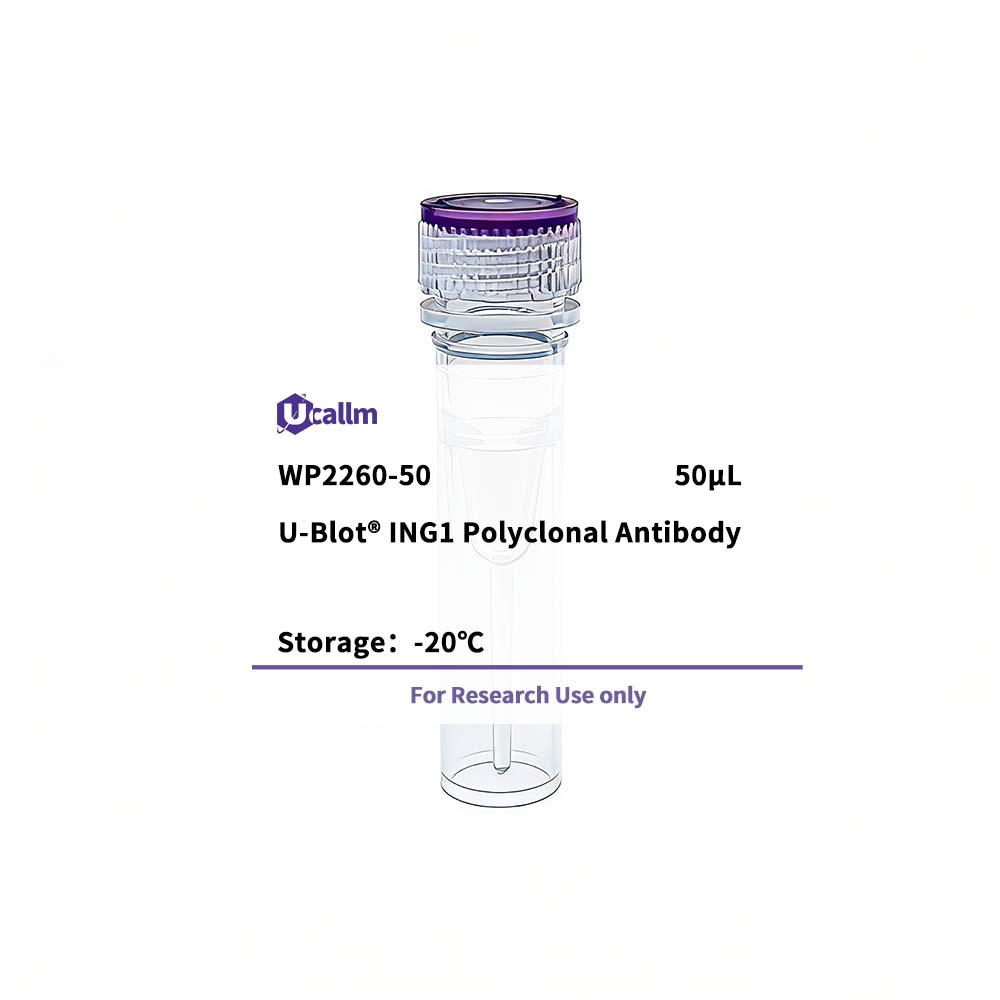
SKU: WP2260 Categories: ,

ING1 Polyclonal Antibody

Price range: $268.00 through $328.00

SKU: WP2260-100
Enter the quantity you would like, or drag the panel to find the quantity and price that best for you
Bulk QuoteAuthorize OEM & ODM

Product details

Background:

This gene encodes a tumor suppressor protein that can induce cell growth arrest and apoptosis. The encoded protein is a nuclear protein that physically interacts with the tumor suppressor protein TP53 and is a component of the p53 signaling pathway. Reduced expression and rearrangement of this gene have been detected in various cancers. Multiple alternatively spliced transcript variants encoding distinct isoforms have been reported. [provided by RefSeq, Jul 2008],

Specifications

Size50μL/100μL
TargetING1
ReactivityHuman, Mouse
ApplicationsWB, ELISA
MW(Calculated)
MW(Observed)46kD
Host SpeciesRabbit
IsotypeIgG
Conjugate/ModificationUnmodified
Recommended Dilution RatioWB 1:500-2000; ELISA 1:5000-20000
FormulationLiquid in PBS containing 50% glycerol,0.5% BSA and 0.02% sodium azide.
PurificationThe antibody was affinity-purified from rabbit antiserum by affinity-chromatography using epitope-specific immunogen.
Storage-15°C to -25°C/1 year(Do not lower than -25°C)
Concentration1 mg/ml
ClonalityPolyclonal
Clone Number
ImmunogenSynthesized peptide derived from part region of human protein
SpecificityING1 Polyclonal Antibody detects endogenous levels of protein.
Gene NameING1
Protein NameInhibitor of growth protein 1
Other Name
SpeciesHuman
Gene ID3621
UniprotQ9UK53,
Species.1Mouse
Gene ID.1
Uniprot.1Q9QXV3
Species.2
Gene ID.2
Uniprot.2
Cellular LocalizationNucleus .
Tissue ExpressionIsoform 2 was expressed in all normal tissues and cells examined, as well as in all breast cancer and melanoma cell lines examined. Isoform 3 was expressed in testis, liver, and kidney, weakly expressed in colon and brain and not expressed in breast and cultured melanocytes. Isoform 4 was highly expressed in testis and weakly expressed in brain, but not expressed in breast, colon, kidney, melanocytes, breast cancer or melanoma cell lines.
Signaling_pathway
Research Areas
FunctionDisease:Defects in ING1 are a cause of squamous cell carcinoma of the head and neck (HNSCC) [MIM:275355].,Function:Cooperates with p53/TP53 in the negative regulatory pathway of cell growth by modulating p53-dependent transcriptional activation. Implicated as a tumor suppressor gene.,similarity:Belongs to the ING family.,similarity:Contains 1 PHD-type zinc finger.,subunit:Interacts with TP53.,tissue specificity:Isoform 2 was expressed in all normal tissues and cells examined, as well as in all breast cancer and melanoma cell lines examined. Isoform 3 was expressed in testis, liver, and kidney, weakly expressed in colon and brain and not expressed in breast and cultured melanocytes. Isoform 4 was highly expressed in testis and weakly expressed in brain, but not expressed in breast, colon, kidney, melanocytes, breast cancer or melanoma cell lines.,
Please login to post questions
Back to Top
Product has been added to your cart
