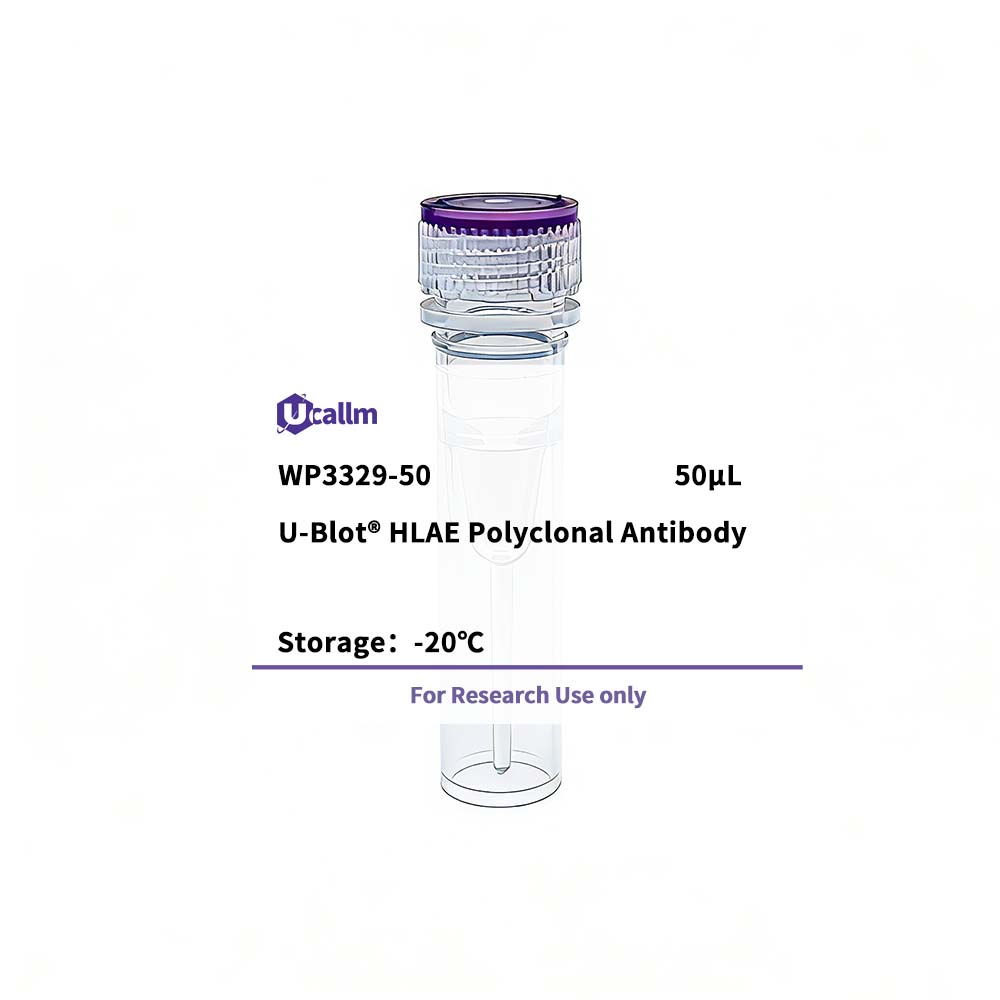
SKU: WP3329 Categories: ,

HLAE Polyclonal Antibody

Price range: $268.00 through $328.00

SKU: WP3329-100
Enter the quantity you would like, or drag the panel to find the quantity and price that best for you
Bulk QuoteAuthorize OEM & ODM

Product details

Background:

HLA-E belongs to the HLA class I heavy chain paralogues. This class I molecule is a heterodimer consisting of a heavy chain and a light chain (beta-2 microglobulin). The heavy chain is anchored in the membrane. HLA-E binds a restricted subset of peptides derived from the leader peptides of other class I molecules. The heavy chain is approximately 45 kDa and its gene contains 8 exons. Exon one encodes the leader peptide, exons 2 and 3 encode the alpha1 and alpha2 domains, which both bind the peptide, exon 4 encodes the alpha3 domain, exon 5 encodes the transmembrane region, and exons 6 and 7 encode the cytoplasmic tail. [provided by RefSeq, Jul 2008],

Specifications

Size50μL/100μL
TargetHLAE
ReactivityHuman
ApplicationsWB, ELISA
MW(Calculated)
MW(Observed)39kD
Host SpeciesRabbit
IsotypeIgG
Conjugate/ModificationUnmodified
Recommended Dilution RatioWB 1:500-2000; ELISA 1:5000-20000
FormulationLiquid in PBS containing 50% glycerol,0.5% BSA and 0.02% sodium azide.
PurificationThe antibody was affinity-purified from rabbit antiserum by affinity-chromatography using epitope-specific immunogen.
Storage-15°C to -25°C/1 year(Do not lower than -25°C)
Concentration1 mg/ml
ClonalityPolyclonal
Clone Number
ImmunogenSynthesized peptide derived from part region of human protein
SpecificityHLAE Polyclonal Antibody detects endogenous levels of protein.
Gene NameHLA-E HLA-6.2 HLAE
Protein NameHLA class I histocompatibility antigen, alpha chain E (MHC class I antigen E)
Other Name
SpeciesHuman
Gene ID3133
UniprotP13747
Species.1
Gene ID.1
Uniprot.1
Species.2
Gene ID.2
Uniprot.2
Cellular LocalizationCell membrane; Single-pass type I membrane protein. Golgi apparatus membrane .; [Soluble HLA class I histocompatibility antigen, alpha chain E]: Secreted .
Tissue ExpressionExpressed in secretory endometrial cells during pregnancy (at protein level). The expression in nonlymphoid tissues is restricted to endothelial cells from all types of vessels, including arteries, veins, capillaries, and lymphatics (at protein level). In lymphoid organs, it is mainly expressed in endothelial venules, B and T cells, monocytes, macrophages, NK cells and megakaryocytes (at protein level).
Signaling_pathwayCellular Processes >> Transport and catabolism >> Phagosome;Cellular Processes >> Cell growth and death >> Cellular senescence;Organismal Systems >> Immune system >> Natural killer cell mediated cytotoxicity;Organismal Systems >> Immune system >> Antigen processing and presentation;Human Diseases >> Immune disease >> Autoimmune thyroid disease;Human Diseases >> Immune disease >> Allograft rejection;Human Diseases >> Immune disease >> Graft-versus-host disease;Environmental Information Processing >> Signaling molecules and interaction >> Cell adhesion molecules
Research Areas>>Endocytosis; / >>Phagosome; / >>Cellular senescence; / >>Cell adhesion molecules; / >>Antigen processing and presentation; / >>Type I diabetes mellitus; / >>Human cytomegalovirus infection; / >>Human papillomavirus infection; / >>Human T-cell leukemia virus 1 infection; / >>Kaposi sarcoma-associated herpesvirus infection; / >>Herpes simplex virus 1 infection; / >>Epstein-Barr virus infection; / >>Human immunodeficiency virus 1 infection; / >>Viral carcinogenesis; / >>Autoimmune thyroid disease; / >>Allograft rejection; / >>Graft-versus-host disease; / >>Viral myocarditis
FunctionCaution:The existence of allele E*0102 (PubMed:3260916) and allele E*0104 (PubMed:1977695) is uncertain. The alleles could not be confirmed in further studies (PubMed:12445303).,Function:Preferably binds to a peptide derived from the signal sequence of most HLA-A, -B, -C and -G molecules.,polymorphism:The following alleles of E-1 are known: E*0101, E*0102, E*0103 and E*0104. The sequence shown is that of E*0101.,similarity:Belongs to the MHC class I family.,similarity:Contains 1 Ig-like C1-type (immunoglobulin-like) domain.,subunit:Heterodimer of an alpha chain and a beta chain (beta-2-microglobulin).,
Please login to post questions
Back to Top
Product has been added to your cart

