

Product details
Background:
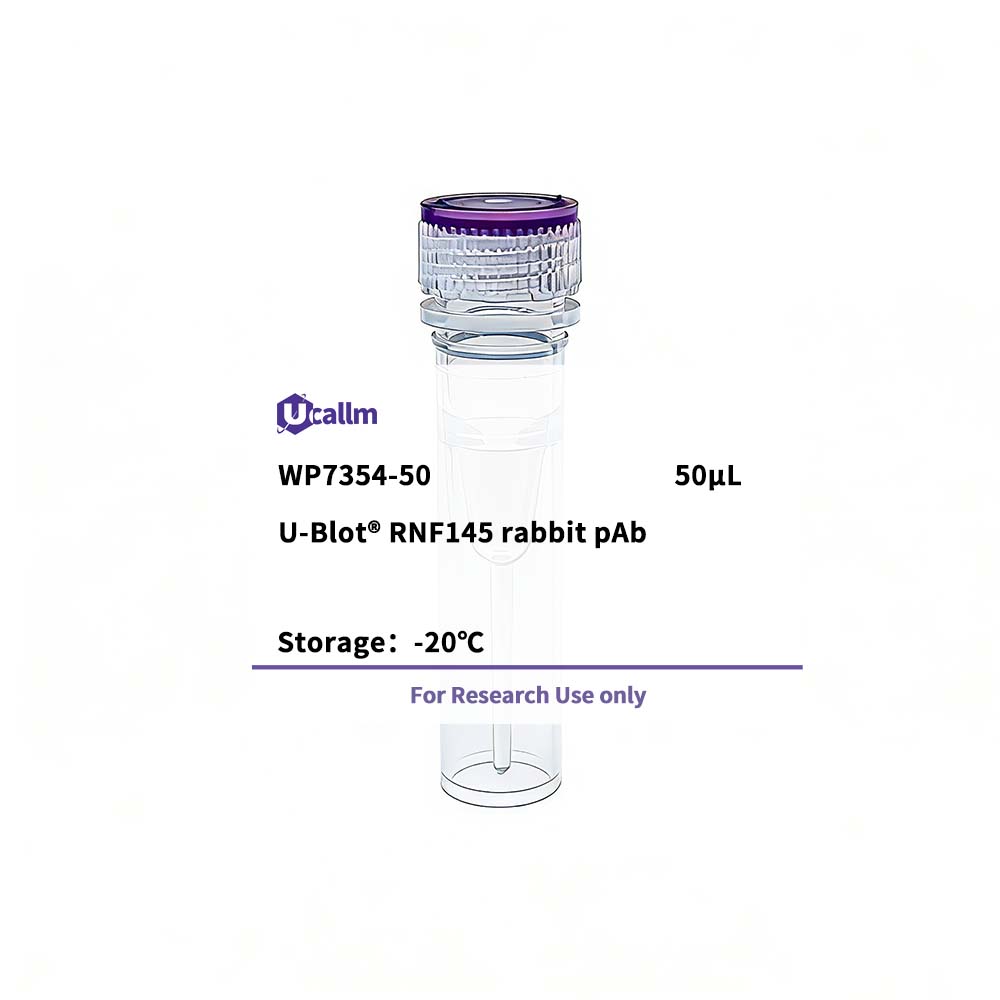
Price range: $268.00 through $328.00
Background:
| Size | 50μL/100μL |
| Target | RNF145 |
| Reactivity | Human, Mouse |
| Applications | WB |
| MW(Calculated) | 73kD |
| MW(Observed) | |
| Host Species | Rabbit |
| Isotype | IgG |
| Conjugate/Modification | Unmodified |
| Recommended Dilution Ratio | WB 1:500-2000 |
| Formulation | Liquid in PBS containing 50% glycerol, 0.5% BSA and 0.02% sodium azide. |
| Purification | The antibody was affinity-purified from rabbit antiserum by affinity-chromatography using epitope-specific immunogen. |
| Storage | -15°C to -25°C/1 year(Do not lower than -25°C) |
| Concentration | 1 mg/ml |
| Clonality | Polyclonal |
| Clone Number | |
| Immunogen | Synthesized peptide derived from human RNF145 |
| Specificity | This antibody detects endogenous levels of RNF145 at Human, Mouse |
| Gene Name | RNF145 |
| Protein Name | RING finger protein 145 |
| Other Name | |
| Species | Human |
| Gene ID | 153830 |
| Uniprot | Q96MT1, |
| Species.1 | Mouse |
| Gene ID.1 | 74315 |
| Uniprot.1 | Q5SWK7 |
| Species.2 | |
| Gene ID.2 | |
| Uniprot.2 | |
| Cellular Localization | Endoplasmic reticulum membrane; Multi-pass membrane protein . |
| Tissue Expression | |
| Signaling_pathway | |
| Research Areas | |
| Function | E3 ubiquitin ligase that catalyzes the direct transfer of ubiquitin from E2 ubiquitin-conjugating enzyme to a specific substrate. In response to bacterial infection, negatively regulates the phagocyte oxidative burst by controlling the turnover of the NADPH oxidase complex subunits. Promotes monoubiquitination of CYBA and 'Lys-48'-linked polyubiquitination and degradation of CYBB NADPH oxidase catalytic subunits, both essential for the generation of antimicrobial reactive oxygen species. Involved in the maintenance of cholesterol homeostasis. In response to high sterol concentrations ubiquitinates HMGCR, a rate-limiting enzyme in cholesterol biosynthesis, and targets it for degradation. The interaction with INSIG1 is required for this function. In addition, triggers ubiquitination of SCAP, likely inhibiting its transport to the Golgi apparatus and the subsequent processing/maturation of SREBPF2, ultimately down-regulating cholesterol biosynthesis. |



