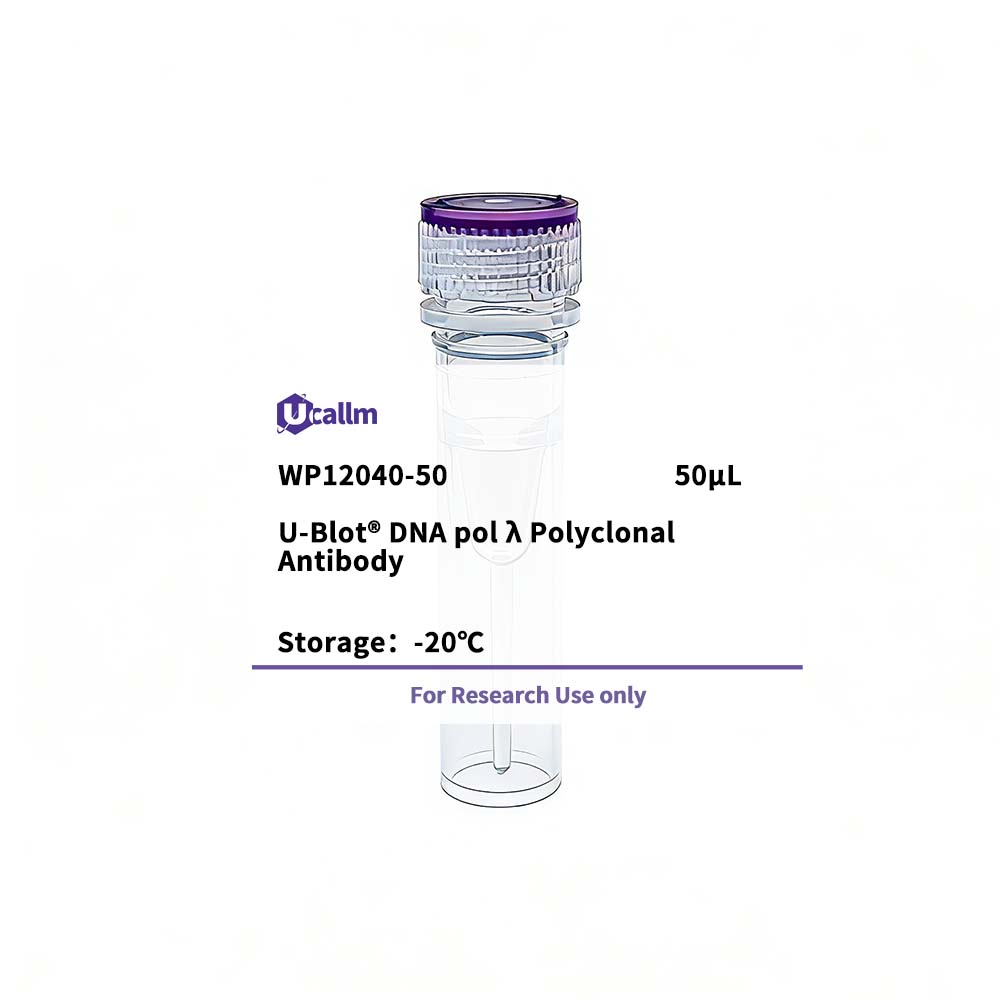
SKU: WP12040 Categories: ,

DNA pol λ Polyclonal Antibody

Price range: $268.00 through $328.00

SKU: WP12040-100
Enter the quantity you would like, or drag the panel to find the quantity and price that best for you
Bulk QuoteAuthorize OEM & ODM

Product details

Background:

This gene encodes a DNA polymerase. DNA polymerases catalyze DNA-template-directed extension of the 3'-end of a DNA strand. This particular polymerase, which is a member of the X family of DNA polymerases, likely plays a role in non-homologous end joining and other DNA repair processes. Alternatively spliced transcript variants have been described. [provided by RefSeq, Mar 2010],


Specifications

Size50μL/100μL
TargetDNA pol λ
ReactivityHuman, Mouse, Rat
ApplicationsWB, IHC, IF, ELISA
MW(Calculated)
MW(Observed)63kD
Host SpeciesRabbit
IsotypeIgG
Conjugate/ModificationUnmodified
Recommended Dilution RatioWB 1:500-1:2000; IHC 1:100-1:300; ELISA 1:10000; IF 1:50-200 / Note: For IHC, we suggest antigen retrieval with TE buffer pH 9.0 (Cat#WT1004)
FormulationLiquid in PBS containing 50% glycerol, 0.5% BSA and 0.02% sodium azide.
PurificationThe antibody was affinity-purified from rabbit antiserum by affinity-chromatography using epitope-specific immunogen.
Storage-15°C to -25°C/1 year(Do not lower than -25°C)
Concentration1 mg/ml
ClonalityPolyclonal
Clone Number
ImmunogenThe antiserum was produced against synthesized peptide derived from human DNA Polymerase lambda. AA range:451-500
SpecificityDNA pol λ Polyclonal Antibody detects endogenous levels of DNA pol λ protein.
Gene NamePOLL
Protein NameDNA polymerase lambda
Other NamePOLL; / DNA polymerase lambda; / Pol Lambda; / DNA polymerase beta-2; / Pol beta2; / DNA polymerase kappa
SpeciesHuman
Gene ID27343
UniprotQ9UGP5,
Species.1Mouse
Gene ID.156626
Uniprot.1Q9QXE2,
Species.2Rat
Gene ID.2361767
Uniprot.2Q5RKI3
Cellular LocalizationNucleus . Chromosome . Accumulates at sites of DNA damage. .
Tissue ExpressionExpressed in a number of tissues. Abundant in testis.
Signaling_pathway
Research Areas>>Base excision repair; / >>Non-homologous end-joining
FunctionCatalytic activity:Deoxynucleoside triphosphate + DNA(n) = diphosphate + DNA(n+1).,cofactor:Manganese.,Function:Repair polymerase. Involved in base excision repair (BER) responsible for repair of lesions that give rise to abasic (AP) sites in DNA. Has both DNA polymerase and terminal transferase activities. Has a 5'-deoxyribose-5-phosphate lyase (dRP lyase) activity.,PTM:Phosphorylated upon DNA damage, probably by ATM or ATR.,similarity:Belongs to the DNA polymerase type-X family.,similarity:Contains 1 BRCT domain.,subunit:Binds PCNA.,tissue specificity:Expressed in a number of tissues. Abundant in testis.,
Please login to post questions
Back to Top
Product has been added to your cart
