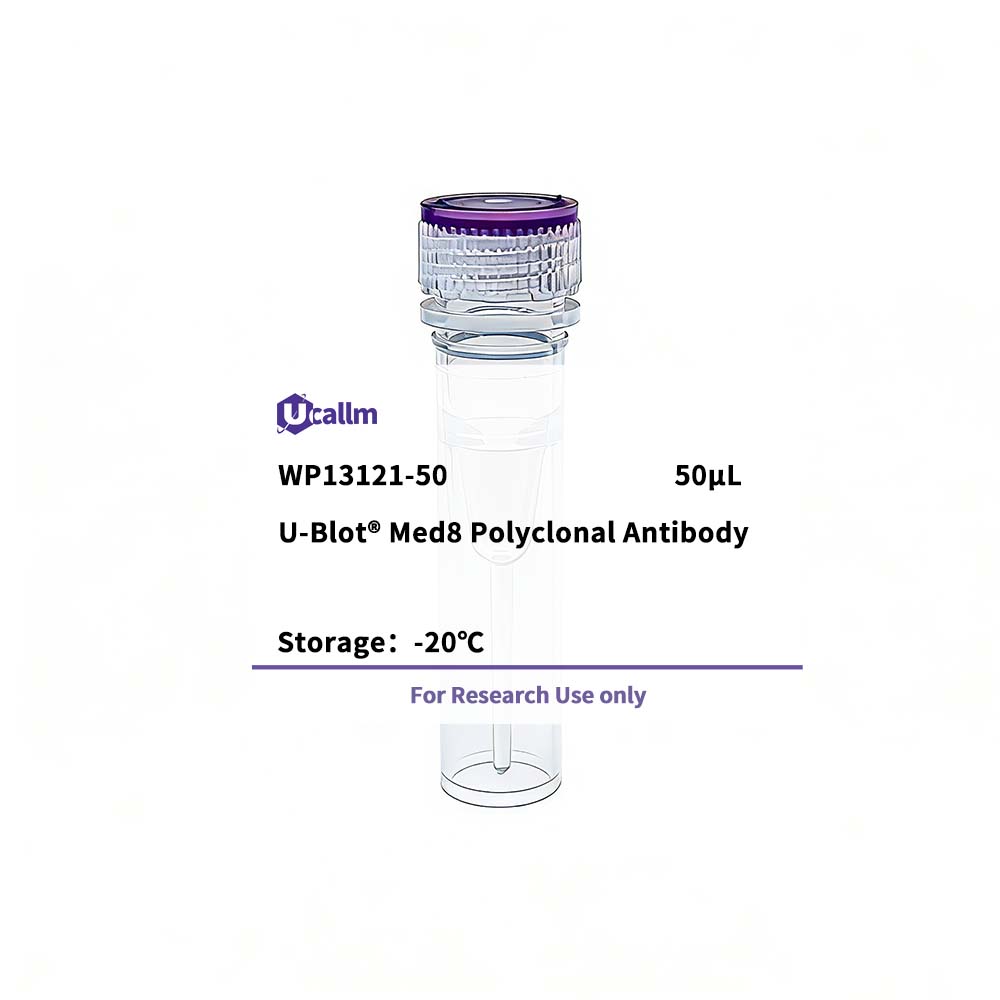
SKU: WP13121 Categories: ,

Med8 Polyclonal Antibody

Price range: $268.00 through $328.00

SKU: WP13121-100
Enter the quantity you would like, or drag the panel to find the quantity and price that best for you
Bulk QuoteAuthorize OEM & ODM

Product details

Background:

This gene encodes a protein component of the mediator complex, which aids in transcriptional activation through interaction with RNA polymerase II and gene-specific transcription factors. The encoded protein may also function in ubiquitin ligation and protein degradation. Alternatively spliced transcript variants encoding multiple isoforms have been observed for this gene. [provided by RefSeq, Jan 2013],


Specifications

Size50μL/100μL
TargetMed8
ReactivityHuman, Mouse, Rat
ApplicationsWB, ELISA
MW(Calculated)
MW(Observed)29kD
Host SpeciesRabbit
IsotypeIgG
Conjugate/ModificationUnmodified
Recommended Dilution RatioWB 1:500-1:2000; ELISA 1:5000; Not yet tested in other applications.
FormulationLiquid in PBS containing 50% glycerol, 0.5% BSA and 0.02% sodium azide.
PurificationThe antibody was affinity-purified from rabbit antiserum by affinity-chromatography using epitope-specific immunogen.
Storage-15°C to -25°C/1 year(Do not lower than -25°C)
Concentration1 mg/ml
ClonalityPolyclonal
Clone Number
ImmunogenSynthesized peptide derived from Med8 . at AA range: 70-150
SpecificityMed8 Polyclonal Antibody detects endogenous levels of Med8 protein.
Gene NameMED8
Protein NameMediator of RNA polymerase II transcription subunit 8
Other NameMED8; / Mediator of RNA polymerase II transcription subunit 8; / Activator-recruited cofactor 32 kDa component; / ARC32; / Mediator complex subunit 8
SpeciesHuman
Gene ID112950
UniprotQ96G25,
Species.1Mouse
Gene ID.180509
Uniprot.1Q9D7W5
Species.2
Gene ID.2
Uniprot.2
Cellular LocalizationNucleus .
Tissue ExpressionCervix carcinoma,Melanoma,Testis,
Signaling_pathway
Research Areas
FunctionDomain:The elongin BC complex binding domain is also known as BC-box with the consensus [APST]-L-x(3)-C-x(3)-[AILV].,Function:Component of the Mediator complex, a coactivator involved in the regulated transcription of nearly all RNA polymerase II-dependent genes. Mediator functions as a bridge to convey information from gene-specific regulatory proteins to the basal RNA polymerase II transcription machinery. Mediator is recruited to promoters by direct interactions with regulatory proteins and serves as a scaffold for the assembly of a functional preinitiation complex with RNA polymerase II and the general transcription factors. May play a role as a target recruitment subunit in E3 ubiquitin-protein ligase complexes and thus in ubiquitination and subsequent proteasomal degradation of target proteins.,pathway:Protein modification; protein ubiquitination.,similarity:Belongs to the Mediator complex subunit 8 family.,subunit:Component of the Mediator complex, which is composed of MED1, MED4, MED6, MED7, MED8, MED9, MED10, MED11, MED12, MED13, MED13L, MED14, MED15, MED16, MED17, MED18, MED19, MED20, MED21, MED22, MED23, MED24, MED25, MED26, MED27, MED29, MED30, MED31, CCNC, CDK8 and CDC2L6/CDK11. The MED12, MED13, CCNC and CDK8 subunits form a distinct module termed the CDK8 module. Mediator containing the CDK8 module is less active than Mediator lacking this module in supporting transcriptional activation. Individual preparations of the Mediator complex lacking one or more distinct subunits have been variously termed ARC, CRSP, DRIP, PC2, SMCC and TRAP. May be part of a multisubunit E3 ubiquitin-protein ligase complex with the Elongin BC complex (TCEB1 and TCEB2), CUL2 and RBX1.,
Please login to post questions
Back to Top
Product has been added to your cart

