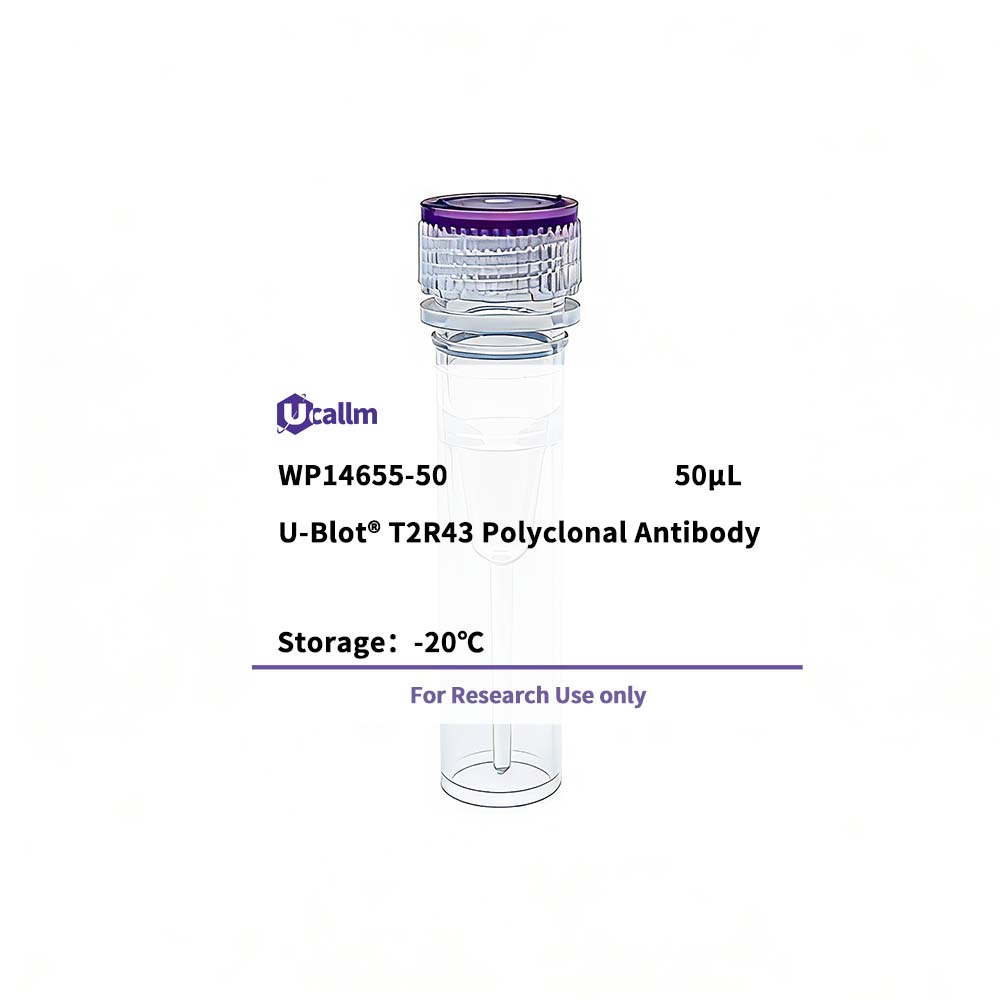
SKU: WP14655 Categories: ,

T2R43 Polyclonal Antibody

Price range: $268.00 through $328.00

SKU: WP14655-100
Enter the quantity you would like, or drag the panel to find the quantity and price that best for you
Bulk QuoteAuthorize OEM & ODM

Product details

Background:

TAS2R43 belongs to the large TAS2R receptor family. TAS2Rs are expressed on the surface of taste receptor cells and mediate the perception of bitterness through a G protein-coupled second messenger pathway (Conte et al., 2002 [PubMed 12584440]). For further information on TAS2Rs, see MIM 604791.[supplied by OMIM, Mar 2009],


Specifications

Size50μL/100μL
TargetT2R43
ReactivityHuman
ApplicationsWB, ELISA
MW(Calculated)
MW(Observed)35kD
Host SpeciesRabbit
IsotypeIgG
Conjugate/ModificationUnmodified
Recommended Dilution RatioWB 1:500-1:2000; ELISA 1:20000; Not yet tested in other applications.
FormulationLiquid in PBS containing 50% glycerol, 0.5% BSA and 0.02% sodium azide.
PurificationThe antibody was affinity-purified from rabbit antiserum by affinity-chromatography using epitope-specific immunogen.
Storage-15°C to -25°C/1 year(Do not lower than -25°C)
Concentration1 mg/ml
ClonalityPolyclonal
Clone Number
ImmunogenThe antiserum was produced against synthesized peptide derived from human TAS2R43. AA range:124-173
SpecificityT2R43 Polyclonal Antibody detects endogenous levels of T2R43 protein.
Gene NameTAS2R43
Protein NameTaste receptor type 2 member 43
Other NameTAS2R43; / Taste receptor type 2 member 43; / T2R43; / Taste receptor type 2 member 52; / T2R52
SpeciesHuman
Gene ID259289
UniprotP59537
Species.1
Gene ID.1
Uniprot.1
Species.2
Gene ID.2
Uniprot.2
Cellular LocalizationMembrane; Multi-pass membrane protein . Cell projection, cilium membrane . In airway epithelial cells, localizes to motile cilia.
Tissue ExpressionExpressed in subsets of taste receptor cells of the tongue and exclusively in gustducin-positive cells. Expressed in airway epithelia.
Signaling_pathway
Research Areas>>Taste transduction
FunctionFunction:Receptor that may play a role in the perception of bitterness and is gustducin-linked. May play a role in sensing the chemical composition of the gastrointestinal content. The activity of this receptor may stimulate alpha gustducin, mediate PLC-beta-2 activation and lead to the gating of TRPM5 (By similarity). Activated by the sulfonyl amide sweeteners saccharin and acesulfame K.,miscellaneous:Most taste cells may be activated by a limited number of bitter compounds; individual taste cells can discriminate among bitter stimuli.,similarity:Belongs to the G-protein coupled receptor T2R family.,tissue specificity:Expressed in subsets of taste receptor cells of the tongue and exclusively in gustducin-positive cells.,
Please login to post questions
Back to Top
Product has been added to your cart
