SKU: WP14899 Categories: ,

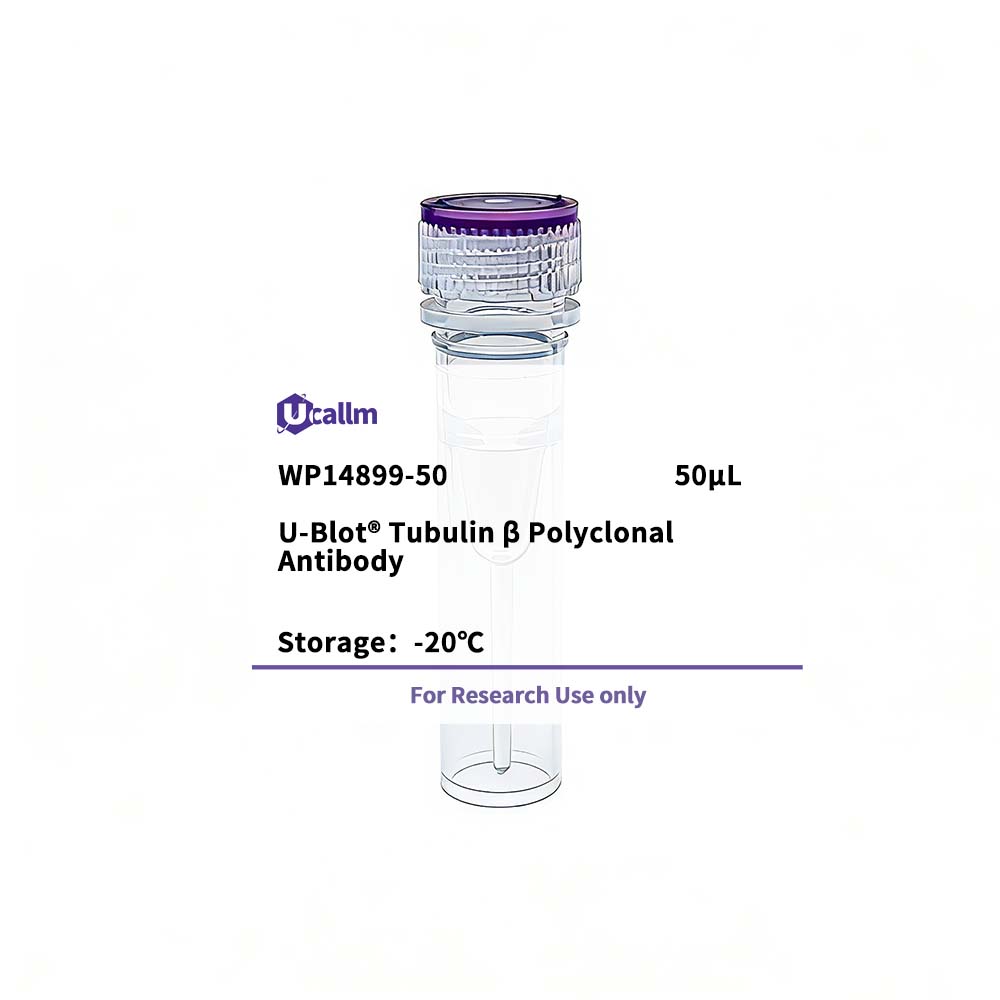
Tubulin β Polyclonal Antibody

Price range: $268.00 through $328.00

SKU: WP14899-100
Enter the quantity you would like, or drag the panel to find the quantity and price that best for you
Bulk QuoteAuthorize OEM & ODM

Product details

Background:

tubulin beta 3 class III(TUBB3) Homo sapiens This gene encodes a class III member of the beta tubulin protein family. Beta tubulins are one of two core protein families (alpha and beta tubulins) that heterodimerize and assemble to form microtubules. This protein is primarily expressed in neurons and may be involved in neurogenesis and axon guidance and maintenance. Mutations in this gene are the cause of congenital fibrosis of the extraocular muscles type 3. Alternate splicing results in multiple transcript variants. A pseudogene of this gene is found on chromosome 6. [provided by RefSeq, Oct 2010],


Specifications

Size50μL/100μL
TargetTubulin β
ReactivityHuman, Mouse, Rat, Pig, Cow, Fish
ApplicationsWB, IHC, IF, IP, ELISA
MW(Calculated)
MW(Observed)55kD
Host SpeciesRabbit
IsotypeIgG
Conjugate/ModificationUnmodified
Recommended Dilution RatioWB 1:500-1:2000; IHC: 1:100-300; ELISA 1:20000; IF 1:100-300; Not yet tested in other applications. / Note: For IHC, we suggest antigen retrieval with TE buffer pH 9.0 (Cat#WT1004)
FormulationLiquid in PBS containing 50% glycerol, 0.5% BSA and 0.02% sodium azide.
PurificationThe antibody was affinity-purified from rabbit antiserum by affinity-chromatography using epitope-specific immunogen.
Storage-15°C to -25°C/1 year(Do not lower than -25°C)
Concentration1 mg/ml
ClonalityPolyclonal
Clone Number
ImmunogenThe antiserum was produced against synthesized peptide derived from human Tubulin beta. AA range:401-450
SpecificityTubulin β Polyclonal Antibody detects endogenous levels of Tubulin β protein.
Gene NameTUBB3
Protein NameTubulin beta-3 chain
Other NameTUBB3; / TUBB4; / Tubulin beta-3 chain; / Tubulin beta-4 chain; / Tubulin beta-III
SpeciesHuman
Gene ID10381
UniprotQ13509,
Species.1Mouse
Gene ID.122152
Uniprot.1Q9ERD7,
Species.2Rat
Gene ID.2246118
Uniprot.2Q4QRB4
Cellular LocalizationCytoplasm, cytoskeleton . Cell projection, growth cone . Cell projection, lamellipodium . Cell projection, filopodium .
Tissue ExpressionExpression is primarily restricted to central and peripheral nervous system. Greatly increased expression in most cancerous tissues.
Signaling_pathwayCellular Processes >> Transport and catabolism >> Phagosome;Cellular Processes >> Cellular community - eukaryotes >> Gap junction;Human Diseases >> Neurodegenerative disease >> Alzheimer disease;Human Diseases >> Neurodegenerative disease >> Parkinson disease;Human Diseases >> Neurodegenerative disease >> Amyotrophic lateral sclerosis;Human Diseases >> Neurodegenerative disease >> Huntington disease;Human Diseases >> Neurodegenerative disease >> Prion disease;Human Diseases >> Neurodegenerative disease >> Pathways of neurodegeneration - multiple diseases
Research Areas>>Phagosome; / >>Gap junction; / >>Alzheimer disease; / >>Parkinson disease; / >>Amyotrophic lateral sclerosis; / >>Huntington disease; / >>Prion disease; / >>Pathways of neurodegeneration - multiple diseases; / >>Pathogenic Escherichia coli infection; / >>Salmonella infection
FunctionDomain:The highly acidic C-terminal region may bind cations such as calcium.,Function:Receptor for MSH (alpha, beta and gamma) and ACTH. The activity of this receptor is mediated by G proteins which activate adenylate cyclase.,Function:Tubulin is the major constituent of microtubules. It binds two moles of GTP, one at an exchangeable site on the beta chain and one at a non-exchangeable site on the alpha-chain.,polymorphism:Genetic variations in MC1R are associated with variation in skin/hair/eye pigmentation type 2 (SHEP2) [MIM:266300]. Hair, eye and skin pigmentation are among the most visible examples of human phenotypic variation, with a broad normal range that is subject to substantial geographic stratification. In the case of skin, individuals tend to have lighter pigmentation with increasing distance from the equator. By contrast, the majority of variation in human eye and hair color is found among individuals of European ancestry, with most other human populations fixed for brown eyes and black hair.,polymorphism:Variations in MC1R are linked to the degree of skin pigmentation (Types I-IV). Type I skin the most lightly pigmented and type IV the most dark pigmented. Partial loss-of-function mutations are associated with fair skin, poor tanning and increased skin cancer risk.,similarity:Belongs to the G-protein coupled receptor 1 family.,similarity:Belongs to the tubulin family.,subunit:Dimer of alpha and beta chains.,tissue specificity:Melanocytes and corticoadrenal tissue.,
Please login to post questions
Back to Top
Product has been added to your cart