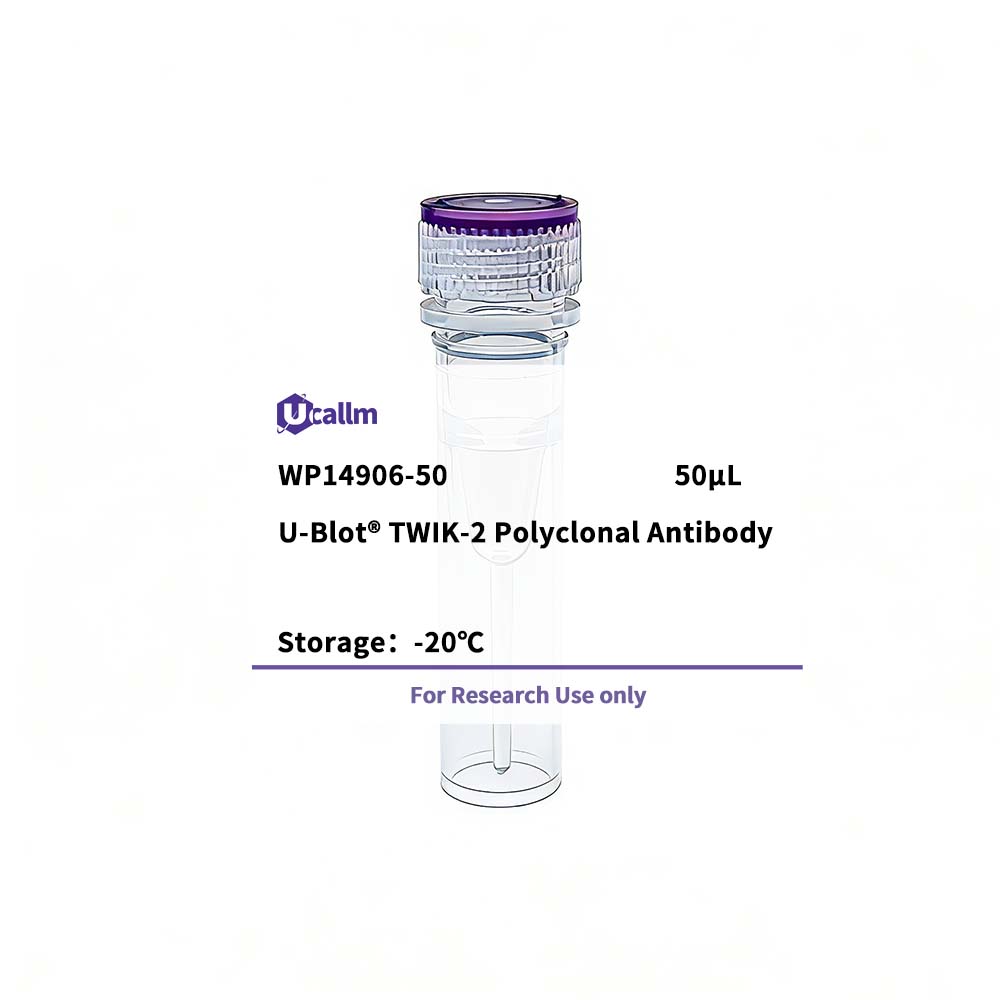
SKU: WP14906 Categories: ,

TWIK-2 Polyclonal Antibody

Price range: $268.00 through $328.00

SKU: WP14906-100
Enter the quantity you would like, or drag the panel to find the quantity and price that best for you
Bulk QuoteAuthorize OEM & ODM

Product details

Background:

This gene encodes one of the members of the superfamily of potassium channel proteins containing two pore-forming P domains. This channel protein, considered an open rectifier, is widely expressed. It is stimulated by arachidonic acid, and inhibited by internal acidification and volatile anaesthetics. [provided by RefSeq, Jul 2008],


Specifications

Size50μL/100μL
TargetTWIK-2
ReactivityHuman
ApplicationsWB, ELISA
MW(Calculated)
MW(Observed)33kD
Host SpeciesRabbit
IsotypeIgG
Conjugate/ModificationUnmodified
Recommended Dilution RatioWB 1:500-1:2000; ELISA 1:5000; Not yet tested in other applications.
FormulationLiquid in PBS containing 50% glycerol, 0.5% BSA and 0.02% sodium azide.
PurificationThe antibody was affinity-purified from rabbit antiserum by affinity-chromatography using epitope-specific immunogen.
Storage-15°C to -25°C/1 year(Do not lower than -25°C)
Concentration1 mg/ml
ClonalityPolyclonal
Clone Number
ImmunogenSynthesized peptide derived from TWIK-2 . at AA range: 240-320
SpecificityTWIK-2 Polyclonal Antibody detects endogenous levels of TWIK-2 protein.
Gene NameKCNK6
Protein NamePotassium channel subfamily K member 6
Other NameKCNK6; / TOSS; / TWIK2; / Potassium channel subfamily K member 6; / Inward rectifying potassium channel protein TWIK-2; / TWIK-originated similarity sequence
SpeciesHuman
Gene ID9424
UniprotQ9Y257
Species.1
Gene ID.1
Uniprot.1
Species.2
Gene ID.2
Uniprot.2
Cellular LocalizationMembrane; Multi-pass membrane protein .
Tissue ExpressionWidespread expression, detected in all tissues tested except for skeletal muscle. Strongest expression in placenta, pancreas, heart, colon and spleen, lower levels detected in peripheral blood leukocytes, lung, liver, kidney and thymus. Lowest expression detected in brain.
Signaling_pathway
Research Areas
FunctionFunction:Exhibits outward rectification in a physiological K(+) gradient and mild inward rectification in symmetrical K(+) conditions.,miscellaneous:Inhibited by internal acidification and, to a small degree, by zinc. Not inhibited by quinine, quinidine or barium.,similarity:Belongs to the two pore domain potassium channel (TC 1.A.1.8) family.,subunit:Homodimer .,tissue specificity:Widespread expression, detected in all tissues tested except for skeletal muscle. Strongest expression in placenta, pancreas, heart, colon and spleen, lower levels detected in peripheral blood leukocytes, lung, liver, kidney and thymus. Lowest expression detected in brain.,
Please login to post questions
Back to Top
Product has been added to your cart

