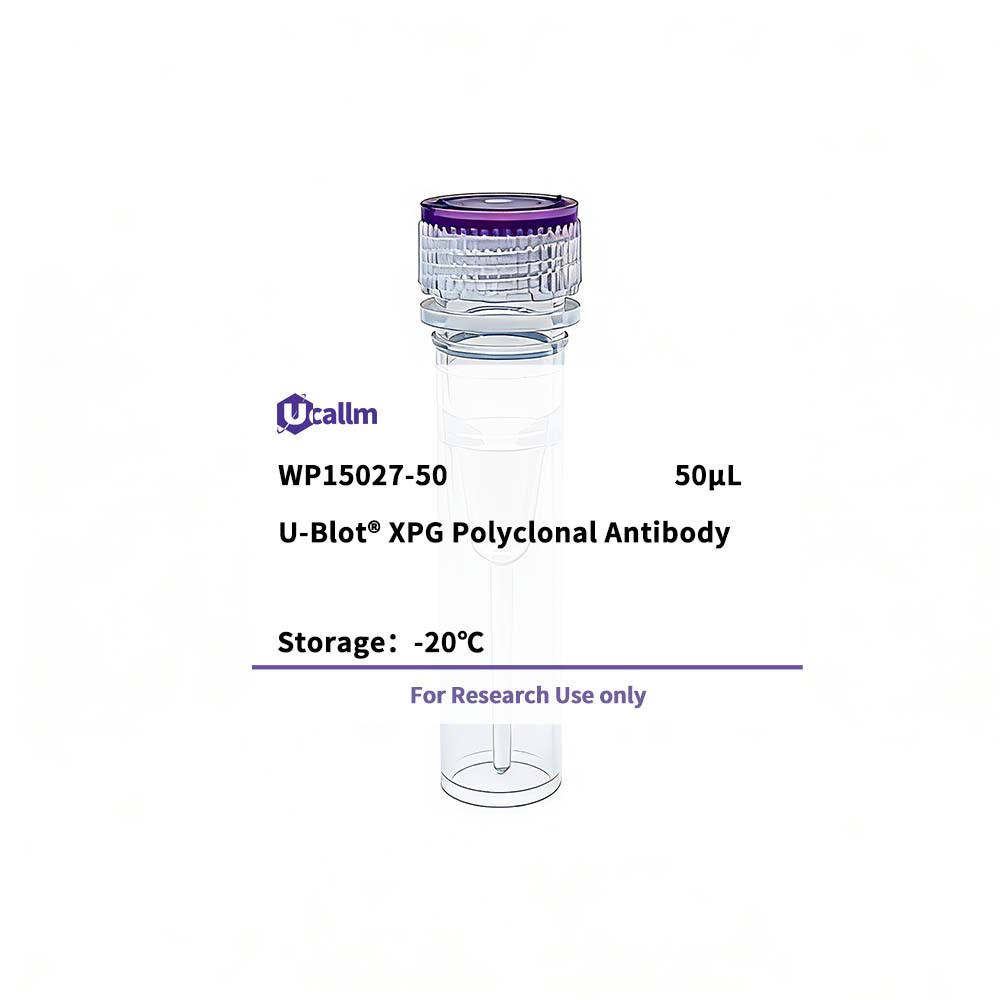
SKU: WP15027 Categories: ,

XPG Polyclonal Antibody

Price range: $268.00 through $328.00

SKU: WP15027-100
Enter the quantity you would like, or drag the panel to find the quantity and price that best for you
Bulk QuoteAuthorize OEM & ODM

Product details

Background:

This gene encodes a single-strand specific DNA endonuclease that makes the 3' incision in DNA excision repair following UV-induced damage. The protein may also function in other cellular processes, including RNA polymerase II transcription, and transcription-coupled DNA repair. Mutations in this gene cause xeroderma pigmentosum complementation group G (XP-G), which is also referred to as xeroderma pigmentosum VII (XP7), a skin disorder characterized by hypersensitivity to UV light and increased susceptibility for skin cancer development following UV exposure. Some patients also develop Cockayne syndrome, which is characterized by severe growth defects, mental retardation, and cachexia. Read-through transcription exists between this gene and the neighboring upstream BIVM (basic, immunoglobulin-like variable motif containing) gene. [provided by RefSeq, Feb 2011],

Specifications

TargetXPG
ReactivityHuman, Mouse
ApplicationsWB, IHC, IF, ELISA
MW(Calculated)
MW(Observed)130kD
Host SpeciesRabbit
IsotypeIgG
Conjugate/ModificationUnmodified
Modification
Recommended Dilution RatioWB 1:500-1:2000; IHC 1:100-1:300; IF 1:200-1:1000; ELISA 1:5000; Not yet tested in other applications. / Note: For IHC, we suggest antigen retrieval with TE buffer pH 9.0 (Cat#YS0004)
FormulationLiquid in PBS containing 50% glycerol, 0.5% BSA and 0.02% sodium azide.
Source
PurificationThe antibody was affinity-purified from rabbit antiserum by affinity-chromatography using epitope-specific immunogen.
Purity
Storage-15°C to -25°C/1 year(Do not lower than -25°C)
Concentration1 mg/ml
ClonalityPolyclonal
Clone Number
ImmunogenThe antiserum was produced against synthesized peptide derived from human ERCC5. AA range:131-180
Sequence
SpecificityXPG Polyclonal Antibody detects endogenous levels of XPG protein.
Gene NameERCC5
Protein NameDNA repair protein complementing XP-G cells
Other NameERCC5; / ERCM2; / XPG; / XPGC; / DNA repair protein complementing XP-G cells; / DNA excision repair protein ERCC-5; / Xeroderma pigmentosum group G-complementing protein
SpeciesHuman
Gene ID-12073
UniprotP28715,
Species.1Mouse
Gene ID-2
Uniprot.1P35689
Species.2
Gene ID-3
Uniprot.2
Organism-4
Gene ID-4
SwissProt-4
BackgroundThis gene encodes a single-strand specific DNA endonuclease that makes the 3' incision in DNA excision repair following UV-induced damage. The protein may also function in other cellular processes, including RNA polymerase II transcription, and transcription-coupled DNA repair. Mutations in this gene cause xeroderma pigmentosum complementation group G (XP-G), which is also referred to as xeroderma pigmentosum VII (XP7), a skin disorder characterized by hypersensitivity to UV light and increased susceptibility for skin cancer development following UV exposure. Some patients also develop Cockayne syndrome, which is characterized by severe growth defects, mental retardation, and cachexia. Read-through transcription exists between this gene and the neighboring upstream BIVM (basic, immunoglobulin-like variable motif containing) gene. [provided by RefSeq, Feb 2011],
Cellular LocalizationNucleus . Chromosome . Colocalizes with RAD51 to nuclear foci in S phase (PubMed:26833090). Localizes to DNA double-strand breaks (DBS) during replication stress (PubMed:26833090). Colocalizes with BRCA2 to nuclear foci following DNA replication stress (PubMed:26833090). .
Tissue ExpressionBone marrow,Epithelium,Eye,
Signaling_pathway
Research Areas>>Nucleotide excision repair
Functioncofactor:Binds 2 magnesium ions per subunit. They probably participate in the reaction catalyzed by the enzyme. May bind an additional third magnesium ion after substrate binding.,Disease:Defects in ERCC5 are the cause of xeroderma pigmentosum complementation group G (XP-G) [MIM:278780]; also known as xeroderma pigmentosum VII (XP7). Xeroderma pigmentosum is an autosomal recessive pigmentary skin disorder characterized by solar hypersensitivity of the skin, high predisposition for developing cancers on areas exposed to sunlight and, in some cases, neurological abnormalities. Some XP-G patients present features of Cockayne syndrome, including dwarfism, sensorineural deafness, microcephaly, mental retardation, pigmentary retinopathy, ataxia, decreased nerve conduction velocities.,Function:Single-stranded structure-specific DNA endonuclease involved in DNA excision repair. Makes the 3'incision in DNA nucleotide excision repair (NER). Acts as a cofactor for a DNA glycosylase that removes oxidized pyrimidines from DNA. May also be involved in transcription-coupled repair of this kind of damage, in transcription by RNA polymerase II, and perhaps in other processes too.,similarity:Belongs to the XPG/RAD2 endonuclease family. XPG subfamily.,subunit:Interacts with PCNA.,
RRID
Please login to post questions
Back to Top
Product has been added to your cart