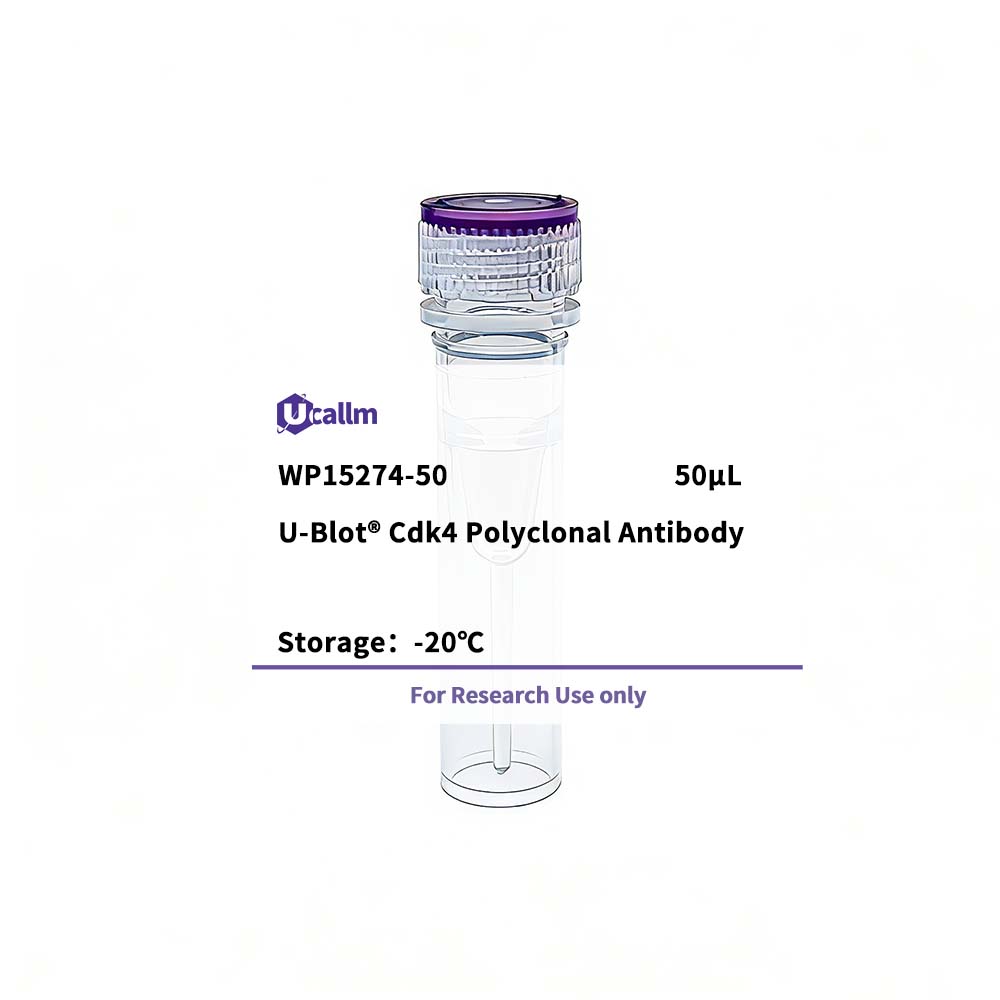
SKU: WP15274 Categories: ,

Cdk4 Polyclonal Antibody

Price range: $268.00 through $328.00

SKU: WP15274-100
Enter the quantity you would like, or drag the panel to find the quantity and price that best for you
Bulk QuoteAuthorize OEM & ODM

Product details

Background:

cyclin dependent kinase 4(CDK4) Homo sapiens The protein encoded by this gene is a member of the Ser/Thr protein kinase family. This protein is highly similar to the gene products of S. cerevisiae cdc28 and S. pombe cdc2. It is a catalytic subunit of the protein kinase complex that is important for cell cycle G1 phase progression. The activity of this kinase is restricted to the G1-S phase, which is controlled by the regulatory subunits D-type cyclins and CDK inhibitor p16(INK4a). This kinase was shown to be responsible for the phosphorylation of retinoblastoma gene product (Rb). Mutations in this gene as well as in its related proteins including D-type cyclins, p16(INK4a) and Rb were all found to be associated with tumorigenesis of a variety of cancers. Multiple polyadenylation sites of this gene have been reported. [provided by RefSeq, Jul 2008],

Specifications

Size50μL/100μL
TargetCdk4
ReactivityHuman, Mouse, Rat
ApplicationsIF, WB, IHC, ELISA
MW(Calculated)
MW(Observed)35kD
Host SpeciesRabbit
IsotypeIgG
Conjugate/ModificationUnmodified
Recommended Dilution RatioIF 1:50-200; WB 1:500-1:2000; IHC: 1:100-300; ELISA 1:20000; Not yet tested in other applications; / Note: For IHC, we suggest antigen retrieval with TE buffer pH 9.0 (Cat#WT1004)
FormulationLiquid in PBS containing 50% glycerol, 0.5% BSA and 0.02% sodium azide.
PurificationThe antibody was affinity-purified from rabbit antiserum by affinity-chromatography using epitope-specific immunogen.
Storage-15°C to -25°C/1 year(Do not lower than -25°C)
Concentration1 mg/ml
ClonalityPolyclonal
Clone Number
ImmunogenThe antiserum was produced against synthesized peptide derived from the N-terminal region of human CDK4. AA range:1-50
SpecificityCdk4 Polyclonal Antibody detects endogenous levels of Cdk4 protein.
Gene NameCDK4
Protein NameCyclin-dependent kinase 4
Other NameCDK4; / Cyclin-dependent kinase 4; / Cell division protein kinase 4; / PSK-J3
SpeciesHuman
Gene ID1019
UniprotP11802,
Species.1Mouse
Gene ID.112567
Uniprot.1P30285,
Species.2Rat
Gene ID.294201
Uniprot.2P35426
Cellular LocalizationCytoplasm . Nucleus . Nucleus membrane . Cytoplasmic when non-complexed. Forms a cyclin D-CDK4 complex in the cytoplasm as cells progress through G(1) phase. The complex accumulates on the nuclear membrane and enters the nucleus on transition from G(1) to S phase. Also present in nucleoli and heterochromatin lumps. Colocalizes with RB1 after release into the nucleus. .
Tissue ExpressionBrain,Muscle,
Signaling_pathwayCellular Processes >> Cell growth and death >> Cell cycle;Cellular Processes >> Cell growth and death >> p53 signaling pathway;Cellular Processes >> Cell growth and death >> Cellular senescence;Cellular Processes >> Cellular community - eukaryotes >> Tight junction;Organismal Systems >> Immune system >> T cell receptor signaling pathway;Human Diseases >> Cancer: overview >> Pathways in cancer;Human Diseases >> Cancer: specific types >> Pancreatic cancer;Human Diseases >> Cancer: specific types >> Hepatocellular carcinoma;Human Diseases >> Cancer: specific types >> Glioma;Human Diseases >> Cancer: specific types >> Chronic myeloid leukemia;Human Diseases >> Cancer: specific types >> Melanoma;Human Diseases >> Cancer: specific types >> Bladder cancer;Human Diseases >> Cancer: specific types >> Breast cancer;Human Diseases >> Cancer: specific types >> Small cell lung cancer;Human Diseases >> Cancer: specific types >> Non-small cell lung cancer;Environmental Information Processing >> Signal transduction >> PI3K-Akt signaling pathway
Research Areas>>Endocrine resistance; / >>Cell cycle; / >>p53 signaling pathway; / >>PI3K-Akt signaling pathway; / >>Cellular senescence; / >>Tight junction; / >>T cell receptor signaling pathway; / >>AGE-RAGE signaling pathway in diabetic complications; / >>Cushing syndrome; / >>Hepatitis C; / >>Measles; / >>Human cytomegalovirus infection; / >>Influenza A; / >>Human papillomavirus infection; / >>Human T-cell leukemia virus 1 infection; / >>Kaposi sarcoma-associated herpesvirus infection; / >>Epstein-Barr virus infection; / >>Pathways in cancer; / >>Viral carcinogenesis; / >>Pancreatic cancer; / >>Glioma; / >>Melanoma; / >>Bladder cancer; / >>Chronic myeloid leukemia; / >>Small cell lung cancer; / >>Non-small cell lung cancer; / >>Breast cancer; / >>Hepatocellular carcinoma
FunctionCatalytic activity:ATP + a protein = ADP + a phosphoprotein.,Disease:CDK4 mutations are involved in tumor formation.,Disease:Defects in CDK4 are the cause of cutaneous malignant melanoma 3 (CMM3) [MIM:609048, 155600]. Malignant melanoma is a malignant neoplasm of melanocytes, arising de novo or from a preexisting benign nevus, which occurs most often in the skin but also may involve other sites.,enzyme regulation:Phosphorylation at Thr-172 is necessary for enzymatic activity.,Function:Probably involved in the control of the cell cycle.,similarity:Belongs to the protein kinase superfamily. CMGC Ser/Thr protein kinase family. CDC2/CDKX subfamily.,similarity:Contains 1 protein kinase domain.,subunit:Forms a stable complex with D-type G1 cyclins. Interacts with SEI1 and ZNF655/VIK.,
Please login to post questions
Back to Top
Product has been added to your cart
