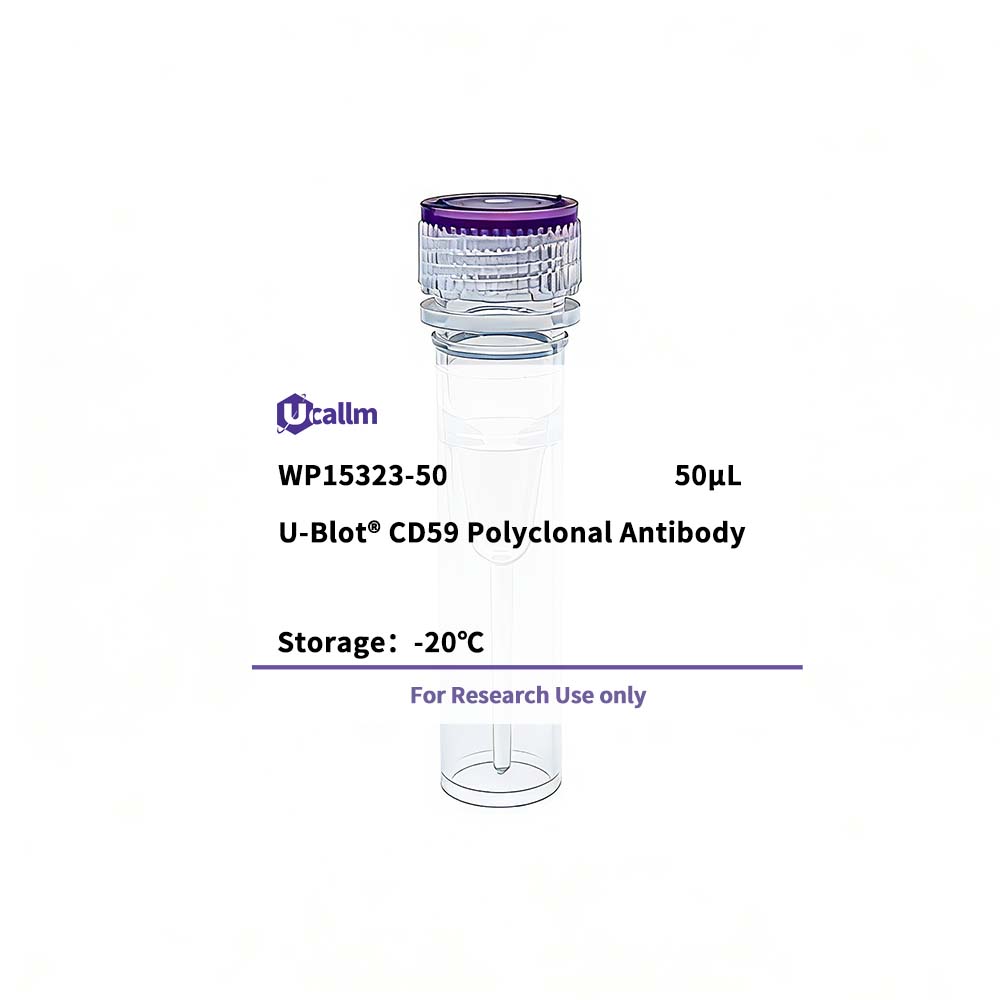
SKU: WP15323 Categories: ,

CD59 Polyclonal Antibody

Price range: $268.00 through $328.00

SKU: WP15323-100
Enter the quantity you would like, or drag the panel to find the quantity and price that best for you
Bulk QuoteAuthorize OEM & ODM

Product details

Background:

This gene encodes a cell surface glycoprotein that regulates complement-mediated cell lysis, and it is involved in lymphocyte signal transduction. This protein is a potent inhibitor of the complement membrane attack complex, whereby it binds complement C8 and/or C9 during the assembly of this complex, thereby inhibiting the incorporation of multiple copies of C9 into the complex, which is necessary for osmolytic pore formation. This protein also plays a role in signal transduction pathways in the activation of T cells. Mutations in this gene cause CD59 deficiency, a disease resulting in hemolytic anemia and thrombosis, and which causes cerebral infarction. Multiple alternatively spliced transcript variants, which encode the same protein, have been identified for this gene. [provided by RefSeq, Jul 2008],


Specifications

Size50μL/100μL
TargetCD59
ReactivityHuman, Rat
ApplicationsWB, IHC, IF, ELISA
MW(Calculated)
MW(Observed)16kD
Host SpeciesRabbit
IsotypeIgG
Conjugate/ModificationUnmodified
Recommended Dilution RatioWB 1:500-1:2000; IHC: 1:100-300; ELISA 1:20000; IF 1:50-200 / Note: For IHC, we suggest antigen retrieval with TE buffer pH 9.0 (Cat#WT1004)
FormulationLiquid in PBS containing 50% glycerol, 0.5% BSA and 0.02% sodium azide.
PurificationThe antibody was affinity-purified from rabbit antiserum by affinity-chromatography using epitope-specific immunogen.
Storage-15°C to -25°C/1 year(Do not lower than -25°C)
Concentration1 mg/ml
ClonalityPolyclonal
Clone Number
ImmunogenThe antiserum was produced against synthesized peptide derived from the Internal region of human CD59. AA range:51-100
SpecificityCD59 Polyclonal Antibody detects endogenous levels of CD59 protein.
Gene NameCD59
Protein NameCD59 glycoprotein
Other NameCD59; / MIC11; / MIN1; / MIN2; / MIN3; / MSK21; / CD59 glycoprotein; / 1F5 antigen; / 20 kDa homologous restriction factor; / HRF-20; / HRF20; / MAC-inhibitory protein; / MAC-IP; / MEM43 antigen; / Membrane attack complex inhibition factor; / MACIF; / Membrane inhibitor of reactive lysis; / MIRL; / Protectin; / CD59
SpeciesHuman
Gene ID966
UniprotP13987
Species.1
Gene ID.1
Uniprot.1
Species.2
Gene ID.2
Uniprot.2
Cellular LocalizationCell membrane; Lipid-anchor, GPI-anchor. Secreted. Soluble form found in a number of tissues.
Tissue ExpressionBlood,Colon,Heart,Milk,T-cell,Urine,
Signaling_pathwayOrganismal Systems >> Immune system >> Hematopoietic cell lineage;Organismal Systems >> Immune system >> Complement and coagulation cascades
Research Areas>>Complement and coagulation cascades; / >>Hematopoietic cell lineage
FunctionDisease:Defects in CD59 are the cause of CD59 deficiency [MIM:612300].,Function:Potent inhibitor of the complement membrane attack complex (MAC) action. Acts by binding to the C8 and/or C9 complements of the assembling MAC, thereby preventing incorporation of the multiple copies of C9 required for complete formation of the osmolytic pore. This inhibitor appears to be species-specific. Involved in signal transduction for T-cell activation complexed to a protein tyrosine kinase.,Function:The soluble form from urine retains its specific complement binding activity, but exhibits greatly reduced ability to inhibit MAC assembly on cell membranes.,online information:CD59 mutation db,PTM:Glycated. Glycation is found in diabetic subjects, but only at minimal levels in nondiabetic subjects. Glycated CD59 lacks MAC-inhibitory function and confers to vascular complications of diabetes.,PTM:N- and O-glycosylated. The N-glycosylation mainly consists of a family of biantennary complex-type structures with and without lactosamine extensions and outer arm fucose residues. Also significant amounts of triantennary complexes (22%). Variable sialylation also present in the Asn-43 oligosaccharide. The predominant O-glycans are mono-sialylated forms of the disaccharide, Gal-beta-1,3GalNAc, and their sites of attachment are probably on Thr-76 and Thr-77. The GPI-anchor of soluble urinary CD59 has no inositol-associated phospholipid, but is composed of seven different GPI-anchor variants of one or more monosaccharide units. Major variants contain sialic acid, mannose and glucosamine Sialic acid linked to an N-acetylhexosamine-galactose arm is present in two variants.,similarity:Contains 1 UPAR/Ly6 domain.,subcellular location:Soluble form found in a number of tissues.,subunit:Interacts with T-cell surface antigen CD2.,
Please login to post questions
Back to Top
Product has been added to your cart