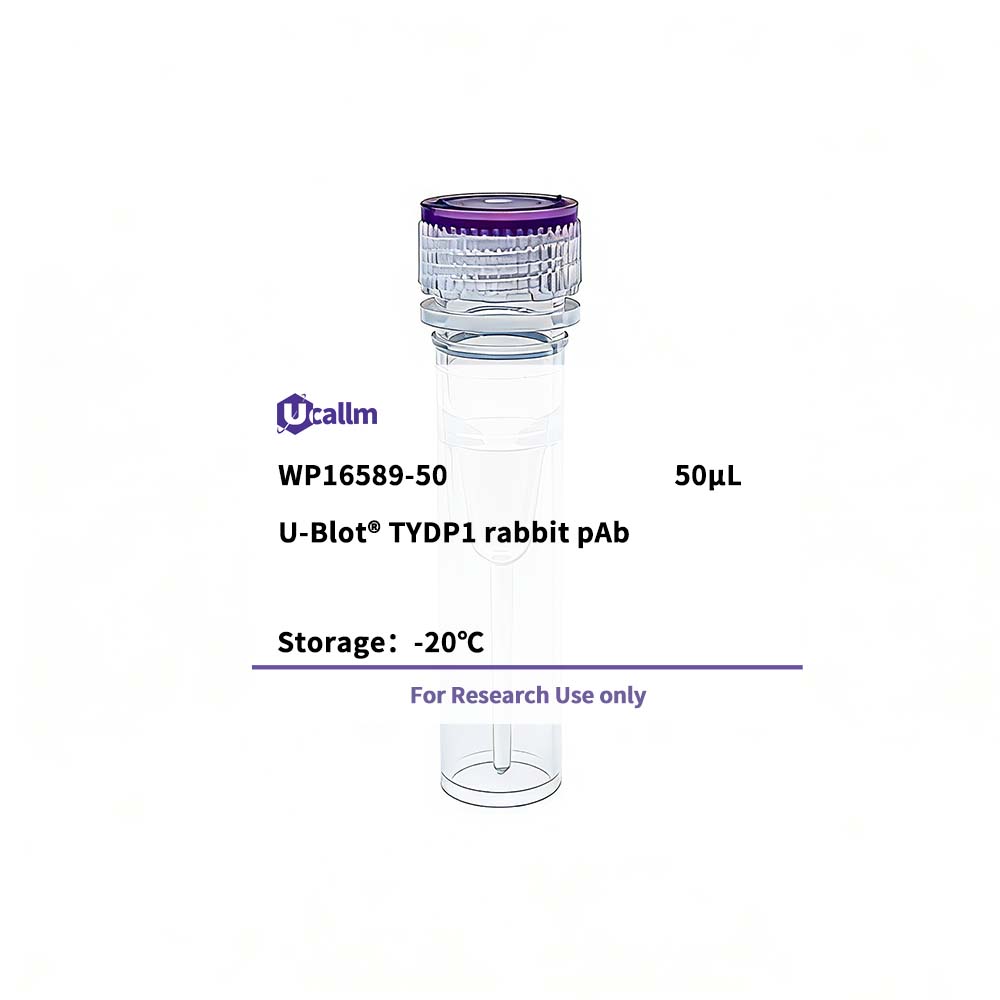
SKU: WP16589 Categories: ,

TYDP1 rabbit pAb

Price range: $268.00 through $328.00

SKU: WP16589-100
Enter the quantity you would like, or drag the panel to find the quantity and price that best for you
Bulk QuoteAuthorize OEM & ODM

Product details

Background:

The protein encoded by this gene is involved in repairing stalled topoisomerase I-DNA complexes by catalyzing the hydrolysis of the phosphodiester bond between the tyrosine residue of topoisomerase I and the 3-prime phosphate of DNA. This protein may also remove glycolate from single-stranded DNA containing 3-prime phosphoglycolate, suggesting a role in repair of free-radical mediated DNA double-strand breaks. This gene is a member of the phospholipase D family and contains two PLD phosphodiesterase domains. Mutations in this gene are associated with the disease spinocerebellar ataxia with axonal neuropathy (SCAN1). [provided by RefSeq, Aug 2016],


Specifications

Size50μL/100μL
TargetTYDP1
ReactivityHuman, Mouse, Rat
ApplicationsWB
MW(Calculated)67kD
MW(Observed)
Host SpeciesRabbit
IsotypeIgG
Conjugate/ModificationUnmodified
Recommended Dilution RatioWB 1:500-2000
FormulationLiquid in PBS containing 50% glycerol, 0.5% BSA and 0.02% sodium azide.
PurificationThe antibody was affinity-purified from rabbit antiserum by affinity-chromatography using epitope-specific immunogen.
Storage-15°C to -25°C/1 year(Do not lower than -25°C)
Concentration1 mg/ml
ClonalityPolyclonal
Clone Number
ImmunogenSynthesized peptide derived from human TYDP1 AA range: 426-476
SpecificityThis antibody detects endogenous levels of TYDP1 at Human/Mouse/Rat
Gene NameTDP1
Protein NameTYDP1
Other Name
SpeciesHuman
Gene ID55775
UniprotQ9NUW8,
Species.1Mouse
Gene ID.1
Uniprot.1Q8BJ37,
Species.2Rat
Gene ID.2314380
Uniprot.2Q4G056
Cellular LocalizationNucleus . Cytoplasm .
Tissue ExpressionUbiquitously expressed. Similar expression throughout the central nervous system (whole brain, amygdala, caudate nucleus, cerebellum, cerebral cortex, frontal lobe, hippocampus, medulla oblongata, occipital lobe, putamen, substantia nigra, temporal lobe, thalamus, nucleus accumbens and spinal cord) and increased expression in testis and thymus.
Signaling_pathway
Research Areas
FunctionDisease:Defects in TDP1 are the cause of spinocerebellar ataxia autosomal recessive with axonal neuropathy (SCAN1) [MIM:607250]. SCAN1 is an autosomal recessive cerebellar ataxia (ARCA) associated with peripheral axonal motor and sensory neuropathy, distal muscular atrophy, pes cavus and steppage gait as seen in Charcot-Marie-Tooth neuropathy. All affected individuals have normal intelligence.,Function:DNA repair enzyme that can remove a variety of covalent adducts from DNA through hydrolysis of a 3'-phosphodiester bond, giving rise to DNA with a free 3' phosphate. Catalyzes the hydrolysis of dead-end complexes between DNA and the topoisomerase I active site tyrosine residue. Hydrolyzes 3'-phosphoglycolates on protruding 3' ends on DNA double-strand breaks due to DNA damage by radiation and free radicals. Acts on blunt-ended double-strand DNA breaks and on single-stranded DNA. Has low 3'exonuclease activity and can remove a single nucleoside from the 3'end of DNA and RNA molecules with 3'hydroxyl groups. Has no exonuclease activity towards DNA or RNA with a 3'phosphate.,PTM:Phosphorylated on serine and/or threonine residues, but not on tyrosine residues.,similarity:Belongs to the tyrosyl-DNA phosphodiesterase family.,subunit:Monomer.,tissue specificity:Ubiquitously expressed. Similar expression throughout the central nervous system (whole brain, amygdala, caudate nucleus, cerebellum, cerebral cortex, frontal lobe, hippocampus, medulla oblongata, occipital lobe, putamen, substantia nigra, temporal lobe, thalamus, nucleus accumbens and spinal cord) and increased expression in testis and thymus.,
Please login to post questions
Back to Top
Product has been added to your cart
