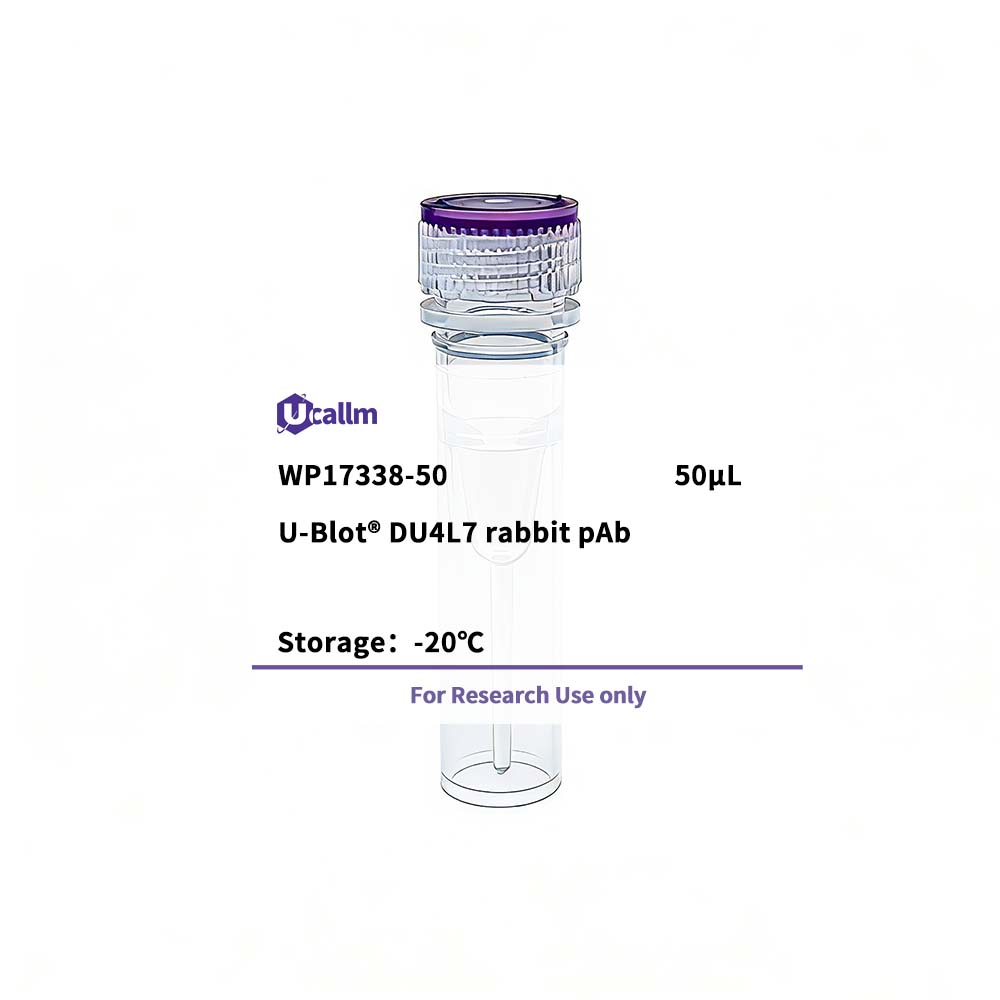
SKU: WP17338 Categories: ,

DU4L7 rabbit pAb

Price range: $268.00 through $328.00

SKU: WP17338-100
Enter the quantity you would like, or drag the panel to find the quantity and price that best for you
Bulk QuoteAuthorize OEM & ODM

Product details

Background:

This gene is located within a D4Z4 repeat array in the subtelomeric region of chromosome 4q. The D4Z4 repeat is polymorphic in length and a similar D4Z4 repeat array has been identified on chromosome 10. Each D4Z4 repeat unit has an open reading frame (named DUX4) that encodes two homeoboxes; the repeat-array and ORF is conserved in other mammals. There is no evidence for transcription of the gene at this locus though RT-PCR and in vitro expression experiments indicate that a telomeric paralog of this gene is transcribed in some haplotypes. Contraction of the macrosatellite repeat causes autosomal dominant facioscapulohumeral muscular dystrophy (FSHD). [provided by RefSeq, Jun 2014],

Specifications

Size50μL/100μL
TargetDU4L7
ReactivityHuman
ApplicationsWB
MW(Calculated)47kD
MW(Observed)
Host SpeciesRabbit
IsotypeIgG
Conjugate/ModificationUnmodified
Recommended Dilution RatioWB 1:500-2000
FormulationLiquid in PBS containing 50% glycerol, 0.5% BSA and 0.02% sodium azide.
PurificationThe antibody was affinity-purified from rabbit antiserum by affinity-chromatography using epitope-specific immunogen.
Storage-15°C to -25°C/1 year(Do not lower than -25°C)
Concentration1 mg/ml
ClonalityPolyclonal
Clone Number
ImmunogenSynthesized peptide derived from human DU4L7 AA range: 314-364
SpecificityThis antibody detects endogenous levels of DU4L7 at Human
Gene NameDUX4L7
Protein NameDU4L7
Other Name
SpeciesHuman
Gene ID
UniprotP0CJ90
Species.1
Gene ID.1
Uniprot.1
Species.2
Gene ID.2
Uniprot.2
Cellular LocalizationNucleus .
Tissue Expression
Signaling_pathway
Research Areas
FunctionDisease:Defects in DUX4 may be the cause of facioscapulohumeral muscular dystrophy (FSHD) [MIM:158900]. FSHD is characterized by weakness of the muscles of the face, upper-arm and shoulder girdle. Severity is highly variable. Weakness is slowly progressive and about 20% of affected individuals eventually require a wheelchair. Approximately 70-90% of individuals have inherited the disease-causing deletion from a parent, and approximately 10-30% of affected individuals have FSHD as the result of a de novo deletion. Offsprings of an affected individual have a 50% chance of inheriting the deletion.,Domain:Both homebox domains confer nuclear targeting.,Function:May be involved in transcriptional regulation.,miscellaneous:DUX genes are present in 3.3-kilobase elements, a tandem repeat family scattered in the genome found on the short arms of all acrocentric chromosomes as well as on several other chromosomes.,similarity:Belongs to the paired homeobox family.,similarity:Contains 2 homeobox DNA-binding domains.,subcellular location:Actively transported through the nuclear pore complex (NPC).,subunit:May exist as a monomer or a dimer.,tissue specificity:Does not seem to be expressed in normal muscle, but in muscle of individuals with FSHD, where it may be toxic to cells.,
Please login to post questions
Back to Top
Product has been added to your cart

